Future Nepal-Europe diplomacy also needs to focus on labor diplomacy, in addition to economic-political, trade, and soft diplomacy. So that the recruitment process for employment in a country with comparatively higher respect for labor and human rights is institutionalized and legal.
We use Google Cloud Translation Services. Google requires we provide the following disclaimer relating to use of this service:
This service may contain translations powered by Google. Google disclaims all warranties related to the translations, expressed or implied, including any warranties of accuracy, reliability, and any implied warranties of merchantability, fitness for a particular purpose, and noninfringement.
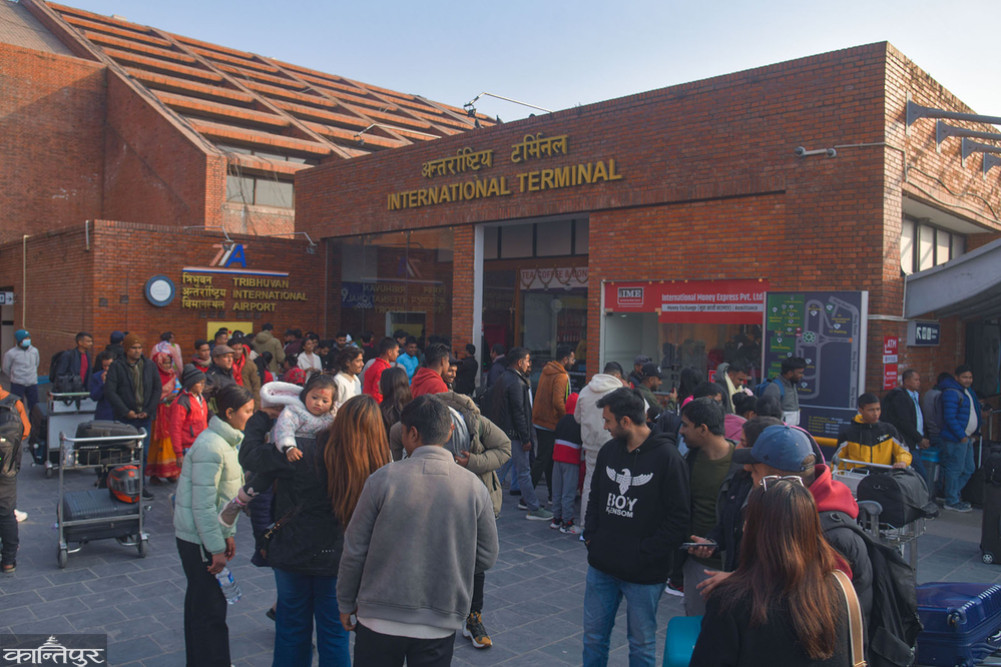
Over time, the number of Nepalis going to India, Gulf and Malaysia, East Asian countries and especially various European countries in the past few years has been increasing . Excluding those who went without a work permit and those who went for studies, more than 12 million Nepalis had obtained work permits to go to Europe for work in the last 5-6 years alone . Similarly, in the two fiscal years 2021/22 and 2024/25 alone, work permits for European destinations increased almost threefold, from a total of 25,697 to 72,953, which is 8.69 percent of the total work permits . Similarly, among Nepalis going to European countries, especially Cyprus and Malta, the number of women was significant (about 24 percent), which is double the national average .
Two to four years ago, Romania was the largest destination for Nepalis . Gradually, Romania, Croatia, Poland, Portugal and Cyprus became the main destinations, and recently, Nepalis have also started going to countries like Malta, Greece, Moldova, Bulgaria, Serbia, Czech Republic, Turkey, Albania. The aim of most of them is employment and earning money. For that, it is customary to go to low-income countries in Europe first. Later, Nordic countries like France, Italy, Germany, Belgium and Austria are being inspired by the purpose of comparatively higher incomes or easier access to temporary and permanent residence permits, and Portugal and Spain are being moved there. Especially, Nepalis have gone to work in the service sectors such as cooks, kitchen helpers, cleaners, gardeners, domestic workers, hospitality, sales, cashiers, waiters, baristas, chefs, bartenders, therapists, receptionists, motorcyclists, bus drivers, heavy drivers, auto drivers, factory workers, carpenters and masons, electricians, AC technicians, plumbers, painters, welders, etc. Due to this 'trend' developed by
, it is estimated that the tendency of Nepalis to go to European countries for employment will increase in the coming days. However, it may not be appropriate to reach such a hasty conclusion. Because the labor market, immigration and immigration policies of the destination country are very uncertain and change unexpectedly. Europe itself is also going through many contradictions and crises. Perhaps the policy of accepting or not accepting immigrants accepted by the Middle East for only a limited number of low-skilled jobs or other destination countries is also ringing the alarm bells that any foreign employment is not long-term and reliable.
On the one hand, due to the increase in the number of (ir)regular immigrants and refugees in European countries due to the Syrian war, the wars and conflicts in some African and Afghan countries, or the recent Ukraine and Israel-Palestine wars, due to the increased pressure of (ir)regular immigrants and refugees in European countries, some European countries, especially the (far)-right-wing governments, are implementing policies and efforts to tighten border control procedures and quickly expel those residing illegally, amid fears of increased political instability and security challenges.
Just as the international negotiations of the ‘Global Compact for Migration’ made ‘regular and managed’ migration the main issue for European countries, and the recent elections to the European Parliament to strengthen and balance borders have brought about a major change in immigration policy, these are the latest vivid examples. In recent years, in some European countries such as Italy, France, Germany and Portugal, immigration and immigrants have become major political issues in those countries due to the rise of anti-immigrant far-right parties in the US, which have erased the reflection of the immigration policy of the Republican Party and President Donald Trump.
On the other hand, the European continent itself is under pressure from negative or low population. Which is now estimated to decrease rapidly in the coming decades. As most European societies age rapidly, with increasing care and social security burdens and shrinking active labor forces, it has been analyzed that the economies of those countries would be more vulnerable without immigrants. On the other hand, as citizens of low-income European countries go to work in other countries with relatively higher incomes, there is a shortage of local workers, and as low-income European countries that are attracting foreign investment need more workers, immigrant workers have become indispensable.
Since joining the European Union, unprecedented migration of citizens from countries such as Romania, Latvia and Lithuania has put additional pressure on them. Indeed, most European countries such as Norway, Ireland, Switzerland, the United Kingdom, Sweden, Germany, Belgium, Finland, France and Denmark have long relied on immigrants to run their health services, which require high and professional skills. Due to such a complex situation, some countries are supplying foreign workers to areas with labor shortages through special 'work permits' or foreign labor quota systems. Countries like Spain, where the birth rate is very low and the domestic labor force is weakening, have long had to adopt a policy that allows undocumented immigrants to regularize and prove their residency status and obtain legal status.
The Nepalese government has also been trying to negotiate and discuss bilateral labor agreements or understandings to legally and institutionally send Nepalis to Europe under a policy to increase employment opportunities for Nepalis. In this environment, it can be estimated that Nepali immigration to Europe will continue for at least a few years.
The context to clarify the issue that Nepalis will not lose their attractiveness for employment in Europe is – there are many examples of (former) employees working in the Nepali security services quitting their jobs to fight in the Russia-Ukraine war, former Maoist fighters quitting their jobs as security guards in the UAE and joining the Russian army on study and visit visas due to the desire for high income. In this process, we also have the unfortunate experience of some dying or returning to Nepal disabled. This has also happened due to the compulsion and aspiration to earn and save more than the living wage at an old age.
Depending on the work, skills, experience and destination country, Nepalis earn between 100,000 and 200,000 rupees per month in countries like Malta, Greece, Moldova, Bulgaria, Serbia, Czech Republic, Bulgaria, Turkey, Albania, Romania, Croatia, Poland, Portugal and Cyprus. Along with this, Nepali workers are also facing difficulties in the Nepal-Europe migration process like in countries like India, Gulf countries, Malaysia, Korea and Japan. In various European countries, a significant number of deaths, suicides, injuries, health problems, labor exploitation and labor rights problems are becoming complicated. The restlessness and mood of their difficult lives are not only expressed in sighs, but some may also be hidden and waiting to explode.
A complicated issue in this regard is the high cost of the recruitment process. Currently, Nepali youth are forced to pay 7/8 lakh to 2 million to go to the mentioned European countries. Similarly, there are instances of agents collecting advance costs by falsely tempting them, taking them to India on the pretext of being out of contact, going to apply for a visa and further exploiting them financially and mentally, and human trafficking through human trafficking. Some have also been defrauded using social media. To understand these issues, it is enough to look at the number of complaints and grievances filed with the Department of Foreign Employment and the Human Trafficking Investigation Bureau. Where, unlike in the past, complaints and grievances related to Nepal-Europe migration have increased significantly.
Ironically or sadly, it has not been possible to provide justice to the victims and punish and hold the perpetrators accountable. Of course, irregularities, fraud and exploitation have not stopped even in the name of sending them institutionally. However, in countries other than Cyprus, instead of adopting an institutional recruitment process for employment, individual agents (often manpower agencies or consultancy) are facilitating labor permits and obtaining them individually. In addition, there is no proper monitoring by the government. Therefore, the problem remains. Therefore, it seems that Nepali embassies in Europe should make arrangements to verify demand letters to bring in Nepali workers in an institutional and systematic manner.
In the past, Nepali embassies in Europe had stopped verification citing insufficient resources, means and manpower to verify demand letters institutionally as per the Foreign Employment Request Verification Guidelines, 2075 BS. Of course, the embassy in Germany finds it challenging to verify demand letters coming from Romania, the Czech Republic, Hungary, Poland, Serbia, Slovakia, Bulgaria and Ukraine. In fact, the problem is not limited to this, it is not difficult to say that the conflict or disagreement between the Ministry of Foreign Affairs and the Ministry of Labor was also one of the main reasons in the past. But the current government, which has moved forward with a policy and budget to make Nepal's embassies and missions stronger and more effective, must now take into account the increasing number of Nepalis in some European countries and the possibility of further gradual increase. Therefore, there is a clear need to make the diplomatic missions, which are the guardians of Nepalis, as strong and active as possible and work to protect the labor and human rights of Nepalis, and a suitable environment has also been created. Now it should not be so difficult to address the conflict between ministries. And, it is not worth depending solely on the kindness and mercy of the Nepali diaspora. In addition, there are vivid examples of unpaid ambassadors being appointed yesterday on the basis of being close to a certain political party and leader or on the basis of investing money. However, now the new government should also consider whether it would be appropriate to delegate the authority to perform tasks such as ‘demand letter review’ and certification by selecting Nepalis in the destination country in an open and impartial manner.
Similarly, the multifaceted problems and challenges that Nepalis are facing after reaching various destination countries in Europe also confirm the inevitability of the Nepali mission’s activity and presence. Some have faced the problem of not having employment and housing arrangements. Some have faced challenges such as having to stay in an irregular situation for months without being unemployed and living in fear of arrest and deportation while staying like that, being imprisoned, having difficulty renting a house or opening a bank account, and having to transfer remittances through informal means.
There are also problems such as communication challenges, verbal abuse, physical harassment, working overtime without pay, and minimum wage for various purposes. It is certainly not advisable for the tragic stories or cries of those undergoing occupational health protection to appear from time to time. There is also the risk of untimely death, suicide, and falling into the clutches of human trafficking and trafficking within Europe. Similarly, there are other challenges such as lack of access to social security and lack of knowledge of labor rights due to changing immigration policies and language and information.
It would not be an exaggeration to say that the Foreign Employment Act, 2064, which was brought specifically to manage employment in the Gulf, is being revised after almost two decades. It is not that fruitless and surprising attempts and ritualistic attempts to amend the act have not been made during the time of various governments in the past. However, it would not be an exaggeration to say that most of the efforts, with exceptions, were made for vested interests. In fact, this columnist believes that it would be reasonable to write a new act to completely replace the existing Foreign Employment Act, 2064, taking into account the changing global labor market, immigration, and its dimensions. But even if it is to be amended, it must be extensively revised. नत्र वैदेशिक रोजगारीका संघीय शासन व्यबस्था तथा संस्थागत व्यवस्थाको पुनर्संरचना लगायतका विविध राष्ट्रिय चासोका विषय, दुई पक्षीय, क्षेत्रीय र अन्तर्राष्ट्रिय बिषय र चासो तथा सम्पूर्ण आपूर्ति शृंखलामा आएका परिवर्तनलाई सम्बोधन गर्न कठिन हुनेछ ।
त्यसैको एक सानो पक्षको रुपमा नेपाल–युरोप आप्रवासनसँग सम्बन्धित माथि उल्लेखित बिषय लगायत अन्य विविध विषयलाई पनि ध्यानमा राखि आवश्यकता अनुरुप ऐन संशोधन गर्दै जाने व्यवस्था हुनेछ भन्ने अपेक्षा छ । त्यस्तै, अबको नेपाल–युरोप कुटनीति पनि अर्थ–राजनीतिक, ब्यापार तथा सौम्य कूटनीतिको अतिरिक्त (विकास कुटनीतिको एउटा पक्षको रुपमा) श्रम कुटनीतिमा पनि केन्द्रित हुन आवश्यक देखिन्छ, ताकी निकट भबिष्यमा तुलनात्मक रुपले श्रम तथा मानव अधिकारको सम्मान बढी हुने देशमा रोजगारीका लागि भर्ना प्रक्रिया संस्थागत र कानुनसम्मत होस् । र, ति देशमा फैलिँदै गइरहेका अवसरबाट नेपालीले अधिकतम लाभ लिन सकुन् । उनीहरुको रोजगारी मर्यादित होस् ।