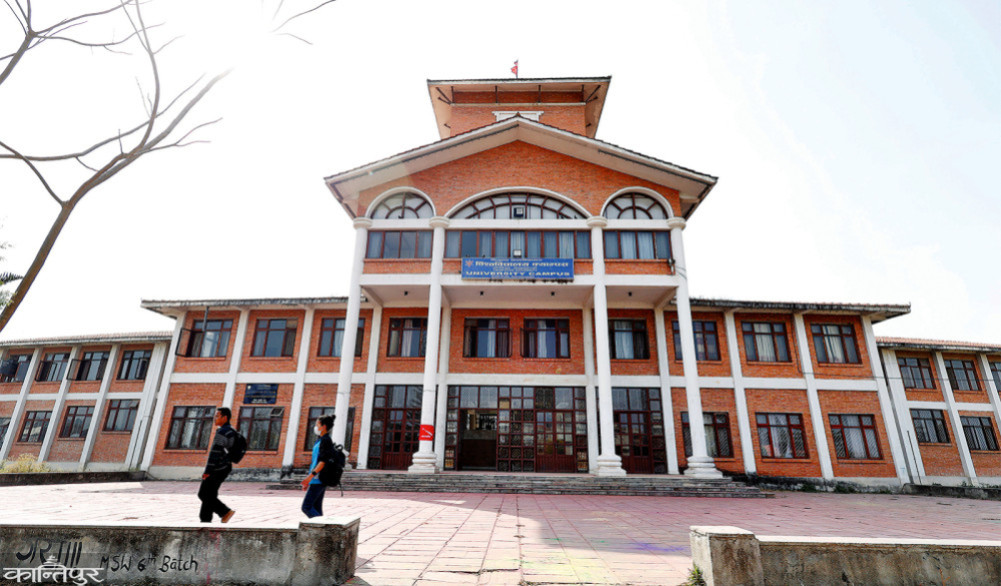
On the one hand, the responsibility of increasing the country's educational literacy, and on the other, the financial crisis of not being able to make ends meet - in between, community campus teachers are caught in the middle. They are the intellectual property of the nation, but they are living 'without identity'.
We use Google Cloud Translation Services. Google requires we provide the following disclaimer relating to use of this service:
This service may contain translations powered by Google. Google disclaims all warranties related to the translations, expressed or implied, including any warranties of accuracy, reliability, and any implied warranties of merchantability, fitness for a particular purpose, and noninfringement.
The real credit for bringing the children of the poor, Dalits, women, tribals and marginalized groups from remote areas to access higher education goes to community campuses. If there were no community campuses, millions of talented Nepalis would have either fallen into addiction or migrated to the Gulf countries for cheap labor after completing school due to financial constraints.
Teachers working in community campuses teach the university's curriculum, participate in the university's examination system and evaluation, and produce the university's academic degrees. Their qualifications, abilities, and academic proficiency are the same as those of teachers in the affiliated campuses. However, the affiliated university has blocked their academic advancement, promotion, and career development for the past 46 years. And, the state has kept community campuses out of its responsibility as a policy. Due to the lack of posts, low grants, and uncertainty of service and facilities, no concrete recognition of their existence has been achieved on the part of the state.
Due to the economic condition of the community and the low fees of the students, it is difficult to get even the minimum wage for labor in some campuses. In this time of skyrocketing inflation, the human resources here are forced to sell their intellectual labor for low wages.
On the one hand, the great responsibility of increasing the country's educational literacy, and on the other hand, the charioteers of community campuses are struggling to survive in the midst of the economic crisis. They are the intellectual property of the nation, but their identity has become 'identityless'. The state and the affiliated universities must do a serious self-examination on this issue.
Community campuses have made a historic contribution to providing accessible and quality education to the middle and lower-middle class citizens in Nepal's higher education. These institutions, established with the initiative and trust of the local community, are not only knowledge centers, but also important pillars of job creation in the country. However, in recent times, due to the weak policies and lack of foresight of the state, these heritages are facing a serious crisis. According to an educational survey conducted by the Central Bureau of Statistics in the fiscal year 2080/81, community campuses have occupied a strong share in the country's employment sector. According to the report, a total of 11,817 people have received direct employment through community campuses. Of these, 9,345 are professors/teachers and 2,471 are administrative employees. From a gender perspective, the number of female teaching staff is 2,263, while the number of male teachers and staff is 9,553. This data shows that the livelihood of thousands of intellectual and working families is directly linked to community campuses. On the one hand, the great responsibility of increasing the country's educational literacy, on the other hand, the community campus leaders are struggling to survive in the face of an economic crisis.
Now, mere assurances are not enough. ‘Teacher standardization’ and ‘academic ranking system’ have become mandatory for respecting the contribution of teachers, professional development and enhancing the overall educational quality. For this, it is the main need of today and the strong demand of the time to take concrete policy-legal initiatives through the joint collaboration of Tribhuvan University, other affiliated universities, the University Grants Commission, the Government of Nepal and related stakeholders. More than 150 community campus representatives had recently expressed their difficulties, complaints and pain at the ‘Dhobighat National Conference’ in Kathmandu. The state must listen to those pains sooner or later. That program has shown a ray of positive and concrete hope. Various speakers and experts have given important suggestions and advice, which the state must listen to. The state must become serious about determining the fair standard of community campus teachers.
Another important point and conclusion of the Dhobighat National Conference is that community campuses should not always be kept in a compassionate and defensive state. These campuses should be allowed to run timely, market-oriented and technical programs while ensuring equal opportunities in the higher education system.
When community campuses are allowed to run attractive subjects of students' choice, information technology, engineering, agriculture and other employment-oriented technical courses, only then can they be transformed into financially self-sufficient, competitive and quality educational institutions. The state and policy-makers must now understand this truth.
Those who developed the literacy and human resources of the country by educating the children of the poor in remote areas, today they have become marginalized witnesses in the eyes of the state. Now the state should not treat the teachers and employees of community campuses as 'stepchildren'. The state should immediately assess their contribution and give them respectful recognition by setting standards. And, by opening the door to technical education, give these institutions the opportunity to become competitive. The journey to sustainable and equitable higher education will begin here.