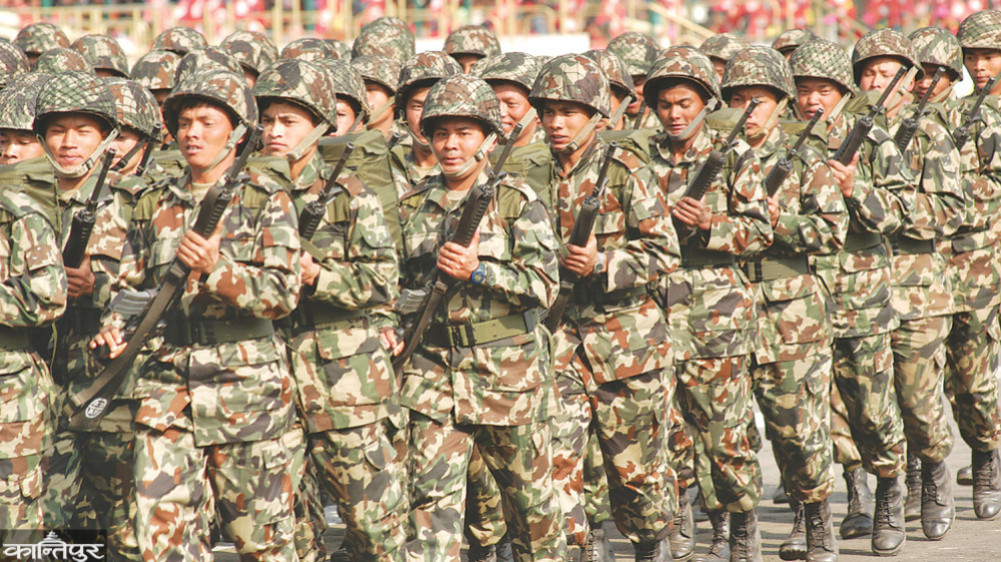
Although the demand for immediate military deployment to the border area appears to be inspired by national sentiment, it is not in line with the Constitution, international relations, and established principles of military power.
We use Google Cloud Translation Services. Google requires we provide the following disclaimer relating to use of this service:
This service may contain translations powered by Google. Google disclaims all warranties related to the translations, expressed or implied, including any warranties of accuracy, reliability, and any implied warranties of merchantability, fitness for a particular purpose, and noninfringement.
In recent days, issues related to border security have once again come to the center of discussion in the Federal Parliament of Nepal. In particular, border encroachments with neighboring countries, the treatment of Nepali citizens in the border areas, and questions related to national sovereignty have been raised. These issues are directly related to national sensitivity. Therefore, debate in the parliament is a natural and democratic practice. However, demands for the immediate mobilization of the Nepali Army in the border areas have also begun to be repeated in public. Such demands seem to be inspired by national sentiment, but this is a conclusion reached without a deep study of the established principles related to national security, the constitution, international relations, and the use of military force.
Since the instruments of national power, including diplomacy, information mechanisms, economic, and military power, are interconnected, it is inevitable to strengthen the foundations of national power. The army is not just a government body in the security system of the nation. It is the ultimate power of the nation. Mobilizing the army is not a simple administrative decision, but rather a decision that directly affects the entire strategic, diplomatic, and security system of the state. Therefore, no responsible country makes its army a subject of daily political debate.
The Constitution of Nepal has made clear provisions regarding the mobilization of the Nepali Army. Accordingly, there is a constitutional provision for the Nepali Army to be mobilized by the President upon the recommendation of the National Security Council. This means that the army is not an institution that is mobilized based on the expression of an individual, political pressure, or immediate response to public sentiment - it is a national instrument that is used only on the basis of constitutional process, overall assessment of national interest, and strategic needs.
In international relations, mobilizing the army in border areas is considered a very sensitive issue. Most countries in the world initially adopt the practice of using diplomatic dialogue, border mechanisms, police, and paramilitary mechanisms in border disputes. Direct deployment of the army is used only as a last resort, because once the armies are face to face, even a small wrong decision or accidental shelling can turn into a major conflict. Therefore, it is not considered natural in military strategy. Because, while guns speak, diplomacy is more difficult.
This is even more true for a geopolitically sensitive country like Nepal. Nepal has consistently prioritized an independent foreign policy, non-alignment, peaceful coexistence, and balanced diplomatic relations. Therefore, seeking a solution to every incident arising on the border through military means is not an approach that is in line with the national interest.
This does not mean that the border problem is not serious. Nepal cannot compromise on the protection of its sovereignty, borders, and national interests. However, military power should be used in a coordinated manner only when necessary after using all available national powers (diplomacy, legal process, administration, border management, information systems). This is the concept of modern comprehensive national security.
It is also necessary to remember the historical contribution of the Nepali Army at this time. From the national unification of Nepal to the present, the army has not only been an organization that fought wars, it has also played a role as a pillar of nation-building. The contribution of the Nepali Army to the protection of Nepal's independent existence, national unity and geographical integrity is a fact proven by history. Therefore, the Constitution has defined the Nepali Army as the main guarantor of national unity.
Another important aspect shown by history is that the institutional credibility of the Nepali Army becomes the ultimate foundation of the nation in times of national crisis. Even when many state mechanisms were weakened during the difficult period of armed conflict, the Nepali Army stood as a major foundation of the national structure. Similarly, the role played by the army in various national instability, disaster management, epidemic control, implementation of the constitution and maintaining peace and stability that have arisen in recent years is becoming clear to everyone.
The greatest value of military power lies only in its existence, not in its use. Strategic thinkers around the world have linked the credibility of military power to its judicious use. If the army is repeatedly dragged into political disputes or presented as the solution to every problem, both its institutional reputation and resilience may weaken in the long run. And, ultimately, this can have a serious impact on national security.
In a democratic society, the government, parliament, political parties and civil society can question the army. Transparency and accountability are the basic values of democracy. However, there is a clear difference between criticism and institutional devaluation. The army of any country is not just an institution of the current government. It is the common property of the entire nation. Therefore, even in public statements, institutional dignity, historical contribution and the sensitivity of national security should always be taken into account.
The challenges of Nepal's border security are real. The state should adopt a more effective policy to resolve border encroachment, problems of border citizens and misunderstandings. It is necessary to strengthen border infrastructure, surveillance systems, border administration, diplomatic activism and cooperation with local communities. Accordingly, in necessary situations, the Nepali Army will also play its role in accordance with the constitution and the national security strategy. However, that role should not be based on sentiment, but should be determined on the basis of national strategic needs.
Finally, it is always worth remembering that the stronger the military power of a nation, the more restrained its use should be. The real strength of the Nepali Army lies in its discipline, constitutional integrity, commitment to national unity, professional culture and public trust. Today, it is the common responsibility of every responsible citizen, political leadership and all state institutions to protect this trust.
Nepal's sovereignty is not only protected by the soldiers standing at the border. The nation remains safe and strong with a balanced combination of prudent political decisions, competent diplomacy, a strong national security policy and, as a last resort, a reliable military force. Therefore, respecting the Nepali Army as one of the instruments of national power and using it within the limits specified by the Constitution will be an important step for Nepal's long-term national interest, stability and sovereignty. This will be the cornerstone for national security, stability and prosperity.