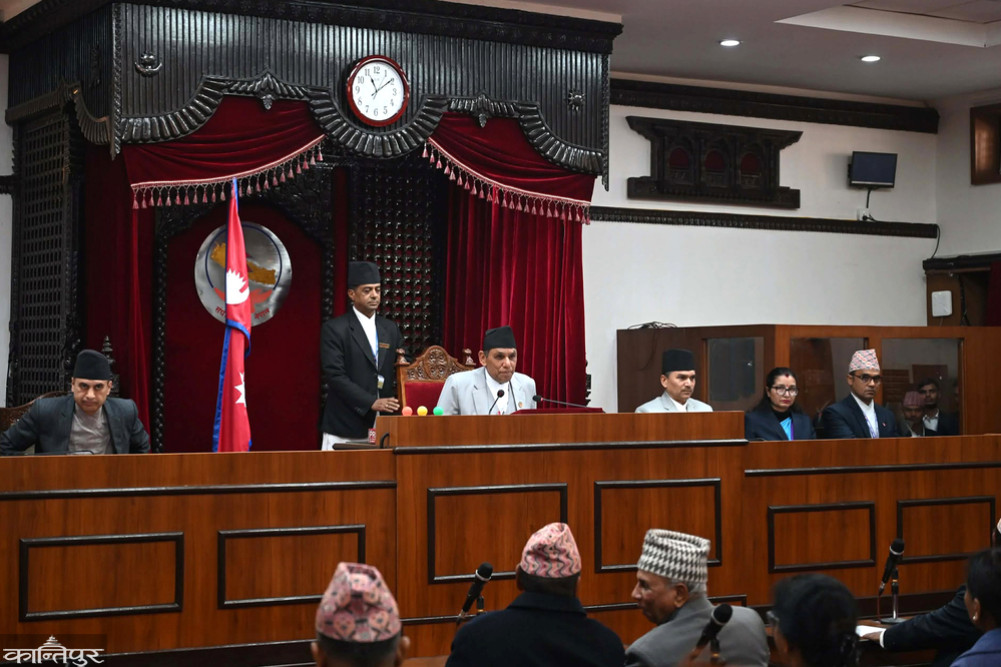
If the office of the ceremonial President, elected for a five-year term, vacates during the term, another election is held immediately. Rather than maintaining the permanent position of Vice President for such a short-term assignment that may arise in the future, it is a suitable alternative to appoint the person who presides over the National Assembly as the ex-officio Vice President. This would eliminate the burden of a separate office, security, and other administrative duties for the Vice President.
We use Google Cloud Translation Services. Google requires we provide the following disclaimer relating to use of this service:
This service may contain translations powered by Google. Google disclaims all warranties related to the translations, expressed or implied, including any warranties of accuracy, reliability, and any implied warranties of merchantability, fitness for a particular purpose, and noninfringement.
Kantipur Debate: Constitutional Amendment
The debate on constitutional amendment has heated up not only because it has been a decade since the constitution issued by the Constituent Assembly was implemented, but also because of the changes brought about in the balance of power by the Gen-G revolution of 23-24 Bhadra and the general election of 21 Falgun. Although the issue of constitutional amendment has gained general acceptance in the election manifesto of the House of Representatives and public debate, no political party, new or old, has presented a concrete roadmap for constitutional reform. A task force formed by the elected government led by Prime Minister Balendra Shah is collecting suggestions for a draft proposal for constitutional amendment, while some political parties have formed internal committees to determine party-based views on it. Still, creating a politically neutral mechanism including academics and experts for an objective review of the implementation of the constitution and identifying the indispensable agenda for amendment may be a more practical and universally acceptable way
The first general convention of the ruling National Independent Party (27-28 Asad, Chitwan), which won almost two-thirds of the seats in the election, introduced the concept of a directly elected executive, expansion of the Vice President's mandate, a non-partisan National Assembly, and independent local bodies. The electoral college of National Assembly members includes not only local level chiefs/deputy chiefs, but also members of the provincial assemblies. How can the National Assembly, which is elected by people's representatives elected by political parties in a multi-party system, be non-partisan? Meanwhile, there has been widespread criticism not about the party narrowness of National Assembly members, but about the lack of attention to the qualification system and expertise in the selection of candidates. Therefore, it is necessary to start the debate on reform from here. The essential prerequisite for making the initial selection system of candidates based on competence and vision is the strengthening of the internal democracy of the parties. Rather, a small effort to reduce the number of people in the form of governance can convey a positive message to the common citizen.
Leisurely Vice President
Even when the Constituent Assembly, which had reached an agreement at the outset to have a bicameral legislature during the initial drafting of the constitution, decided on the form of government, there was uncertainty as to whether the Speaker of the National Assembly would be elected by its members or by the Vice President. In the bicameral parliamentary practice with the king, the members of the National Assembly had first elected their own Speaker according to the 2015 constitution and the second time according to the 2047 constitution. However, the framers of the constitution must have been aware that the US Vice President presides over the powerful Senate there and the Vice President also presides over the Rajya Sabha in neighboring India. The Vice President there, who presides over the upper house and maintains the neutrality of the house, even casts the deciding vote in cases where the legislative process is blocked due to a tie.
During the initial draft of the constitution, the Constituent Assembly, which had reached an agreement at the outset to have a bicameral legislature, decided on the form of government, and there was uncertainty as to whether the Speaker of the National Assembly would be elected by its members or presided over by the Vice President. The Lok Sabha Speaker presides over the joint house in India, while the Lord Speaker in Britain presides over it. In the US Congress, the Speaker presides over joint meetings except for the counting and certification of the President's votes. The issue of protocol has not been raised anywhere. However, in the final stages of constitution-making in Nepal, when discussions were underway to make the Vice President and the Speaker of the National Assembly the same person, the question of rank irrelevantly entered. Perhaps the then political leadership was focused on the possible management of its close associates. As a result, even in the constitutional system where there was a symbolic president, two very special positions, the Vice President and the Speaker of the National Assembly, were created.
The Constitution of Nepal (Article 67) has provided for the post of Vice President to perform the functions of the head of state in the absence of the President. Although there is no specific jurisdiction for other general situations, there is a constitutional provision (Article 73) that the Vice President, like the President, should have a separate office. The Vice President, who is privileged to be the acting head of state during the President's occasional foreign visits, finds it difficult to spend the same amount of time as after retirement even while in office. Due to the constitutional provision that the President and Vice President are of different genders or communities, the post of Vice President is limited to inclusive representation only. Formal/informal discussions have occasionally been held on the option of making the Vice President the President of the National Assembly from the perspective of creating work rather than the option of increasing the quality of legislative work, the need for coordination, and the dignity of the Upper House.
Option Ex-officio Vice President
It is more practical and economical to make the Speaker of the National Assembly the Vice President ex-officio than making the Vice President the President of the Upper House through constitutional amendment. The expansion of the Vice President's scope of work does not significantly reduce the unnecessary burden on state resources. The abolition of the post of Speaker of the National Assembly alone creates a dual management responsibility for the Office of the Vice President and the Parliament Secretariat on the one hand, and on the other, it can lead to complications in the coordination between the two secretariats. Even in the current system where both houses are run by a single management committee and a common secretariat, there is not always sufficient coordination, cooperation, and cordiality between the Speaker and the Speaker. Except for Nepal and South Africa, in most democratic countries, the bicameral legislature secretariats are separate.
On the other hand, even though the Vice President leads the upper house, the importance of the Vice President in the daily management work of the assembly increases. This increases the office and administrative structure of the Vice President, and in practice, the Vice President of the new system replaces the former Speaker. That is, as a result, the constitutional amendment is limited to the name of the amendment. Such a system creates a new responsibility for coordinating the overall legislative work with the Vice President, who presides over a limited number of meetings in practice of the upper house.
According to the principle of separation and balance of powers, it is more appropriate to make the Speaker of the National Assembly the Vice President ex officio than to make the Vice President, who is elected as a part of the executive, the chairman of the upper house. The members of the National Assembly are selected as representatives of the federal unit by the members of the provincial assemblies and the heads/deputy heads of the local levels. Therefore, making the person who presides over the meeting or the person elected by the National Assembly, who is an inclusive character and can also be called a symbol of federalism, the Vice President ex officio may be an acceptable alternative to amending the constitution. This can also be expected to help promote Nepali plurality and strengthen the federal system.
Nepali needs and originality
Our constitutional system has not accepted the provision for the Vice President to serve the remaining term when the presidency becomes vacant in the middle of a term, as in the United States. The US Constitution has clearly provided that the Vice President will assume the office of the President in the event of incapacity, resignation, or death. The Vice President, who regularly participates in the Council of Ministers, is also the President's chief political advisor. In our country, the President himself is a ceremonial (constitutional) position. Since all other work, except for certain formalities to be performed on the recommendation of the officials specified by the Constitution, must be done with the consent and recommendation of the Council of Ministers (Article 66, Clause 2), the President's chief political advisor is the Prime Minister. In this sense, there is no separate need and justification for the post of Vice President in our system.
If the post of the ceremonial President elected for a five-year term becomes vacant during the term, another election is held immediately. Rather than keeping the permanent post of Vice President for such a short-term assignment that may arise in the future, it is a suitable option to appoint the person who presides over the National Assembly as the Vice President ex officio. This will remove the burden of a separate office, security, and other arrangements for the Vice President. This does not disrupt the existing structure of the Constitutional Council, which is chaired by the Prime Minister, where the Speaker of the National Assembly is also an ex-officio member. A separate debate is needed on whether the Chief Justice should not be kept as a member of the Constitutional Council.
Article 180 of the Constitution provides for the Speaker of the House of Representatives to exercise the powers of the President in exceptional circumstances when both the posts of the President and the Vice President are vacant. But the post of Speaker itself is not a permanent post. According to Article 91, Clause 6 (a) of the Constitution, the post of Speaker/Deputy Speaker automatically becomes vacant from the day of nomination for the election to the House of Representatives. Unfortunately, the Constitution is silent on what to do if the posts of President and Vice President are vacant at the same time when the post of Speaker is vacant. Yes, even in such an unthinkable situation, an amendment to Article 180 of the Constitution is necessary to ensure that the responsibility of the Head of State remains uninterrupted. It would be appropriate to include the term "person presiding over the National Assembly" in such an amendment.
Although the National Assembly is permanent, the posts of its Chairman/Vice-Chairman are periodic. Due to the clear constitutional provision (Article 92, Clause 5) that the eldest member presides over the meeting based on age in the event that both the posts of Chairman/Vice-Chairman are vacant, it can be said that the Permanent Assembly will never be leaderless. It would be appropriate to remove the post of Vice-President through a constitutional amendment so that the post of President remains uninterrupted. The parliamentary system adopted by the Constitution of Nepal is not exactly like that of Britain, India or South Africa, but our original one. Our original parliamentary system has adopted the parliamentary hearings that were put in place for checks and balances in the directly elected presidential system. It is necessary to decide on a separate list of the main controversial issues that need to be discussed in the roadmap for constitutional reform so that all the issues that need to be discussed can be done on the basis of immediate consensus and that need to be taken up for a comprehensive discussion. The first issue of consensus could be the provision that the person who chairs the National Assembly will be the ex-officio Vice President.
(A lot of experience has been gained during the 10 years of implementation of the constitution. Its strengths and weaknesses have also come to the surface. The Gen-G movement of 23-24 Bhadra 2082 and the subsequent circumstances also make it clear that constitutional amendment is now inevitable. The issue of constitutional amendment, which has been agreed upon by political parties, has gained momentum since the formation of the government under the leadership of the Rashtriya Swayamsevak Sangh (RSS). Against this backdrop, Kantipur has started a new series with the intention of contributing to the debate on constitutional amendment. Kantipur requests writers to send articles focusing on specific areas.)