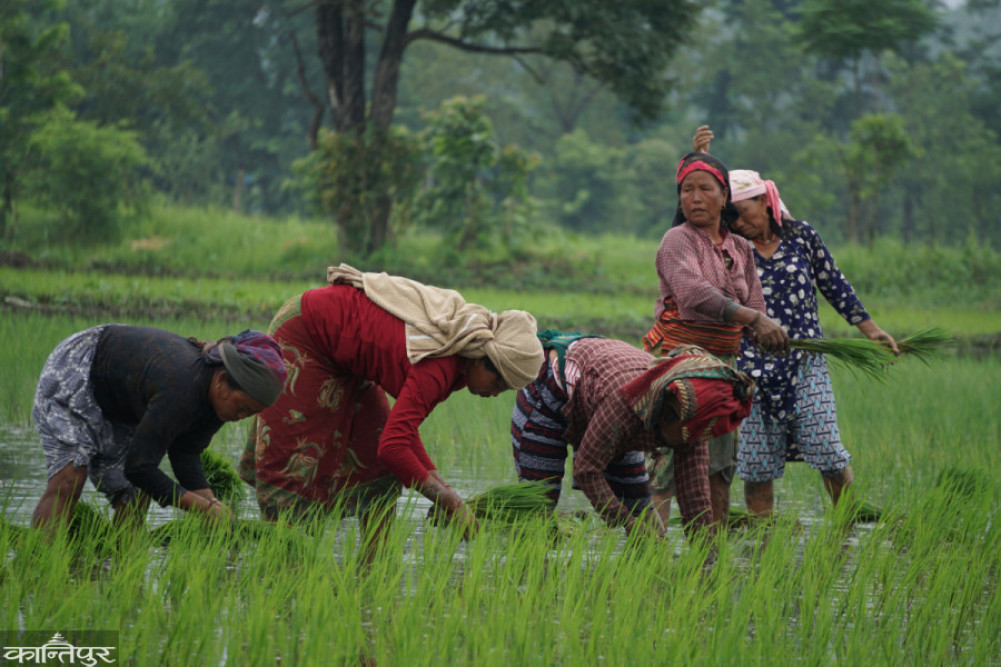
Transformation of agriculture is not possible without ensuring equal opportunities for women farmers in land rights, financial access, technology, leadership, and markets.
We use Google Cloud Translation Services. Google requires we provide the following disclaimer relating to use of this service:
This service may contain translations powered by Google. Google disclaims all warranties related to the translations, expressed or implied, including any warranties of accuracy, reliability, and any implied warranties of merchantability, fitness for a particular purpose, and noninfringement.
For Nepali farmers, Asad 15 is a day to sow hope, labor, and the future throughout the year. The annual ‘National Rice Day’ should not be limited to just celebrations – it should provide an opportunity for serious debate on the country’s agriculture, food security, farmers’ lives, rural economy, and the direction of national development.
Rice is the most important food crop in Nepal. Rice is the staple food of most Nepalis. It contributes about 20 percent to Nepal’s agricultural GDP and about 7 percent to the national GDP. About 5.9 million metric tons of rice are produced on about 1.4 million hectares in Nepal, while Nepal’s average rice productivity is 4 metric tons per hectare. Nepal is a country rich in rice genetic resources, home to thousands of rice varieties.
Rice production not only supports the livelihoods of millions of farming families in the country, but also determines the national economy, food security, social stability, and cultural identity. So when we talk about increasing rice production, what impact is it having on the lives of farmers? This question should also be raised.
In the last few decades, rice production and productivity have improved in Nepal. Production increase is possible with improved varieties of seeds, expansion of irrigation in some areas, agricultural research, mechanization, and tireless efforts of farmers. However, increasing production and changing the living standards of farmers are not the same thing.
Most rice farmers in Nepal are small and marginal farmers. Their cultivable land is limited, and the costs of fertilizers, seeds, pesticides, labor, irrigation, and agricultural equipment are constantly increasing. Even though production has increased, farmers' income and savings have not increased accordingly. In some cases, when market prices fall in years when production is good, farmers are unable to cover their costs. Therefore, even though production figures appear positive, the expected changes in the real lives of farmers have not been achieved.
Agricultural development should not be evaluated only on the basis of production and productivity, but also on the basis of farmers' income, living standards and respect. If production has increased but farmers are mired in debt, are not getting fair prices or if young people are leaving agriculture and migrating for foreign employment, such production growth cannot be considered sustainable. Therefore, now the center of our agricultural policy should not be only production, but the farmers who produce it.
To make rice production sustainable and farmer-oriented, it is necessary to effectively implement the minimum support price, timely government procurement, strengthen farmers' cooperatives, develop storage and processing infrastructure, agricultural technology, mechanization, financial services and make agricultural extension easily accessible to farmers. Only if rice farmers can be developed as agricultural entrepreneurs and increase their share in the value chain, the direct benefits of production growth will be visible in the lives of farmers.
Nepal's agriculture is facing a new challenge. Due to climate change, rainfall is becoming irregular. Sometimes there is prolonged drought, sometimes there is excessive rainfall and floods. New diseases and pests have increased . The risk of production is increasing every year .
In the last few decades, rice production and productivity in Nepal have improved . Production increase is possible with improved varieties of seeds, expansion of irrigation in some areas, agricultural research, mechanization and the tireless efforts of farmers . On the other hand, cultivable land is continuously decreasing . Fertile agricultural land is being converted into housing, roads and other infrastructure . Land is becoming fragmented . The challenge for small farmers has increased due to the increase in production costs . The labor force in the villages is decreasing due to the migration of youth abroad . Therefore, with the increase in foreign employment of men, the contribution of women in rice farming is extraordinary . The main responsibility of rice production has fallen on the shoulders of women . Women do most of the work of preparing nurseries, planting, weeding, harvesting, drying, storing and saving seeds for the next year .
However, women's contribution is not yet adequately appreciated . Many women farmers do not own land . Their access to agricultural credit, training, technology, insurance and government services is limited . Women farmers must be placed at the center of agricultural policy to ensure sustainable production growth . Transformation of agriculture is not possible without ensuring equal opportunities for women farmers in land rights, financial access, technology, leadership and markets .
Nepal's agriculture must now move forward through a combination of traditional knowledge and modern science . Climate-tolerant rice varieties, quality seeds, timely agricultural technology, ecological agriculture based on biodiversity, youth and women-friendly mechanization, effective use of digital information systems and agricultural extension services are necessary .
Ensuring a respectable income, access to technology, startup support, concessional loans and markets are necessary to attract youth to agriculture . If agriculture cannot become a profitable and respectable profession, it will be difficult to attract youth to agriculture and maintain production in the future .
The way forward: Farmers' prosperity along with production
The National Rice Day celebrated by the Nepal government should give a new message. A national campaign should be launched to not only increase production, but also to change the lives of farmers who produce it. For that, some basic reforms are necessary.
Agricultural land should be protected. Irrigation systems should be expanded. Quality seeds and fertilizers should be provided on time. Investment in agricultural research should be increased. Climate-friendly and sustainable agricultural technologies should be expanded. Farmers' rights, especially the rights of women farmers, should be ensured. Young farmers should be encouraged. Arrangements should be made for farmers to get a fair price for their produce. Public and private investment in storage, processing and market infrastructure should be increased.
These reforms will not only increase production, but will also have a direct positive impact on the living standards of farmers.
National Rice Day is not just a day to enjoy the mud for Nepali farmers, but also a day to respect farmers' labor, review agricultural policies, and set the direction for the future. Production growth is indispensable for Nepal to achieve sustainable success in food security. However, production growth alone is not enough. Its benefits must reach farmers. Farmers' income, respect, social security, and living standards must improve.
If farmers are weak, production will be weak, and if production is weak, food security and food sovereignty will be weak. Therefore, the biggest message of National Rice Day should be - let's increase rice production and productivity based on sustainable agriculture, and make the lives of rice farmers prosperous. Only when production and farmers' prosperity move together can Nepal's agriculture truly become sustainable, self-reliant, and prosperous. Only then can Nepal become self-reliant and food sovereign in agriculture.