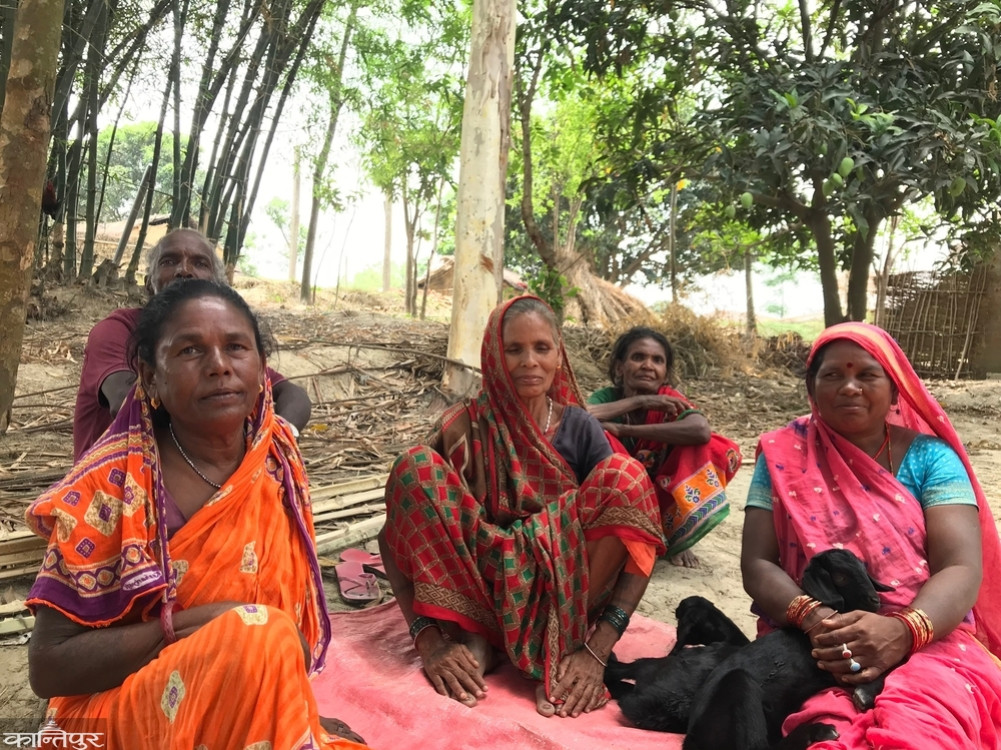
People, not structures, must now be at the center of development. Only if we can make the home a center of learning, the community a center of opportunity, and the workplace a center of skill development will Nepal's demographic potential be transformed into economic prosperity.
We use Google Cloud Translation Services. Google requires we provide the following disclaimer relating to use of this service:
This service may contain translations powered by Google. Google disclaims all warranties related to the translations, expressed or implied, including any warranties of accuracy, reliability, and any implied warranties of merchantability, fitness for a particular purpose, and noninfringement.
When discussing development in Nepal, issues such as roads, bridges, hydropower, airports, tunnels, irrigation projects or large infrastructure projects are often prioritized. From political debates to budget formulation and public evaluation, development is often viewed in conjunction with the expansion of physical infrastructure. Undoubtedly, such infrastructure is indispensable for development. However, a serious question has not yet been raised – can infrastructure alone ensure prosperity?
The book ‘Building Human Capital Where It Matters: Homes, Neighborhoods and Workplaces’, recently published by the World Bank, has put forward an important debate at the center of this question. The main conclusion of the book is that the basis of a nation’s long-term prosperity is human capital, more than infrastructure. More importantly, human capital is not only built in schools, universities and hospitals – it is continuously built, developed and used in homes, communities and workplaces.
This idea is extraordinarily relevant in the current development debate in Nepal. Today, Nepal is in the phase of economic transformation, demographic change, increasing urbanization, labor migration, digital transition, and institutional strengthening of the federal governance system. Amidst such changes, if people cannot be placed at the center of development, the achievements of infrastructure construction cannot give the expected socio-economic returns.
What is the ultimate objective of development?
The real objective of development is not to build roads, but to bring people to opportunities. It is not just to build schools, but to ensure learning. It is not just to build hospitals, but to make healthy living possible. It is not just to create jobs, but to increase productive capacity.
That is, the ultimate goal of development is not structure, but to expand human capacity. This is why today, the successful economies of the world have not moved forward solely on the basis of natural resources or physical infrastructure. Their success is based on quality human capital. Educated, healthy, skilled and creative citizens have become the real power of the modern economy. Nepal also needs to look at development not only from the perspective of spending, construction and expansion but also from the perspective of citizen capacity development.
Home: The beginning of building the future
School enrollment rates in Nepal have increased significantly. Access to basic health services has also expanded. However, indicators of learning achievement, nutritional status and productive capacity still show challenges. One reason for this lies in the fact that the book points out – human capital formation does not start in school.
The real purpose of development is not to build roads, but to bring people to opportunities. It is not just about building schools, it is about ensuring learning. It is not just about building hospitals, it is about making healthy living possible. It is not just about creating jobs, it is about increasing productive capacity. A crucial stage of children's brain development is completed within the first thousand days of life. Nutrition, maternal health, parental education, communication with children, emotional security and the early learning environment determine future learning capacity. Nepal still has child malnutrition, adolescent motherhood, lack of parental awareness and quality inequality in early childhood development services. We debate school reform but often ignore the learning environment inside the home.
If human capital development is to be made a national priority, then early childhood development, nutrition, maternal health and parental empowerment should not be seen as routine programs in the social sector, but as fundamental investments in economic transformation.
The community also writes its destiny
The inequality between two children in Nepal is not just inequality of income, it is also inequality of opportunity. There is still a huge gap between the opportunities that children in the Kathmandu Valley, Pokhara or Bharatpur get and those of children in remote Himalayan or hilly settlements. The differences in schools, health services, internet, libraries, playgrounds, safe public spaces and employment opportunities directly affect human capital development.
The book describes this as an ‘environment of opportunity’. A person’s potential is not determined only by his individual efforts, but also by the social and physical environment he finds himself in.
In this context, it is necessary to understand local infrastructure not only as construction, but also as a matter of human capital development. Roads, drinking water, sanitation, digital connectivity, safe settlements, public libraries and community centers are actually the basis of human capital development. In the context of federal Nepal, local levels can become the most important carriers of this change.
Nepal's greatest asset is abroad
The debate on Nepal's human capital cannot be complete without discussing labor migration. Today, millions of Nepali youth are using labor, skills and productive energy in foreign economies. Remittances are making a significant contribution to the national economy. However, there is another reality - a large part of the human capital that Nepal has created is not being utilized within the country. The increasing exodus of highly educated youth in recent years has added a new challenge. Therefore, Nepal's human capital strategy cannot be focused solely on construction. Now it is necessary to look at 'human capital creation, protection and utilization' from an integrated perspective. Investment in human capital cannot be fully realized without creating opportunities within the country.
When the employment debate needs to change
In Nepal, the employment debate often focuses on the number of jobs. However, the challenge of the coming decade is not quantity, but quality. If any job does not teach new skills, does not increase productivity and does not encourage innovation, it will only make a limited contribution to expanding human capital.
Nepal's large labor force is still concentrated in sectors with low productivity. This is limiting both income growth and economic transformation. Therefore, technical and vocational education, apprenticeship programs, industry-education collaboration, research, innovation and entrepreneurship development must now be brought to the center of employment policy. We need jobs that not only increase employment, but also increase learning and productivity.
Federal governance and human capital
Nepal's federal structure has created a historic opportunity for human capital development. The federal government should ensure policies, standards and resources, and the provincial government should run regional coordination, skill development and economic transformation programs. If the local government is to make child development, education, health and community-level service delivery effective, qualitative improvement in human capital development is possible.
However, for this, it is necessary to rise above ministerial thinking. It is necessary to institutionalize the coordination between education, health, labor, infrastructure, agriculture, social development and the economic sector at the policy level.
Now let's change the measurement of development
Whatever development strategy Nepal adopts in the coming decade, it will ultimately have to answer one question - are our policies, budgets and programs increasing the capacity of Nepali citizens? If the answer is positive, then development is in the right direction. If not, it will be difficult to convert the achievements of infrastructure expansion into the expected prosperity.
The World Bank's 'Building Human Capital Where It Matters: Homes, Neighborhoods and Workplaces' has given this important message to Nepal. People, not structures, should be at the center of development. Only if we can make the home a center of learning, the community a center of opportunity, and the workplace a center of skill development, will Nepal's demographic potential be transformed into economic prosperity.
Ultimately, the future of the nation lies not in roads, buildings, and budgets but in the knowledge, skills, health, and creativity of its citizens. That is the foundation of a prosperous Nepal.