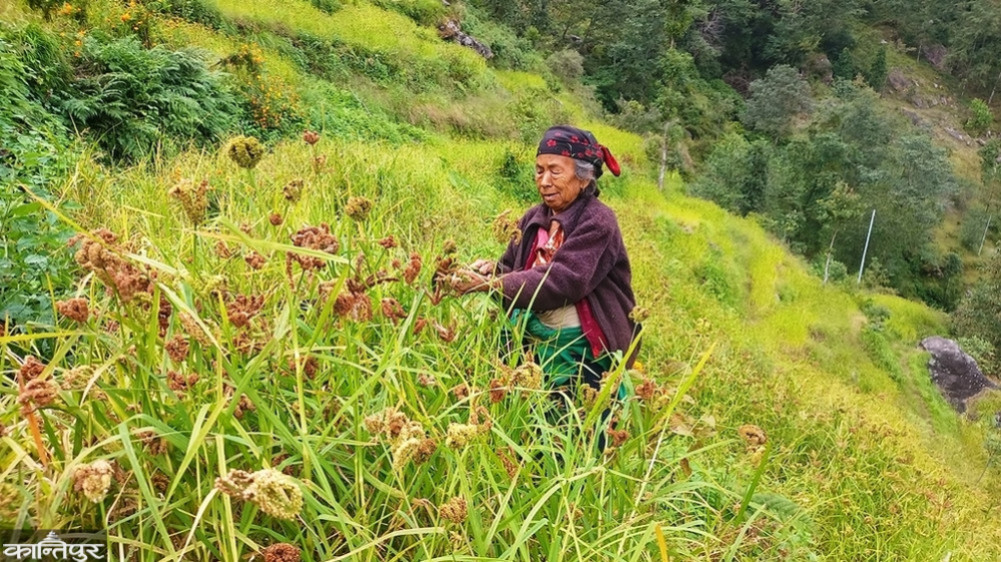
Saving Nepalese millet farming is not just about preserving a crop, but also about protecting our cultural identity, economic prosperity, and environmental balance.
We use Google Cloud Translation Services. Google requires we provide the following disclaimer relating to use of this service:
This service may contain translations powered by Google. Google disclaims all warranties related to the translations, expressed or implied, including any warranties of accuracy, reliability, and any implied warranties of merchantability, fitness for a particular purpose, and noninfringement.
Millet is considered to be very rich in terms of nutrition. It is especially rich in calcium, iron and fiber, which helps in fighting malnutrition and anemia. However, in the case of Nepal, the situation of millet cultivation is worrying day by day.
Nepal is ranked 13th in the list of millet producing countries in the world. However, its production volume is constantly decreasing. According to the data of the Ministry of Agriculture and Livestock Development, in the fiscal year 2080/81, millet was cultivated in an area of 224,935 hectares in Nepal, of which only 373,200 metric tons were produced. This productivity of around 1.66 metric tons per hectare is considered very low compared to rice or maize.
However, the consumption of millet in Nepal is much higher than the production. According to the Customs Department, in the fiscal year 2080/81 alone, Nepal had to import 15.292 million 820 kilograms of millet, with a total value of Rs 754.195 million. Surprisingly, in the last four and a half years alone, Nepal has imported millet worth more than Rs 2.5 billion.
The import of our indigenous crop millet in such large quantities from abroad is a serious warning for the national economy and food security. According to experts, the main reason for this is the increasing migration along with climate change and the neglect of the state's agricultural policy.
The impact of climate change is already starting to be clearly seen in Nepal. The average temperature in Nepal increased by 1.8 degrees Celsius from 1975 to 2006, which is higher than the global average, and this increase has become even more rapid in the last decade. This increase in temperature has directly affected millet cultivation. Especially during the flowering stage of the millet crop, excessive temperatures cause a huge decline in its production.
The irregularity of the monsoon has become another big challenge for millet. Recently, the hilly regions of Nepal have been experiencing a rise in the number of sudden heavy rains during the monsoon season, followed by long dry spells. Millet seeds grown on steep slopes are often washed away by such heavy rains or buried by landslides. Due to all climate-induced factors, the productivity of millet in Nepal has now shrunk to around 1.3 metric tons per hectare, which is about 20 percent less than a few decades ago.
Millet farming is considered very laborious and labor-intensive. The processes of land preparation, sowing, tillage, bringing in the crop, and threshing (separating the grain) require a lot of labor and time. With the young generation leaving for abroad, only the elderly and women are left in farming. They are also giving up cultivating millet due to physical disabilities. Millet farming is considered very laborious and labor-intensive. The processes of land preparation, sowing, tillage, bringing in the crop, and threshing (separating the grain) require a lot of labor and time.
Another major problem is the lack of certainty of sale. Despite the demand for millet in the local market, farmers have not received fair prices due to the lack of systematic marketing and the influence of middlemen. There is still a narrow-minded tendency to view millet as a 'poor man's grain' or a 'rotational crop' in society. And, it is always being neglected in government policies and grants. Compared to rice, wheat, and corn, there is often a lack of separate research, advanced seeds, and technology for millet cultivation. Due to all these reasons, there is a data that the area under millet cultivation is decreasing by 2 to 3 percent every year. In addition, due to the lack of modern equipment in the storage and processing of millet, there is a problem of spoilage of many products before and after harvest.
However, this disappointing situation can be changed if there is willpower. Although millet is a native crop that is vulnerable to climate change, it has immense potential to be adapted and developed as a 'climate-friendly crop'. The concept of 'climate-smart agriculture' is currently being promoted globally, in which crops that can yield good results even with less water, less fertilizer, and can withstand temperature fluctuations are sought. Millet is the best crop with all these characteristics.
For its conservation and promotion in Nepal, first of all, investment in research should be increased. The Nepal Agricultural Research Council should develop such climate-friendly improved varieties of millet that are resistant to drought, excessive rainfall, and disease. Most of the millet varieties currently used in Nepal are old and indigenous, with low productivity.
Second, it is necessary to focus on making farmers technology-friendly. Easy availability of modern small machines (threshers) for separating millet grains, light cultivators, and micro-irrigation systems, and provision of government subsidies for them, can make millet farming attractive again.
The third important link is the local level. The Constitution of Nepal has placed agriculture in the exclusive jurisdiction of local governments. Therefore, the local level should prioritize millet cultivation by providing seed subsidies, irrigation infrastructure, and establishing processing centers at the local level. Small industries for various diversified products made from millet (such as chiura, powder, cookies, nutritious khol or alcohol, etc.) can be operated in collaboration with the local level.
The fourth step is systematic marketing. Nowadays, the demand for millet is increasing among health-conscious consumers in cities. 'Organic' and 'ready-to-cook' millet products are fetching good prices in the market. It is necessary to open special 'millet corners' (sales centers) in local markets and tourist areas to directly connect farmers with the main market.
Fifth, domestic production should be encouraged by limiting uncontrolled imports of millet. If a policy can be introduced to make millet lunch mandatory at least one day a week in government school lunches, health posts, and government canteens, it will create huge domestic demand, which will ultimately help in controlling malnutrition.
Sixth, to adapt to climate change, we need to revive the traditional rainwater harvesting system. The tradition of storing rainwater by first building wells and ponds in the hilly areas is disappearing, which can be revived as micro-irrigation projects by linking it with technology. Similarly, it is equally necessary to promote regular soil health checks and the use of organic fertilizers.
If we take timely precautions and increase investment in this sector, Nepal can become an exporter of millet from an importer in the future. Millet farming plays a key role in controlling soil erosion in our hills, conserving biodiversity, and increasing the income of marginalized farmers.
Saving Nepali millet farming, which is in the grip of climate change, is not only about protecting a crop, but also about protecting our cultural identity, economic prosperity, and environmental balance. For this, united and immediate initiatives are required from all government agencies, local levels, non-governmental organizations, researchers, and farmers. If we integrate technology, policy, and markets, rather than relying solely on rain water, millet can become a strong backbone for our food security and climate-resilient agriculture in the coming days. This national potential should no longer be ignored.