If the state does not wake up now, tomorrow there will be magnificent hospital buildings and state-of-the-art equipment, but the 'minds and brains' to run them will not be found in this country.
We use Google Cloud Translation Services. Google requires we provide the following disclaimer relating to use of this service:
This service may contain translations powered by Google. Google disclaims all warranties related to the translations, expressed or implied, including any warranties of accuracy, reliability, and any implied warranties of merchantability, fitness for a particular purpose, and noninfringement.
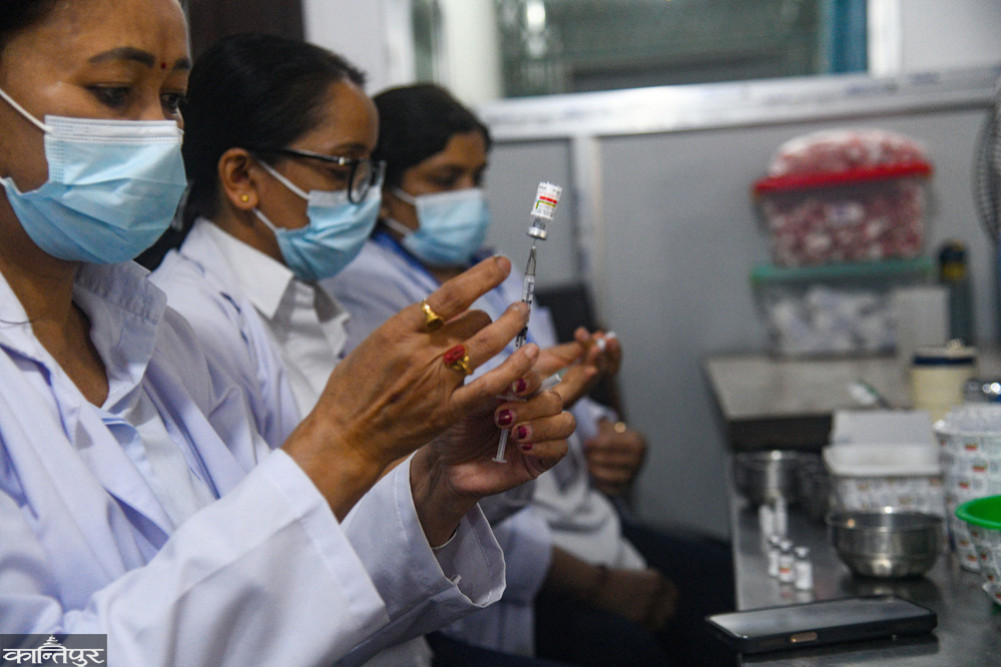
Saying ‘Shariram Vyadhimandiram, Vaidyo Narayano Hari’, Eastern philosophy considers the human body as the home of disease and the doctor or health worker who cures it as Narayana or God. But in Nepal, those ‘Gods’ have not received the proper price for their sweat, appreciation of labor, and minimum financial security. The country’s health workforce has been caught in the trap of state indifference, the narrow-mindedness of the traditional bureaucracy, and the extreme profit-oriented tendency of the private sector. Medical officers, specialist doctors, paramedics, or nurses who have completed their studies after spending millions of rupees and years of golden time are selling their labor at some private hospitals for less than the minimum wage set by the government. They are not getting remuneration according to their expertise.
Not all doctors and nurses registered in Nepal are working in Nepal. According to estimates by various studies and professional bodies, a significant percentage of health workforce has migrated abroad. The main reason for this 'brain drain' is not desire, but the extreme economic insecurity and lack of professional development prevalent in the country. In the current government system, the basic salary of the eighth level (medical officer) and the eleventh level (specialist doctor) is not sufficient. The hourly labor value of the nursing staff, laboratory personnel, and paramedics who work in health services, including those who are in direct contact with patients 24 hours a day, is even lower.
Internationally, in the UK's National Health Services or the American systems, wages are determined based on working hours, risk, and specialization. Although there are good salary facilities there, the state guarantees attractive overtime and 100 percent social security. But in Nepal, injustice has been done by weighing all disciplines on the same traditional civil service scale. Whereas, becoming a specialist requires an additional 23-24 years of hard mental and physical labor. Therefore, considering the current economic index and rising inflation in Nepal, it has become imperative to restructure the basic remuneration structure of healthcare workers.
It is not that the state does not have the resources to manage the financial burden of increasing remuneration, but only the lack of willpower. The scope of health insurance can be increased. The premiums collected in this way and the state's contribution can be spent on hospital human resource management through the 'provider payment mechanism'. A minimum of 40 percent of the hospital's total income can be compulsorily allocated to employee remuneration and incentives. According to the data of the Internal Revenue Department, billions of rupees are collected annually from tobacco and alcohol products in the health tax fund. This can be directly diverted to the risk allowance of healthcare workers without being spent on other administrative work. This is not a new practice.
Medical officers, specialist doctors, paramedics or nurses who have completed their studies after spending lakhs of rupees and years of their golden time are selling their labor in some private hospitals for less than the minimum wage set by the government. In Nepal, there has been a legal system for providing a certain percentage of the collected amount as an incentive or 'incentive' to traffic police, customs or revenue employees who are engaged in revenue or fine collection. It is right that those who catch smugglers at customs should be rewarded and those who cheat traffickers should be encouraged. Why can't we give 'incentives' from the same revenue to health workers who treat patients in hospitals and collect crores of rupees in 'treatment fees' for the institution? We have successful examples of medical education teaching hospitals or Gangalal Heart Centers retaining their best doctors by giving a certain percentage of the amount to the team involved in the treatment through 'paying clinics'.
However, when trying to make this system nationwide, two main 'objections' and concerns are raised at the policy level. The first objection is that of 'moral crisis'. If the doctor's income is directly linked to the fees or number of 'tests' paid by the patient, the greed for more money can lead to the distortion of recommending unnecessary tests or surgeries (over-prescription). This further increases the patient's expenses. Second, it comes from the proponents of the principle of bureaucracy and the welfare state.
Customs or traffic fines are associated with luxury and punishment, but since patients who come to the hospital come not out of desire but out of pain, it is not morally appropriate for the state to make the health of citizens a 'earning pot' or 'source of commission'. To address these objections, a middle-ground and scientific incentive model can be adopted. Where the treatment fee paid by the patient is not directly transferred to the account of the doctor, but rather it is deposited in a 'pool fund' of the hospital's total monthly income, and from this fund, incentives can be distributed fairly to doctors, nurses, lab workers and cleaning staff working in the hospital based on their working hours and performance.
No matter how attractive this scientific system looks on paper, implementing it in the current political and administrative landscape of Nepal is like ‘chewing on iron bars’. According to the annual budget reports of the Ministry of Finance and the Ministry of Health, the share of the health sector in Nepal’s total national budget is still limited to only about 5.5 to 6 percent. The World Health Organization and various international health economists have been emphasizing on increasing sufficient public investment in the health sector. Second, the biggest obstacle is the traditional ‘principle of equality’ of the bureaucracy.
Even though the work nature and educational investment of an eleventh-level joint secretary and an eleventh-level specialist doctor are completely different, they are weighed on the same scale. And, increasing the salary of a doctor raises the fear of rebellion in other administrative bodies. Similarly, if the minimum wage board is set in the private sector and attractive salaries are made mandatory, there will definitely be a lot of political lobbying and professional resistance from the umbrella organization of private hospital operators (AFIN), saying that ‘operating expenses cannot be met and treatment will be expensive’. Even within the health sector, there is a risk of internal conflict in the distribution of departmental allowances, as there is a plurality of unions close to political parties.
Unless the state stops considering investment in health manpower as ‘unproductive expenditure’ and takes bold decisions, the country’s health sector itself will not be able to get out of the ‘ICU’. If the state does not wake up now, tomorrow there will be magnificent hospital buildings and state-of-the-art equipment, but the ‘minds and brains’ to run them will not be found in this country.