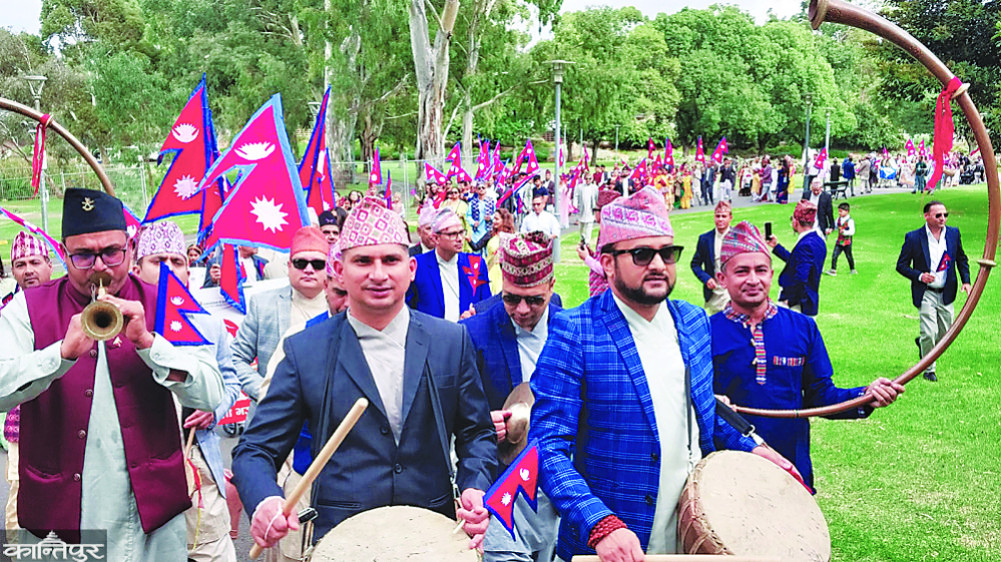
The migrants who until yesterday used to knock on Singha Durbar and Baluwatar for their rights now have their rights and influence in the White House and Downing Street. Nepal should understand this as access, not a rejection of its roots.
We use Google Cloud Translation Services. Google requires we provide the following disclaimer relating to use of this service:
This service may contain translations powered by Google. Google disclaims all warranties related to the translations, expressed or implied, including any warranties of accuracy, reliability, and any implied warranties of merchantability, fitness for a particular purpose, and noninfringement.
When US President Donald Trump flew to China on Air Force One last month with more than two dozen corporate CEOs, he sent a message that went beyond diplomacy. Usually dominated by government officials and diplomats, the parallel presence of business leaders alongside politics sent a new message to the world. Trump sought to build partnerships not only between nations but also between boardrooms. And he reminded the world that today's diplomatic partnerships are spoken in the language of capital, investment, and mutual economic interests. This applies not only to world powers but also to small economies like Nepal, and Nepal should learn from this.
For a long time, Nepal has maintained relations and cooperation with the world mainly based on aid, remittances, and goodwill. Along with our two neighboring countries, India and China, we also have similar relations with old friends like the US and the UK. However, in today's world, connected by technology and expanded in terms of opportunities, Nepal's geography and economy have expanded more than ever. As important as technology is to enable the continuous expansion of Nepali geography and economy, diaspora is equally important. The budget statement for 2083/84 presented by Finance Minister Swarnim Wagle recently attempts to address this importance by making good use of the skills, capital, and networks of the diaspora in the expansion of gentle power.
Nepal and Google are connected by service. However, Nepali scientists working at Google can make this relationship even more special. Singha Durbar and the White House are connected by history. However, Nepalis who have relations and concerns with both countries can further equip the relationship. Institutional mobilization of the diaspora is necessary to make international relations based on aid, remittances, and
goodwill based on cooperation, opportunity, and prosperity. An institutional response is necessary on the part of Nepal to make their activism result-oriented and efforts coordinated. Overseas Nepalis are the unannounced ambassadors of the state, who can become a bridge for international investment and partnership. They can become a means of landing Air Force One at Tribhuvan International Airport. 10 Downing Street and Baluwatar can become the ‘X factor’ that brings them closer. For this, a broader redefinition of Nepal is necessary.
Redefinition of Nepali Diaspora
Concrete steps should be taken now to keep the second and third generation youth of Nepali origin born abroad connected to Nepal through language, culture and opportunities. The liberalization of the 1990s, parallel to the increasing access and use of the internet, opened the door to new possibilities for Nepal and the world. A large number of Nepalis entering India in search of employment and opportunities gradually went to the Middle East and Gulf countries. With the money from remittances, Nepali society was able to send their children to boarding schools and provide them with relatively quality education. Gradually, young people who were growing up started to enter Australia, Britain, Canada, America and developed countries of Europe for study or work. After the US also announced the ‘diversity visa’ in 1990, the first generation of Nepalis started entering there through legal immigration. Today, by 2026, the second generation of Nepalis born in America are ready. In this way, the diaspora, which spreads around the world and shares Nepal's identity, exchanges culture, promotes language, festivals and arts, seeks investment and cooperation opportunities, and always wants progress and development in the country, has further expanded the boundaries of Nepali identity and influence. Although this emotional angle of understanding of the diaspora is correct for many of us, if the state adopts a diaspora policy with such a limited understanding, it will be short-sighted and objectively incomplete.
The expatriates who have been introducing themselves as non-resident Nepalis until now have now become Nepali-Americans, Nepali-British, Nepali-Europeans, etc. Many people of Nepali origin hold foreign citizenship these days, and especially the second generation of Nepalis are born and raised abroad. This means that the diaspora, who used to knock on Singha Durbar and Baluwatar for their rights, now has their rights and influence even in the White House and Downing Street. This should not be seen as a rejection of their roots, but as access.
The children of the diaspora who appealed to the Nepal government to ‘create an environment for running IT companies in Kathmandu’ are now running start-ups in Silicon Valley. Nepalis who advocate for good governance and responsible politics in Nepal and their children are now active in policy-making in the US or UK. From the US Space Agency to engineering, from Silicon Valley to Wall Street, from research to business, Nepalis scattered around the world are making their mark in their respective places and regions. They are not only establishing cultural relations by introducing foreigners to mahm, waiwai and gundruk – they are also promoting Nepal’s economic and scientific potential by explaining about ‘Silicon Peaks’. Nepalis in diaspora personally want to ‘do something for our homeland’. However, if individual aspirations can be integrated with national diaspora strategies through institutional channels, contribution, activism, and change can be made more result-oriented and sustainable.
Lessons from the Israeli and Indian diasporas
India and Israel have set a global example of how their citizens abroad can be made a ‘strategic asset’ for national development. The main lesson for Nepal from the experience of these two countries is to view the diaspora not just as a source of remittances, but as a ‘soft power’ and a partner in development. India seems to have made a leap in its policy from ‘brain drain’ to ‘brain circulation’, i.e., talent mobilization. After the Singhvi Committee Report of 2000, India created institutional frameworks such as Pravasi Bharatiya Divas, OCI (Overseas Citizen of India) cards, and separate departments under the ministry. This has inspired experts from Silicon Valley to the health sector to invest and transfer technology to India. Prime Minister Modi has put the Indian diaspora at the forefront of restructuring India-US relations since 2014. India's NRI deposits are expected to reach nearly $800 billion by 2024 and the diaspora's lobbying for the Indo-US civilian nuclear deal further confirms its economic and diplomatic influence. Nepal should learn from this and, as a shared responsibility for nation-building, be able to connect the knowledge, talent, experience and expertise of Nepali experts from around the world with Nepal's development.
Israel has also started considering its diaspora as a basis for the nation's expansion and security, instead of calling it a negative outcast in recent years. After the October 7 incident, the Israeli diaspora has played an extraordinary role in procuring equipment for the army and lobbying around the world. The main lesson Nepal needs to learn from this is to convert emotional ties into sustainable investment and diplomatic influence. It is necessary to form a high-level committee like India to address the expectations of the diaspora and, like Israel, to use their expertise in times of crisis. Diaspora should be recognized not only as a ‘number’ but also as a ‘power’ and mobilized as ‘brand ambassadors’ in promoting Nepal’s higher education, technology, investment and tourism. Our strategy should be to ensure the civil rights and investment security of the diaspora and integrate them into the national mainstream. In this, the diaspora also has a duty to organize, engage politically, build economic bridges and move towards common interests.
The way forward
Despite having nearly two lakh Nepalis in Australia or having nearly 200 years of relations with the UK, why has there not been a prime minister-level meeting or any concrete business partnership between us till date? This question goes back not only to the state but also to the diaspora. Why have we not been able to move from a diplomacy of exchanging gifts and good wishes to a diplomacy of exchanging opportunities? If we could have prioritized issues of economic development and mutual interest on the diplomatic table, international relations would have definitely reached a new height.
The diaspora can have a constructive role in this regard. The Non-Resident Nepali Association, the Federation of Nepalese Chambers of Commerce and Industry, and active community organizations can advocate for Nepal's 'branding' and investment at the international level. As the world continues to be amazed by the development and impact of technologies such as AI and quantum, the diaspora can become our window to the world. Concrete steps should be taken now to keep the second and third generation youth of Nepali origin born abroad connected to Nepal through language, culture, and opportunities. If millions of Nepalis who love their country in the diaspora can become ambassadors of the country and become a bridge for international coordination in an organizational manner, the slogan 'Where there are Nepalis, there is Nepal' will be fulfilled in the true sense. The way forward should be institutional coordination of the state and integrated efforts of the diaspora for Nepal's foreign relations and international investment.