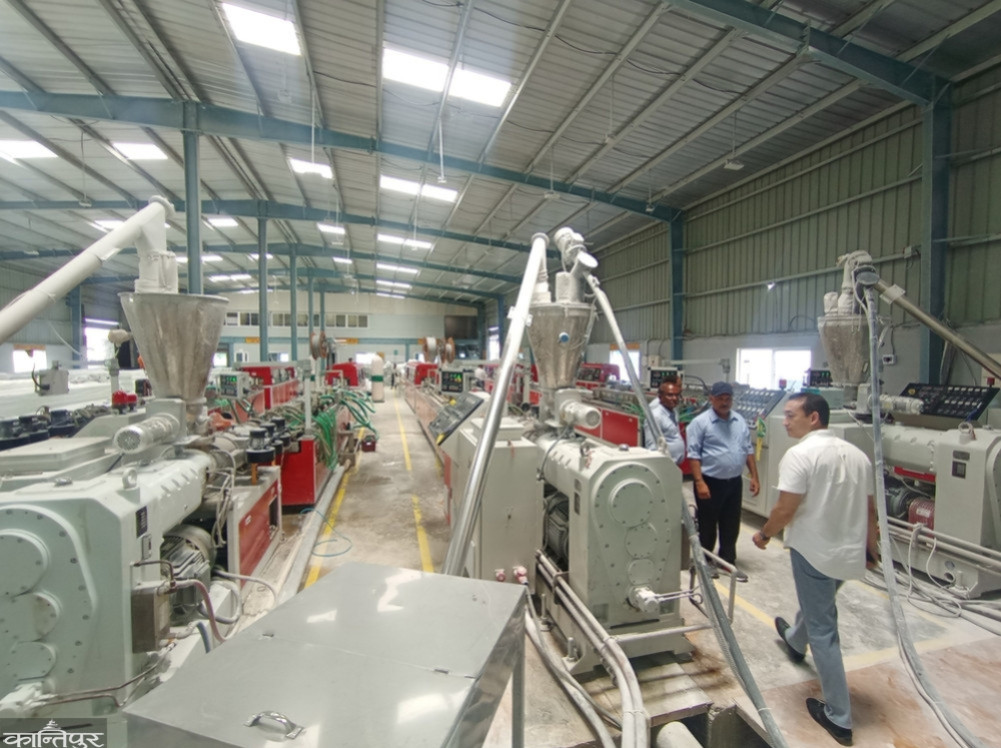
The government must communicate directly with the indigenous people of local settlements about the current state of the industries in operation, their impact on the environment, and their impact on the environment.
We use Google Cloud Translation Services. Google requires we provide the following disclaimer relating to use of this service:
This service may contain translations powered by Google. Google disclaims all warranties related to the translations, expressed or implied, including any warranties of accuracy, reliability, and any implied warranties of merchantability, fitness for a particular purpose, and noninfringement.
The plan to reopen government industries that have been closed for a long time has brought hope to millions of Nepalis inside and outside the country when it was made public through the budget speech. Even if the government had been in deficit for a few years, at least our youth would not have had to go to the desert in millions every year for employment.
The main reason why we should have industries in the country was employment. If Nepalis go to the Gulf countries and sweat in the same industries and construction sectors, why not use that labor in our own country? However, the reality is completely the opposite. In a series of ‘Herne Katha’, a local woman expresses her frustration and anger and the dialogue is heartbreaking. She says, ‘There is no employment, there is only smoke and dust. Even if someone from this village had found employment, it would have been said that they had found work. All the people who do the work are Indians. We only want disease?’
This is a very serious and thought-provoking matter. This problem is growing rapidly in most of the big industries and construction sectors of Nepal. There is no concrete and scientific plan to control pollution in the country. In the name of saving the cost of scrubbers and filters in the cement industry, work is done night and day, due to which when we wake up in the morning, a thick layer of white lime-like dust accumulates on the roofs, courtyards and farmlands of the locals.
The industry opened, but the locals did not get employment or clean air. What is the point of boasting that this is a product of my country when the lungs are damaged and cancer develops due to pollution? Nationalism does not cure diseases.
The bitter truth is that the low-level foreign workers who enter our industries in the name of technical or unskilled labor do not contribute much to the economic activity of the local market. To understand how deep and suicidal the gap between industrial policy and environmental awareness is in Nepal, one only needs to look at the beautiful laws written on paper and the reality on the ground. Legal provisions like Environmental Impact Assessment (EIA) and Preliminary Environmental Examination (IEEE) have become nothing more than paper processes and economic tools to block or release files.
On the one hand, Nepali youth are forced to stand in line for labor approval and be humiliated at the airport, on the other hand, many foreign citizens are working without any work permits, labor approvals, and records in such industries in our country. The government has neither accurate data on how many foreign workers are in the country's industries, nor the will to implement the Labor Act.
Now, the government needs to rise above cheap popularity and conduct research, debate, and dialogue on the issue of reopening closed industries or opening new industries. In particular, the government must directly communicate with the state of the currently operating industries, their impact on the environment, and the indigenous citizens of the local settlements.
If the people are suffering so much due to lax management and monitoring when a few industries are operating, what will be the condition of the country if more industries are opened in a haphazard manner tomorrow without any strict standards? It cannot be said that an environmental crisis will not arise then.
The current government led by the new youth should have a comprehensive and honest dialogue with the citizens, environmentalists and operators of the relevant areas in every small and big construction and industrial plan. Let a new, sustainable and environmentally friendly development be established.
If the state does not think in time, the first and cruel blow of every policy weakness and environmental crisis will always fall on the poor, marginalized, and economically weak class. Those who do not have the means to seek treatment are forced to reach the first grave by eating the dust of the industry. However, what the owners of the industry, capitalists and policymakers should not forget is that smoke and polluted air do not recognize class.
The cancerous air that initially enters the huts of the poor also reaches the lungs of the rich who drive luxurious palaces and fancy cars. If the air becomes dirty, the industrialists who make the air dirty must also pay a heavy price by sacrificing their own health and the lives of future generations. Nature cannot be tempted and controlled by anyone. Therefore, effective pollution control policies are indispensable in the areas where industries are operating.
The ruins left by history, the challenges of today and thousands of complex problems for the security of the future have formed a mountain before the country. However, the new government is expected to have the enthusiasm and new thinking of the youth. Therefore, this government should not fall behind the politics of momentary gain by saying, 'This was done during my tenure, that was done, I cut this ribbon or lit a lamp here.' This government should break the old habit of cutting ribbons in a hurry and regretting it later. Whatever it does, it should do it with far-sighted thinking, strong research, and in a way that will last for generations.