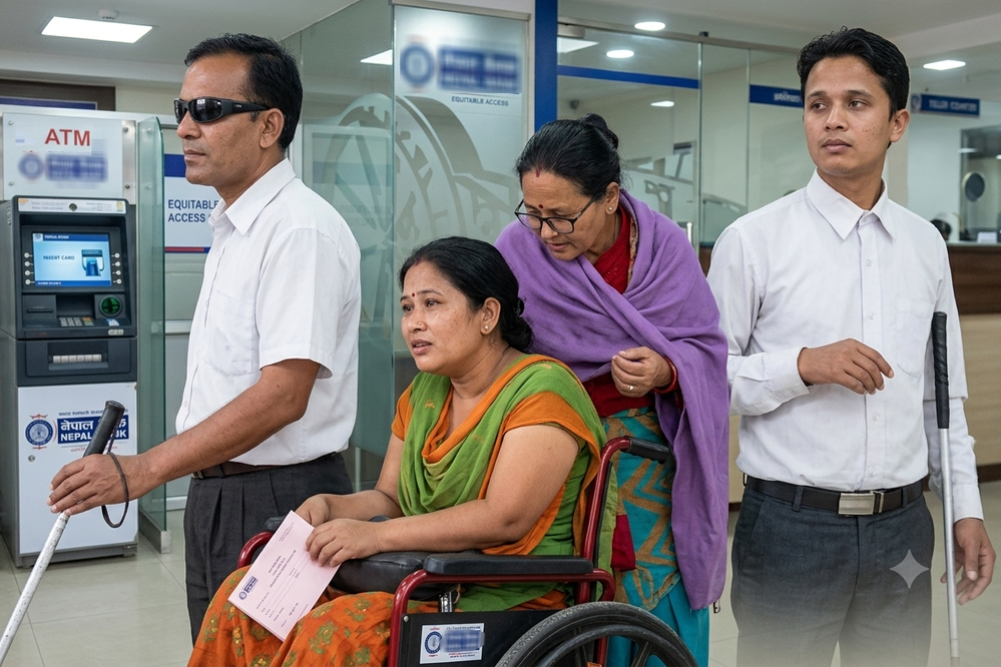
Disability is neither a matter of ability nor a disease. A disease can lead to a person becoming disabled, but having a disease does not mean becoming disabled.
We use Google Cloud Translation Services. Google requires we provide the following disclaimer relating to use of this service:
This service may contain translations powered by Google. Google disclaims all warranties related to the translations, expressed or implied, including any warranties of accuracy, reliability, and any implied warranties of merchantability, fitness for a particular purpose, and noninfringement.
There is a lot of controversy over the definition of the word ‘disability’ in Nepal. Perhaps this ambiguity has also caused problems in the implementation of disability-related programs. Before delving into issues related to disability rights and benefits, I will present some examples. These examples are particularly related to recent materials published in Nepali media and the perceptions, thoughts, and experiences related to disability prevalent in Nepali society. Some time ago, the issue of a blind person begging and earning a living by taking a taxi went viral on social media. We have also read news that the government or local administration has forcibly removed blind people who were sitting on the roadside and singing songs in the name of improving ‘urban beauty’.
In recent days, someone has claimed to be helping the disabled and poor by ‘treating’ disability, and has also been heard describing disabled people as ‘differently abled’ or ‘specially abled’ people. The question arises – if these issues are not related to the real issue of disability, then what is the real issue of disability? Now let us discuss this.
Disability is neither a matter related to ability nor to any disease. A disease can lead a person to a state of disability, but having a disease does not mean disability. A WHO report published in 2022 has made it clear that having a disease in the body is not disability. Disability is not a ‘different ability’ or a ‘special ability’ either. For example, a blind person can read like any other person. What is needed is opportunity and a suitable environment. If the conditions and environment cannot be made easy, not only people with disabilities, but also people without disabilities cannot read effectively.
As soon as we see a person with a disability, we interpret him as unable to work, unproductive, a burden or burden to the family and society. But, when we see that same person succeed, we do not hesitate to discuss him as courageous, brave or exceptionally talented.
The subject of disability is neither taught in schools nor in colleges. Even if we want to, the places to learn or understand about it are limited. Therefore, it is not surprising that there is a widespread misconception about disability. The subject of disability needs to be included in the curriculum. Otherwise, people like me and others who are living for disability rights will have to spend their entire lives explaining about disability.
Society is stuck in such an old way of thinking about disability that when it continues to explain it as ‘differently able’, ‘specially able’, ‘extraordinarily talented’ or ‘the karma of previous births’ or ‘the result of sins’, it is forgetting a fundamental thing. For example, the ability to read and write is a common human ability for both people with and without disabilities. The only difference is in the way and medium of reading, writing and understanding. This difference is not understood and is viewed in relation to the overall ability. As a result, our thinking, policies, programs and behavior are all going in the opposite direction.
How does this thinking affect the government's policies and programs? When traveling on a public bus, as soon as a blind person boards, he is asked to sit in a seat reserved for the disabled. However, in reality, a blind person may not have problems with his arms, legs, waist or other parts of the body. If there is an elderly person or a person with arthritis or a physical disability on the same bus, they may need that seat more. However, in the context of Nepal, there are many obstacles for a blind person to move from his residence to school, college, workplace or commercial place. In such a situation, the policy of the government paying the fare incurred while traveling on public transport is considered useful.
In the context of facilities provided solely because of disability, it is not appropriate to directly distribute allowances without a thorough analysis of the obstacles, obstacles, and environmental problems faced by people with disabilities in their daily lives. The practice of only providing allowances in this way reinforces the idea that people with disabilities are dependent, cannot work, and need to be looked after by someone.
Some time ago, I heard such examples. A person with a disability, who had received a red disability identity card and was working as a teacher, was questioned by some government employees, ‘Should a red identity card holder either leave his job as a teacher or only receive allowances? But he cannot receive double benefits.’ Now the question arises here, which did those government employees interpret as a facility, the job or the allowance? Legally, both of these things are not a matter of facilities, but rather a matter of human rights of people with disabilities.
Similarly, there is no provision in any law of Nepal that a person with a red disability identity card cannot receive allowances and work both. However, in practice, it was seen as if the employees themselves made the rules. Similarly, people with disabilities with red identity cards were found to be deprived of participation in the Prime Minister's Employment Program and other government concessional programs. This clarifies the ambiguity and negative perception of people with disabilities among government employees and exposes the violation of the human rights of people with disabilities.
Having said this, according to the 'United Nations Convention on the Rights of Persons with Disabilities', people with disabilities are entitled to all human rights like other citizens. They are also guaranteed the right to enjoy, protect and seek redress in case of violation of those rights.
This Convention also includes some special principles that are not adequately addressed by other human rights treaties. Among them, the principle and right related to accessibility comes first. Related to it is another important right, ‘reasonable accommodation’. On the same occasion, equality is also mentioned as its basic principle.
Article 3 of the same Convention mentions 8 principles. I consider it relevant to discuss two of those principles.
First, according to the principle of ‘full and effective participation and inclusion in society’, it has been considered a legal requirement to determine any government policy and program through direct participation and result-oriented consultation of persons with disabilities or organizations representing them. Accordingly, there is no possibility of achieving full and effective participation through tokenism prevalent in Nepal. As many believe, this principle is not considered to be properly utilized by involving only a large number of persons with disabilities of any nature.
Second, the principle of ‘equality of opportunity’ is very complicated. According to this principle, if children with autism are placed in ‘residential schools with infrastructure’ at the whim of their parents, the principle of equality of opportunity will not be fulfilled. This principle explains that any child with autism, including those with disabilities, should have the opportunity to learn, play, and utilize intellectual development with peers like them and those different from them, just like other children, while remaining in their own homes and communities.
Therefore, when formulating policies and programs by the government, instead of focusing only on ‘what facilities to provide’ and ‘how much to provide’ to people with disabilities, it is appropriate to think about how to ensure equality of opportunity.