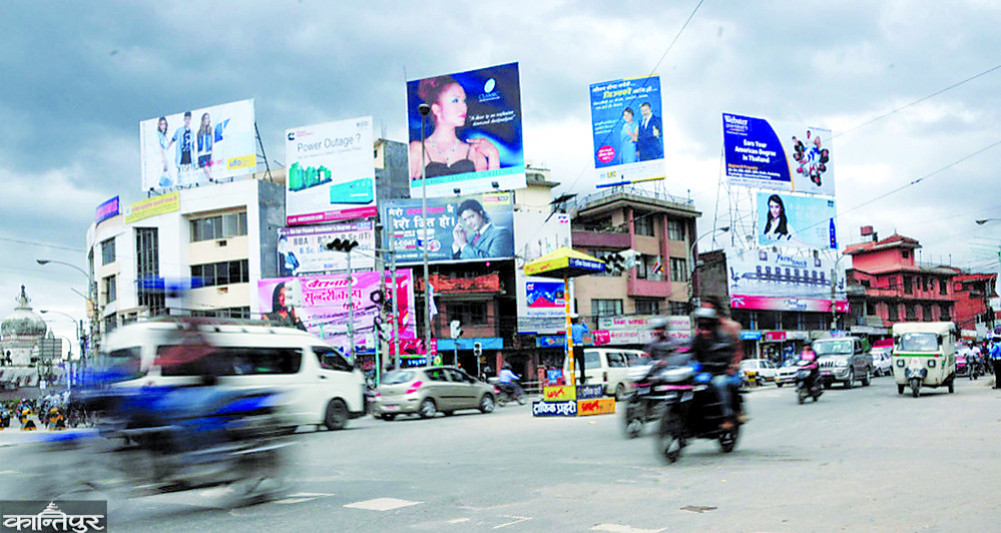
Countless hoarding boards have turned the streets of Kathmandu Metropolitan City into a pollution laboratory. Here are the problems, challenges, and policy deficiencies.
We use Google Cloud Translation Services. Google requires we provide the following disclaimer relating to use of this service:
This service may contain translations powered by Google. Google disclaims all warranties related to the translations, expressed or implied, including any warranties of accuracy, reliability, and any implied warranties of merchantability, fitness for a particular purpose, and noninfringement.
Suppose you are going from Lalitpur Kupandol to the Patan Durbar area via Lagankhel. There are hoarding boards on the right and left of the road. Somewhere there are torn old flexes, somewhere the bright colorful rays of new digital screens dazzle the eyes. From small advertisements hung on poles to banners stuck on the walls of historical temples, you can see them everywhere. This creates various arguments in our minds. The question arises – what is the state’s policy towards ‘outdoor advertising’? How is it possible for the cultural dignity of Patan, listed on the World Heritage List, and the existence of disorderly outdoor advertisements to coexist?
However, such questions are not only related to Lalitpur – they are interrelated with the question of what is the state’s outdoor advertising policy in the case of urban settlements, commercial and tourist towns that carry the identity of the city, and the entire capital. With modernity, cities began to change their faces. Then the trend of putting up hoarding boards for business and information and communication began. Whether it was Kathmandu's New Road or Pokhara's Lakeside, Biratnagar's Traffic Chowk or Nepalgunj's Jayabageshwori Chowk - outdoor advertising began to change the face of the city.
Did such advertisements make the city look beautiful or ugly? To find the answer to this question, an attempt has been made to analyze the situation of Lalitpur Metropolitan City through a 'research paper'. In a research conducted by the columnist himself, 102 stakeholders in Lalitpur Metropolitan City were asked the question 'What impact has outdoor advertising had on the beauty of the city?' 72.55 percent of the respondents said that it had a negative impact. Only 1.96 percent said that it had a 'positive' impact. This figure also gives us vivid evidence of the weaknesses of urban management.
When asked ‘Has the Metropolitan Municipality effectively monitored and regulated outdoor advertising?’, 72.55 percent answered ‘not’. This also shows that the implementation of the existing policy is weak. We can easily understand – we have rules, but no monitoring. We have laws, but there is no fear of punishment for violating them.
If we consider Lalitpur as a ‘window’, it helps us to identify the real picture of outdoor advertising in Nepali cities. From here, we see that despite the well-organized governance structure from Singha Durbar to the local level, the state has not been able to regulate even minor issues like placing random boards on the streets and placing Manalagdi flexes. Why is this happening?
The first reason is the gap between policy and practice. The Constitution of Nepal-2072 has given the local level the right to regulate advertising and collect taxes. The Advertisement (Regulation) Act 2076 has given the local level the authority to determine the location, size and content of advertisements. However, the employees of Lalitpur Metropolitan City have a different view. According to them, despite the sufficient legal basis, there are many complications in implementing it in practice.
While digging into this complexity, we find a shortage of manpower, lack of technical expertise, political pressure and lack of institutional willpower. The second reason is the greed for revenue from such chaotic advertisements. Lalitpur Metropolitan City considers outdoor advertising to be only a source of income.
Outdoor advertising has not promoted the city's local products, culture, traditional skills, knowledge and technology. Instead, it is helping to make indigenous knowledge, skills and technology vulnerable to extinction. According to various studies, the size of the outdoor advertising market in Nepal is about 2.37 billion. However, if there is proper regulation and management, a study by the Advertising Board has projected that its size can increase to over 19 billion. In such a situation, a serious question arises, are we exchanging the beauty and safety of the city for revenue for just 2.5 billion?
The third and most important reason is the 'digital transition'. 'Digital LED screens' are now seen flickering in the main squares of Lalitpur. Such 'screens' have posed a serious risk to the safety of night-time traffic. In our survey, 80.39 percent of respondents said that 'outdoor advertising is affecting traffic safety'. Ironically, our policies have still failed to set scientific standards for the brightness, sound and safe location of digital advertising.
Apart from all these problems, there is another serious problem. In the case of Lalitpur, the hoarding boards of outdoor advertising have not promoted local products, culture, traditional skills, knowledge and technology. On the contrary, they are helping to make indigenous knowledge, skills and technology extinct. Patan in Lalitpur is a historical city in itself. For centuries, Patan has been famous as a center for woodcraft, metalwork, sculpture, Paubha paintings, handicrafts and many other materials and traditional technology-based skills. But, ironically! Most of the billboards hanging on the roadside only display products of multinational companies.
The promotion of indigenous products, including local original architecture and indigenous skills, traditional technology and cultural products of Lalitpur is almost nil. This leads to the new generation becoming alienated from their own heritage. And, the risk of the cultural identity of the locals gradually disappearing has also increased. This has also deprived local artisans, businessmen and skill-based enterprises of marketing opportunities.
Is this problem only in Lalitpur? Of course not. Lalitpur's research paper speaks in a representative voice of the pain of the cities of Nepal as a whole. If we travel from Tripureshwor in Kathmandu metropolis to the new bus park, we see countless hoarding boards turning the roads into a laboratory of pollution. Problems, challenges and the same policy deficiency are found everywhere.
There is one root cause behind all this. That is, the concept of urban planning in Nepal is not linked to the management of advertising. We do not care about how, what type, what kind and what size of advertising is appropriate to place while constructing roads, buildings, parks or other structures. As the city develops, mind-blowing advertisements are spread indiscriminately.
This problem is not only faced by Nepal. Other cities of the world have also faced similar problems. Many have also sought a solution to it. Indore in Madhya Pradesh has been consistently declared the cleanest city in India in recent times. Indore decided to take strict action against outdoor advertising in 2016. It was not easy to start the campaign of ‘Hoarding Board Free City’. During that time, all unauthorized hoarding boards were removed from the main roads and squares of the city. And, ‘Advertising Zone’ was created.
Chandigarh in India set scientific standards for the size, location, color, etc. of advertisements in the name of ‘Visual Pollution Control Act’. In big cities like Shanghai, Beijing, Shenzhen in China, policies are set to consider outdoor advertisements as an integral part of the city’s design. There, while preparing the master plan of the city, a master plan for advertisements is also prepared. An automatic ‘brightness control’ system has been implemented for ‘digital screens’ placed in the city. The advertisement permission system has also been made completely digital. All aspects of advertising permits (permits obtained/not obtained, permit expiration date, and taxes paid/not paid) can be easily viewed online.
The story of Europe is even more intriguing. Cities like Copenhagen and Paris have put forward the concept of green advertising. Outdoor advertising is mostly limited to public transport stops. Such advertising is also operated with green energy. Some cities have set a goal of reducing their city's outdoor advertising to zero carbon use. The French capital Paris has adopted a policy of removing all advertising boards near schools and hospitals in 2019.
Based on the on-site study of Lalitpur and the observation of various international experiences and good practices, we can put forward some suggestions on the management of outdoor advertising.
First of all, a separate 'Outdoor Advertising Guide' is needed to solve the problem. The experience of Lalitpur Metropolitan City shows that a single policy cannot address both historical heritage areas and new commercial areas. Outdoor advertising should be completely banned in important areas on the World Heritage List such as Patan Durbar Square, Swayambhu, Pashupati, Lumbini. In our survey, 86.27 percent of respondents have demanded a similar step. Since the beauty and cultural dignity of these areas are much greater than commercial advertising, it seems that strict legal provisions should be made by declaring them as ‘Special Heritage Conservation Areas’. There should be no delay in creating an effective monitoring system for
advertising management. More than 72 percent of the respondents who participated in the research said that monitoring was not effective. We can easily find a solution to such problems in the coming days in technology. Online applications, permits, tax collection and monitoring of all outdoor advertising can be managed through a centralized digital platform. Different parts of the city can be divided into ‘zones’ and different standards can be applied.
More than 80 percent of respondents in our research have said that advertising has affected traffic safety. Nowadays, the concept of 'Clear Vision Zone' can be implemented by keeping the impact of advertising in mind while designing new roads.
Community participation and public awareness are also of no less importance. During the study, we learned that 39 percent of respondents do not know much about Lalitpur Metropolitan City's advertising policy. 10 percent do not know anything. This shows that policymakers have not been able to inform citizens or do not consider it necessary. Like in Amsterdam in the Netherlands, it would be appropriate for us to create a mechanism for regular dialogue and cooperation between advertising professionals, local residents, and local government and administration.
The study conducted in Lalitpur Metropolitan City has given us a glimpse of a serious problem. We seem to be running after revenue only with unimplementable policies and unenforceable laws. This is telling the story of our systemic failure. We need a systematic, scientific and participatory outdoor advertising policy, one that helps preserve the beauty, safety and cultural identity of not only Lalitpur but all cities in Nepal.