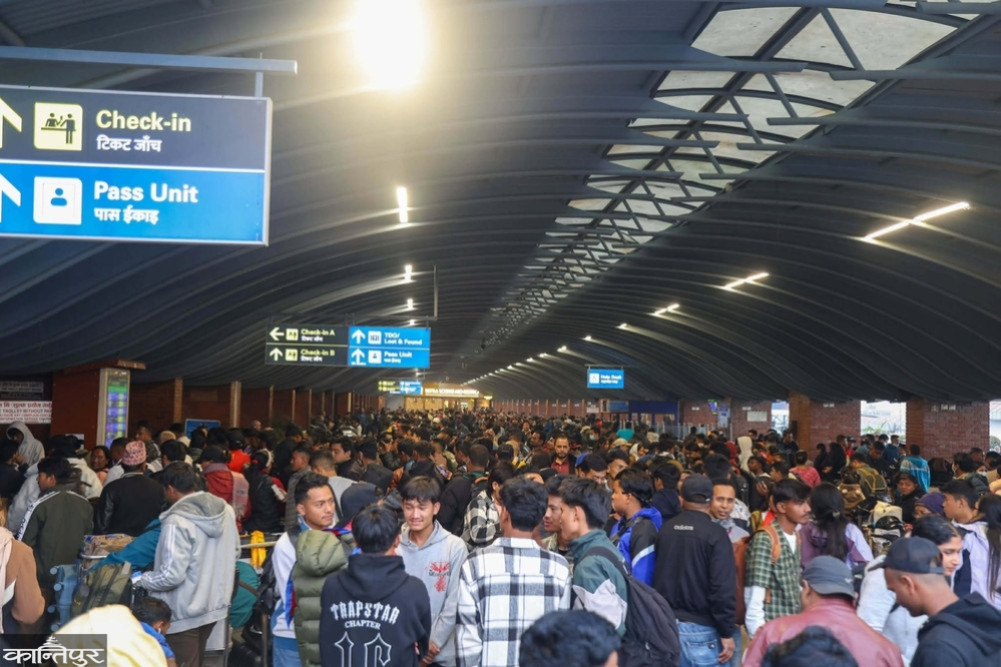
The demographic dividend becomes a 'benefit' only when that youth power can be engaged in productive work. Otherwise, the same 'dividend' can also become a dormant explosive.
We use Google Cloud Translation Services. Google requires we provide the following disclaimer relating to use of this service:
This service may contain translations powered by Google. Google disclaims all warranties related to the translations, expressed or implied, including any warranties of accuracy, reliability, and any implied warranties of merchantability, fitness for a particular purpose, and noninfringement.
The Department of Foreign Employment reports that more than seven lakh youth (both new and old) from Nepal leave for abroad in search of employment every year. If we look at the number of youth who go abroad with a No Objection Certificate (NOC) from the Ministry of Education in the name of higher education, this figure seems even wider. From the Gulf countries to Malaysia, from Korea to Japan, from Eastern Europe to African countries, Nepali workers are selling their labor in different corners of the world. This trend of going abroad for employment is a complex socio-economic issue linked to the state's economy, population policy, and development direction.
There are two opinions prevalent in the Nepali intellectual world and policy-making sector regarding foreign employment. One side says that foreign employment empties the country's labor market, causing a shortage of labor in agriculture and industry. The other side answers that youth are forced to go abroad because there is not enough employment in the country. Both these opinions are partially true, but the deeper dimension of this debate is often overlooked. That is – demographic dividend .
The third stage of demographic transition
According to the theory of demographic transition, when a society reaches the third stage out of the four stages, the birth rate starts to decline, the death rate has already decreased, and the proportion of the population in the working age group (15-64 years) is the highest . Nepal is currently in this very youth boom . According to the National Census 2078, approximately 56 percent of the total population of Nepal is in the age group of 15 to 59 years . This is the golden opportunity for the ‘demographic dividend’ that any country can get in its long history . What follows after this is the aging society .
‘Demographic dividend’ is also one of the various reasons behind the ‘economic miracle’ of East Asian countries . South Korea, Taiwan, and Singapore achieved significant growth in GDP in the 1960s–1990s by mobilizing their young populations in industry and technology. Research by World Bank economists David Bloom and Jeffrey Williamson has shown that more than a third of East Asia’s economic growth was due to this demographic dividend. Nepal has a similar opportunity. But the question arises – have we been able to make the most of this rare moment?
Theoretical basis of labor migration
Economist Everett Lee’s ‘push-pull’ theory explains that labor migration is driven by two types of forces. ‘Push’ forces include unemployment, low wages, political instability, and lack of services at home. ‘Pull’ forces include higher wages, better working conditions and other personal perceptual opportunities available in the destination country. The
wage gap is a key factor in this process. In Nepal, the minimum wage is Rs. 17,300 (about $130) per month. In Malaysia, an unskilled Nepali worker earns Rs. 65,000 (about $1,700) per month. Under Japan’s ‘Specified Skilled Worker’ program, it is possible to earn between $1,500 and $2,000 per month. In this situation of unequal wages, Arthur Lewis’ ‘dual economy model’ becomes relevant. When wages in the traditional sector (agriculture) are limited to subsistence levels, workers are naturally attracted to the modern or external sectors.
Youth Emergence and the Risk of Social Instability
The demographic dividend becomes a ‘benefit’ only when that youth power can be engaged in productive work. Otherwise, the same ‘dividend’ can also become a dormant explosive. Studies by German sociologist Gunnar Heinzohn and research by Norwegian political scientist Henrik Urdal have shown that when the proportion of youth (15–24) exceeds 30–35 percent of the total population, a ‘youth bulge’ forms, and such a situation increases the likelihood of armed conflict in underdeveloped countries by up to 150 percent.
In the context of Nepal, it can be assumed that a major socio-economic reason for the ten-year armed conflict and repeated rebellions was the large presence of unemployed and disillusioned youth. The same situation is seen in Africa. International security analysts have repeatedly pointed out the relationship between youth unemployment and rebel recruitment in the Sahel region, including countries such as Mali, Niger, Senegal, and Sudan. The 2011 Arab Spring in the Middle East was also partly driven by youth unemployment and a lack of opportunity.
From this perspective, foreign employment has acted as a pressure valve to some extent to defuse a potential social explosion in Nepal. But it is not a permanent solution, but only a temporary relief.
Remittances: a blessing or a curse?
In the fiscal year 2081/82, Nepal received more than Rs. 1.7 trillion in remittances. This is more than a quarter of its gross domestic product. This ratio is considered one of the highest in the world. Remittances have improved the living standards of millions of families, reduced poverty and expanded the consumer market. But this has also created a remittance trap.
Economist Dani Rodrik explains this situation with the concept of ‘Dutch Disease’. The inflow of foreign currency increases the value of the local currency, which makes exports more expensive and weakens domestic production. In Nepal, remittances were mainly spent on consumption. They were consumed on marriage, real estate, imported goods and services rather than on productive investment. As a result, agricultural production decreased, there was a shortage of agricultural labor, and the country became dependent on food. On the other hand, internal migration caused by climate change and other reasons also made rural areas deserted and the area of barren lands expanded rapidly.
Brain drain and skill erosion
The most serious consequence of foreign employment is brain drain. Not only ordinary workers, but also highly and moderately skilled doctors, engineers, scientists, information technology experts and nurses are migrating abroad. According to government data, hundreds of doctors, nurses and other healthcare workers leave for countries like the US, Australia, the UK, and the Maldives every year. India and China are the opposite examples. A large number of skilled workers went abroad in both these countries. But they adopted the concept of ‘brain circulation’. Returning home after gaining experience and capital abroad and expanding startup and technology industries. India’s ‘Diaspora Entrepreneurship’ and China’s ‘Thousand Talent Program’ are examples of this. Such a ‘homecoming culture’ has not yet been developed in Nepal. Path to a solution
Multi-faceted policy interventions are needed to resolve this conflict between foreign employment and demographic dividend –
a) Creating an employment-oriented investment environment: Quality employment should be created domestically through incentives for the private sector, simplification of labor and foreign investment laws, and effective operation of special economic zones.
b) Skilled Labor Export Policy: The flow of labor in the global market is guided by the principle of demand and supply. However, to send skilled and semi-skilled workers compared to unskilled labor, bilateral labor agreements with countries like Japan, Korea, and Germany should be expanded to ensure higher wages. It is also necessary to provide access to the international ‘supply chain’ of labor recruitment. This reflects the inevitability of agile labor diplomacy.
c) Converting remittances into productive investment: Remittances should be converted into investment by issuing ‘diaspora bonds’, providing tax exemptions on establishment of enterprises from remittances, and operating a ‘matching grant’ program.
d) Reintegration of returning manpower: To utilize the skills, experience, and capital learned by workers returning from abroad in domestic industries, a ‘Return Entrepreneur Fund’ and a ‘Skill Recognition’ program should be introduced. This task seems to be incomplete without adequate investment in the socio-economic empowerment of the families of workers who go for foreign employment.
Conclusion
Foreign employment is neither the problem nor the solution. It is only a consequence. The result of inadequate employment opportunities and a high wage gap within the country. Nepal is currently standing at almost the ‘midpoint’ of the demographic dividend era. There are still a few decades left to move towards an aging society. If reforms are not made now in labor, education, investment, and industrial policies, this ‘dividend’ is sure to turn into a burden amid the growing tragedy of social security spending.
The example of Ireland is inspiring here. After the ‘Great Famine’ of 1840-1850, millions of Irish people migrated to America. But in the 1990s, Ireland emerged as the ‘Celtic Tiger’. Investment in education and technology and EU membership have contributed to the return of the Irish diaspora abroad. Nepal should not be slow to adopt this model.
Finally, it is never appropriate to view the demographic dividend and foreign employment as a zero-sum game. With the right policies, the right investments and governance reforms, the two can and must be made to complement each other. The question is not whether young people go abroad or not. The question is whether the young people who go return with skills and experience or not, and whether their contribution to the country's development will be used upon their return.
(Dhakal is a Deputy Secretary to the Government of Nepal)