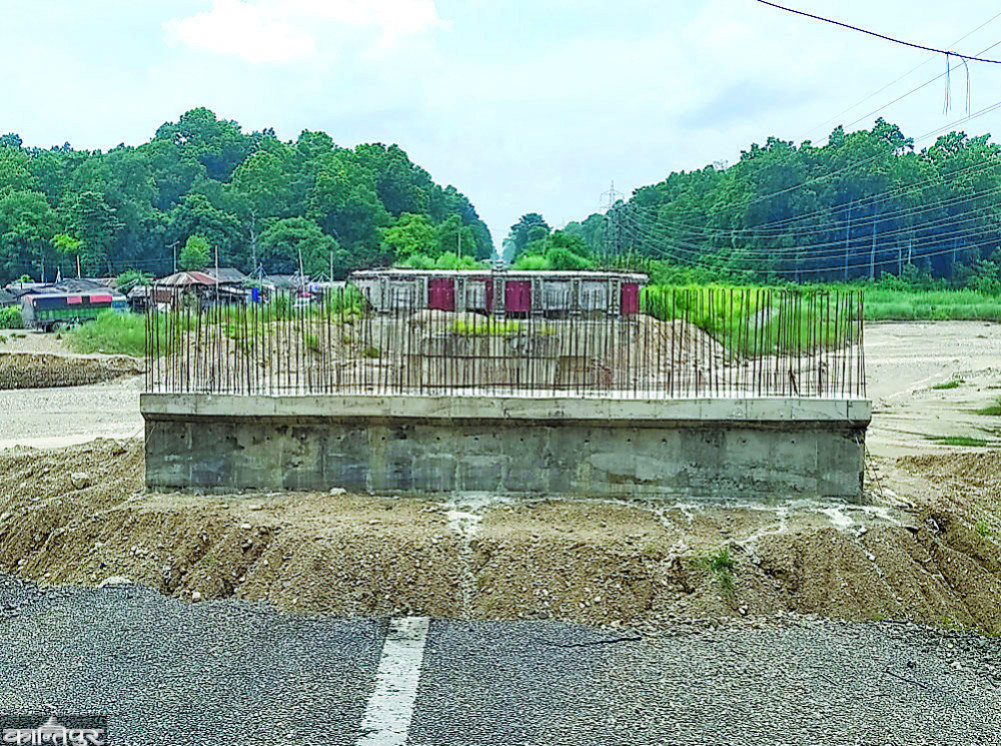
Public investment management can be radically improved by strengthening the national project bank system. Otherwise, the risk of poor project selection and prioritization, implementation delays, cost escalation, and misuse of limited public resources will persist.
We use Google Cloud Translation Services. Google requires we provide the following disclaimer relating to use of this service:
This service may contain translations powered by Google. Google disclaims all warranties related to the translations, expressed or implied, including any warranties of accuracy, reliability, and any implied warranties of merchantability, fitness for a particular purpose, and noninfringement.
The country's capital expenditure reflects not only the pace of development, but also the reality of public investment management. It is a well-known fact that billions of rupees allocated for infrastructure development in Nepal are not spent every year and are returned to the government treasury. On average, only about 60 percent of the annual capital budget is spent. Looking at the data for the first 9 months of the fiscal year 2082/83, only 24.15 percent of the total capital budget of 407.88 billion has been spent. There have been some signs of improvement after the formation of the new government, but there is growing concern that the old trend will repeat itself in this fiscal year as well.
Various studies, including the Ministry of Finance's Public Expenditure and Fiscal Responsibility Assessment Report-2081, the World Bank's Analysis of Constraints to Nepal's Capital Expenditure Report-2082 have shown that Nepal's capital expenditure system has deep structural problems. Project selection is often guided more by political influence than by evidence-based decision-making and national, sectoral plans and priorities. Most projects are announced without feasibility studies, environmental clearances, and necessary land acquisition. As a result, some projects are only on paper when included in the budget.
Even after entering the implementation phase, the progress of the projects has been slow due to delays in the procurement process, seasonal obstacles, and weak contract management. Thus, poor selection of infrastructure projects, failure to complete contracted projects on time, and failure to achieve expected returns even from projects that have already been commissioned have clearly reflected the fundamental weaknesses of Nepal's public investment management system.
Public investment management refers to the policies, procedures, and institutional framework that organize the entire process of selecting, prioritizing, budget allocation, implementation, monitoring, and evaluation of capital projects operated from public sources. An effective public investment management system helps to focus investment on priority projects that provide high economic and social returns while ensuring optimal utilization of limited public resources. Experience in low-income countries has shown that the returns from public investment can be reduced by about half due to a weak public investment management system.
In order to address the problems seen in public investment, the National Project Bank was established under the National Planning Commission in 2076 BS in accordance with the concept of public investment management. For this, the Project Identification, Evaluation, Selection and Prioritization Guidelines-2076 were formulated and the National Project Bank Management Information System was developed and put into operation accordingly.
The Project Bank Information System provides project-related information to the National Planning Commission, departmental ministries and related bodies through a dashboard in real time. It also assists in the monitoring and decision-making process. As a result, it plays an important role in completing projects within the stipulated time, cost and quality. This system is also important in terms of project portfolio management, sectoral budget analysis, balanced development planning and identification and management of sick projects.
Strong legal provisions have also been made to operate the National Project Bank effectively. The Financial Procedures and Financial Responsibility Act, 2076 has provided for budget allocation only for projects entered in the Project Bank. The National Project Bank (Operation and Management) Standards-2081 stipulate that Rs. It has been clearly stipulated that only projects above Rs 30 million should be entered into the Project Bank, and the necessary preparatory documents such as the project feasibility study report, environmental assessment report, outcome framework and land acquisition plan should also be included in the Project Bank Information System.
Challenges in the Implementation of the National Project Bank
In theory, the National Project Bank was developed as a 'gatekeeper' to enter the budget system through a predetermined process based on evidence of pre-prepared and prioritized projects. However, in practice, it does not seem to have been able to play an effective role as expected. The Project Bank is gradually becoming limited to the process of completing a formal 'checklist' rather than a system for selecting and prioritizing quality projects. There is a tendency for projects to be entered and considered eligible for the budget simply on the basis of uploading project-related documents to the online system without meaningful assessment of the economic feasibility, technical suitability and cost-benefit effectiveness of the projects.
The National Project Bank Management Information System is still in its initial stage. As a result, there are difficulties in evidence-based project selection, efficient budget allocation, transparent and competitive procurement, and effective monitoring and evaluation. Despite the strong legal framework, most government agencies have viewed the Project Bank process as an additional administrative burden rather than a reformative system. According to the National Project Bank (Operation and Management) Standard-2081, there is a provision that new projects to be implemented in the upcoming fiscal year should be entered into the Project Bank by mid-Falgun of the current fiscal year. However, in practice, this provision has not been effectively implemented. Often, projects are entered into the system in a hurry without adequate preparation in the final stage of budget preparation.
A common understanding of the National Project Bank has not been developed among government agencies. Many agencies have understood it only as a simple system for collecting information about projects. Some ministries have considered it as a duplicate task since the same type of information and documents have to be entered repeatedly in various government systems. Ministries have not shown the expected readiness towards this system due to the fear of interference of the National Planning Commission in the project selection and prioritization process falling within their jurisdiction.
Similarly, the National Project Bank Management Information System is still in its initial stage. It has not been able to be integrated with other major electronic systems of the government (such as financial information, public procurement and monitoring). As a result, evidence-based project selection, efficient budget allocation, transparent and competitive procurement, and effective monitoring and evaluation are being hampered.
Nepal's federal structure has further complicated this challenge. Projects run by the provincial and local levels have not yet been fully integrated with the national project bank system. Although the provincial and local governments have prepared a list of projects, the process of project selection, prioritization and budget allocation does not seem to be sufficiently fact-based due to the lack of clear and unified criteria. Therefore, limited institutional capacity, lack of technical resources and weak coordination between the three levels of government are the main challenges to the effective implementation of the national project bank.
The path to be taken
To make the national project bank effective and credible, strict implementation of existing policies and legal provisions as well as gradual institutional reforms are necessary. For this, the Project Bank should be developed not only as a project registration system but as a strong ‘gatekeeping’ mechanism for public investment management.
Merely entering a project into the Project Bank’s online system should not be the basis for eligibility for the budget. Any project should enter the prioritization and budget process only after completing clear preparatory stages such as pre-feasibility study, feasibility study and detailed appraisal. The initial responsibility for project selection and prioritization lies with the concerned ministry or agency. Especially in the case of large projects, the necessary evaluation and review work should be carried out by an expert body (such as the National Planning Commission or a third party) separate and independent from the project implementing agency.
Similarly, it is necessary to make the first priority (A1) and second priority (A2) classification process of projects by the ministry for budget allocation based on clear, objective and measurable criteria. Since the currently used prioritization bases are highly subjective, in most cases, public agencies have tended to increase the prioritization score as needed to ensure budget for their respective projects. As a result, more than 70 percent of projects are recommended by the ministry as first priority (A1). This has raised questions about the credibility of the prioritization process and criteria.
It is also essential to establish a strong Public Investment Management Unit with adequate resources within the National Planning Commission. The participation of financial analysts, economists, engineers and other subject matter experts who can conduct in-depth analysis and evaluation of projects should be ensured in such a unit. Currently, the Planning Commission is dominated by administrative staff, so its technical and analytical capacity seems relatively weak. In addition, the Planning Commission needs to standardize project evaluation methods in various sectors and also facilitate capacity building at the federal ministry, provincial government and local levels.
It is very important to transform the National Project Bank Online Information System into an integrated Public Investment Management Information System in the long term. This system should not be limited to the means of entering projects but should cover the entire project life cycle from project identification, appraisal, implementation, monitoring and post-evaluation. For this, a project development stage-based gateway system should be implemented. In addition, it should not be delayed to integrate it with the Financial Management Information System under the Ministry of Finance, the e-procurement system of the Public Procurement Monitoring Office, and the monitoring dashboard under the Office of the Prime Minister and Council of Ministers. Such an integrated system will facilitate real-time information exchange between various agencies, reduce duplication, and enhance transparency and accountability.
It is equally important to expand the scope of the National Project Bank. Currently, public-private partnerships (PPPs), government-owned enterprises, and projects run by the provincial and local levels account for a large share of public investment. However, these projects are still being managed through fragmented and separate systems. Therefore, such projects should also be integrated into the National Project Bank system through an integrated framework.
Similarly, regular monitoring of infrastructure projects and a system for evaluating their impact after project completion should be mandatory. Especially large projects should be evaluated three to five years after their completion to see whether they have achieved the expected economic and social results or not. Learning and feedback from such evaluations will contribute significantly to improving the design, selection, and implementation of future projects, as well as strengthening public accountability.
Ultimately, public investment management can be fundamentally improved by strengthening the national project banking system. Otherwise, the risks of poor project selection and prioritization, implementation delays, cost overruns, and misuse of limited public resources will persist.