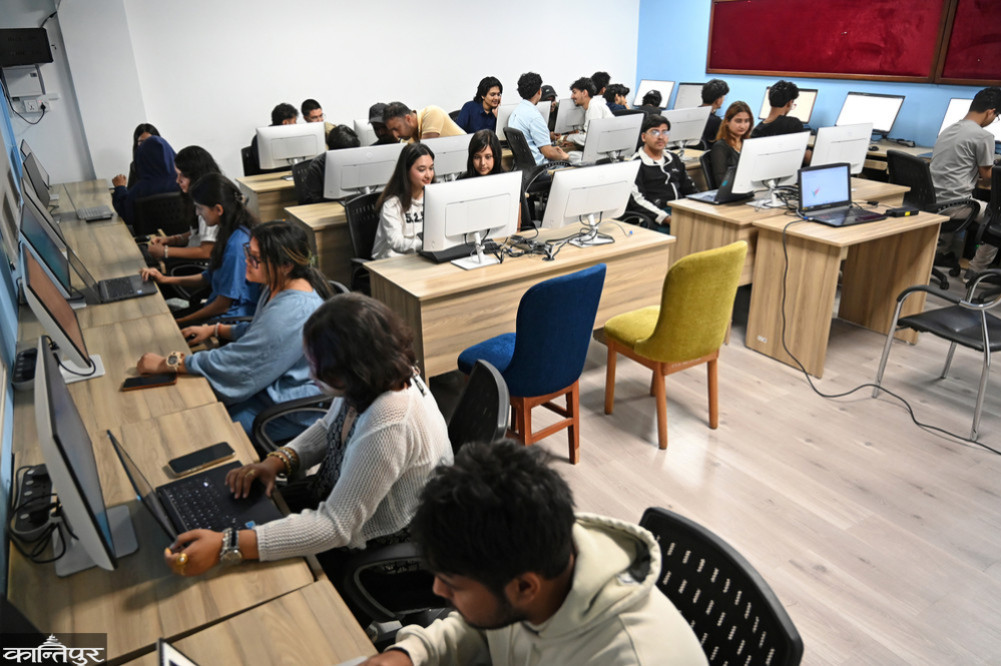
Today's students are becoming completely dependent on AI. This will have a negative impact on the research culture. The misuse of AI is increasing the risk of academic plagiarism, production of unfounded content, and the spread of fake information. Therefore, AI is a supporting tool, not a substitute.
We use Google Cloud Translation Services. Google requires we provide the following disclaimer relating to use of this service:
This service may contain translations powered by Google. Google disclaims all warranties related to the translations, expressed or implied, including any warranties of accuracy, reliability, and any implied warranties of merchantability, fitness for a particular purpose, and noninfringement.
Nepal's education system is directly linked to time, society, culture and political changes. The Nepali education system, which started from the ancient Gurukul tradition, has today reached the era of Artificial Intelligence (AI), digital technology, online learning and global information flow. This clearly shows that education is not just a means of imparting knowledge, but also the foundation of nation building, social change, economic development and modern civilization.
In today's era, if education cannot be advanced by linking it with AI, digital systems and technology-friendly systems, there is a danger that Nepal's educational development may lag behind in global competition. Therefore, it is necessary to re-analyze Nepal's education policy by linking it with history, current needs and the digital world of the future.
In the present situation, education is not just a process of acquiring knowledge, it is also linked to the ability to select and analyze knowledge. Today, many countries in the world have made AI-based education a national priority. China, America, South Korea and India have already included digital literacy and AI education in the curriculum from the school level. In such a situation, Nepal also needs to coordinate with the global trend.
The tradition of giving and receiving education in Nepal began with the Gurukul system. In the Gurukul system, students would stay in the ashram of the Guru and acquire knowledge related to moral education, religious education, Sanskrit, Vedas, philosophy, astrology and social conduct. At that time, the aim of education was not only to get employment but to prepare cultured, disciplined and responsible citizens. During the Lichchhavi period, schools like Devkul, Rajkul and Pitrukul were in operation. Maths, temples and ashrams were the centers of education. This shows that there is a deep connection between education and society. During the Malla period, efforts were made to develop vocational and skill-based education. Jayasthiti Malla had started a skill-based education system by organizing various professions and businesses. This can be considered the basis of today's technical and vocational education.
After the unification of Nepal, Prithvi Narayan Shah saw education as a means of nation-building, prioritizing national unity, language, culture, and security. The concepts of national consciousness, self-reliance, and practical education are clearly found in his divine teachings. Modern school education in Nepal was formally started in 1910 BS with the establishment of Durbar High School. Jung Bahadur Rana brought modern English education to Nepal after his visit to Britain, and English education entered the Rana era. However, that education was only for a limited class. After democracy in 2007, there were extensive reforms in the education sector. The establishment of Tribhuvan University, the National Education System Plan, the Women's Education Program, and the expansion of technical and vocational education helped lay the foundation for modern education.
In the current situation, education is not just a process of acquiring knowledge, it is also linked to the ability to select and analyze knowledge. Therefore, today's world is not in a position to move forward with traditional education alone. This is the era of AI, robotics, machine learning systems, big data analytics, cloud computing, digital learning systems and virtual education. Developed countries of the world are linking education with digital technology to make students practical, research-oriented and innovative. Students in Nepal are also being attracted to digital technology.
The changing education system has now reached from chalk-dusters to chatbots. Mobile, internet, online media, digital libraries and AI-based learning systems have started taking the teaching-learning process in a new direction. However, access to digital education is still unequal in Nepal. Although some schools and universities in urban areas have adopted digital systems, the lack of internet, computers and technical resources is still a big challenge in rural and remote areas. Students from economically weaker families are still deprived of access to mobile, internet and digital devices. This has created a new type of inequality in education, which is understood as the digital divide.
Today's students are becoming dependent on AI and digital technology. Tools like ChatGPT, Google Gemini, AI-based search systems, online learning media, virtual classrooms, smart boards and electronic libraries are directly connecting students to world-class knowledge. There are many positive aspects to this. Students can get information faster, research has become easier, and they can connect with the world's best teachers and universities through online classes. Digital education has removed the barriers of time and distance. Online education has made its importance even clearer during the COVID-19 pandemic.
However, excessive dependence on AI and digital technology is not without challenges. There is an increased risk of weakening original thinking, creativity and analytical skills in students. Many students have started to completely depend on artificial intelligence while preparing homework, reports and projects. This can have a negative impact on the research culture. In addition, the risk of academic plagiarism, production of untrue content, and the spread of fake information has also increased due to the misuse of AI. The misuse of digital technology, cybercrime, online addiction, excessive dependence on social media, and the flow of misinformation are also affecting the mindset and social behavior of students. Therefore, it is necessary to teach how to use AI as a supporting tool, not as an alternative.
China, America, South Korea, and India have already included digital literacy and AI education in the curriculum from the school level. In such a situation, Nepal also needs to coordinate with the global trend. Nepal's current education policy still lacks practical, technical, and AI-based education. Many educational institutions are still limited to theoretical and exam-centered education. Not enough attention has been paid to making students job-oriented, innovative, and digitally competent. As the world moves toward an AI revolution, Nepal also needs to make its education policy timely. Even though the Government of Nepal has put forward the concept of technology-friendly education through the National Education Policy and Digital Nepal Framework, its effective implementation is still challenging. Subjects such as coding, programming, robotics, data analysis, and digital literacy should be included from the school level. Teachers also need to be made proficient in digital teaching technology. Since many teachers are not yet fully accustomed to the digital teaching system, regular training, technology access, and practical practice are necessary.
Universities in Nepal should emphasize research, innovation, and digital technology-friendly education. Universities should not be limited to being institutions that only distribute certificates. It is necessary to establish AI-based research centers, digital laboratories, innovation centers, and technology promotion centers. Students should be connected to startups, entrepreneurship, and the digital economy. Today, the digital economy is expanding rapidly in the world. It is also necessary to make Nepal's youth competitive in the global digital market.
In the current situation where the trend of skilled manpower migrating abroad is increasing, universities should inspire youth to create opportunities within the country through research and innovation.
Nepal's education system is still weak due to political interference, weak implementation, lack of resources and lack of long-term planning. The participation of educationists, technologists, researchers, teachers, industrialists and students is necessary in policy making. Education should not be just a means of obtaining certificates, but should be developed as a basis for nation building. While using AI and digital technology, equal importance should be given to moral education, social responsibility and human values.
Overall, the history of Nepal's education is a changing journey from the Gurukul system to the modern digital era. Today's need is to maintain a balance between traditional values, national culture and modern artificial intelligence-based technology. Only if Nepal adopts a timely, practical, technology-friendly and artificial intelligence-focused education policy can students be made capable of global competition.
If education is to truly become the backbone of national development, it is imperative to transform it according to the needs of the digital age. 21st century education is not just knowledge limited to books, but also a process of creating conscious citizens who can collaborate responsibly with technology. The power to build the Nepal of the future lies in today's students. And, modern education policies must play a decisive role in making those students capable, creative and technology-friendly.