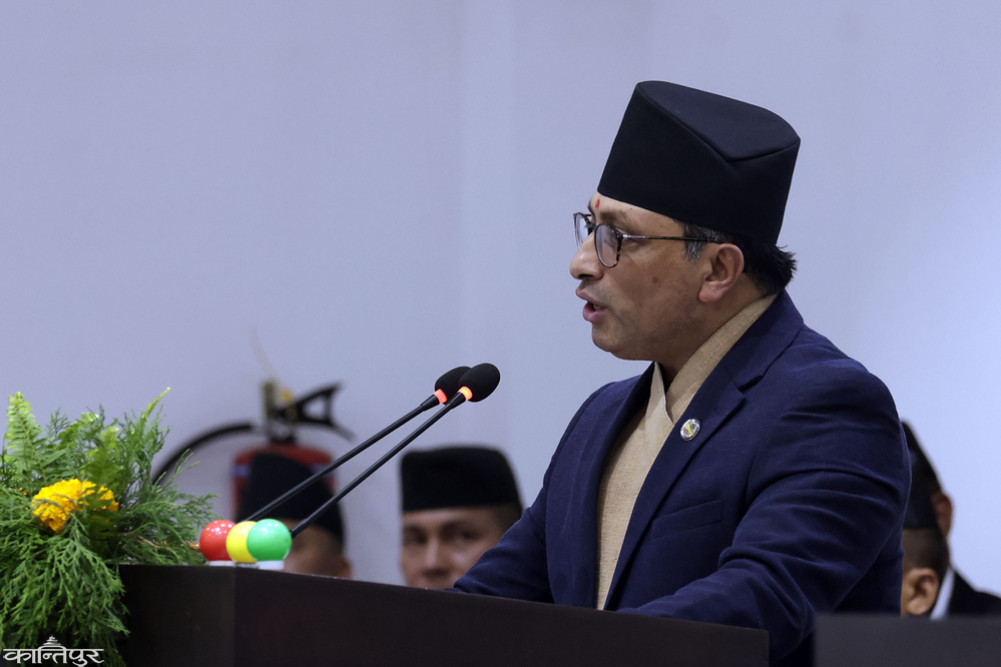
The beautiful vocabulary and the Finance Minister's melodious, rhythmic budget delivery style were certainly 'early-pleasing'. However, a budget that has particularly pleased the wealthy and upper middle class, including employees, businessmen, and public representatives, does not seem to be able to please the grassroots people.
We use Google Cloud Translation Services. Google requires we provide the following disclaimer relating to use of this service:
This service may contain translations powered by Google. Google disclaims all warranties related to the translations, expressed or implied, including any warranties of accuracy, reliability, and any implied warranties of merchantability, fitness for a particular purpose, and noninfringement.
As the new fiscal year is about to begin, the government has presented its estimated income and expenditure through the annual budget. In the budget presented to the parliament for the upcoming fiscal year 2083/84, Finance Minister Swarnim Wagle seems to have mainly emphasized economic, administrative reforms and digitalization of public services.
The government has announced in the budget to build a result-oriented governance system by ‘ending policy confusion, delay, institutional capture and exploitation of state resources’. To achieve this objective, it seems necessary for the government to cooperate extensively with all stakeholders. However, the current working style of the government seems to be reflected in ‘legal dictatorship’ rather than in cooperation.
Some tax reforms made by the government through the budget to make the economic sector systematic and dynamic can be considered positive. The budget's announcements of reforms such as increasing the lower limit of income tax exemption, matching customs and excise duties, calculating capital gains tax as the final tax, abolishing and merging some redundant bodies and departments are positive.
The decision to reduce the number of ministries, cut posts in departments and government offices, abolish 31 central bodies under the government, merge and transfer 6/6 bodies, and restructure 18 bodies can also be considered a good start to administrative reform. However, the decision to reduce the number of ministries seems to have been made in a haphazard manner. The abolition of ministries and departments that directly affect the delivery of services to the people will certainly create administrative confusion and there is a possibility of complications in the delivery of services.
Although it seems that it has done the right thing by increasing the lower limit of individual income tax exemption, the government has violated the essence of the progressive tax system by reducing the tax on upper marginal income. The government, which has announced tax reforms in the guise of a blanket tax, has imposed additional indirect tax burden on the general public by imposing taxes on health, education, and electricity consumption. Despite these reform efforts, the clever manipulation of tax rates and the government's 'selective' approach to tax exemptions and creation of new taxes seem to increase the tax burden on the general public. On the one hand, it seems that it has done the right thing by increasing the lower limit of personal income tax exemption, but by reducing the tax on the upper marginal income, the government has violated the essence of the progressive tax system. The government, which has announced tax reforms in the guise of a blanket tax, has imposed additional indirect tax burden on the general public by imposing taxes on health, education, and electricity consumption.
The Finance Minister has allocated a total estimated expenditure of Rs. 21 trillion 24 billion 340 million for the coming fiscal year. Of which, Rs. 12 trillion 70 billion 580 million or 59.8 percent is for regular (current) expenditure, Rs. 4 trillion 31 billion 100 million or 20.3 percent and financial management (for payment of principal and interest on public debt) is Rs. 4 trillion 22 billion 64 million or 19.9 percent . The budget presented for the coming year is 25.2 percent higher than the revised estimate for the current fiscal year .
The Finance Minister has estimated that Rs. 14 trillion 5 billion 310 million will be received from revenue income for the allocated budget, while Rs. 61 billion 740 million is expected to be received from foreign grants . Thus, reducing the potential income in the total allocated budget will be Rs. 6 trillion 57 billion 290 million less, and it is stated that public debt will be used as a means to meet the financial deficit .
Thus, the Finance Minister has set a target of mobilizing an additional Rs. 2 trillion 47 billion 280 million in external debt and Rs. 4 trillion 100 billion in internal debt for the coming fiscal year . The size of the budget brought by the powerful government with a nearly two-thirds Prachanda majority also seems to be huge. However, the government's strategy in identifying and implementing the sources to implement the budget seems to be inadequate.
If the government does not seem to be able to expand the sources of revenue through the budget, it seems to be thinking of exploiting the existing sources and burdening the citizens with additional taxes to meet the revenue target. Looking at the revenue collection records of the current fiscal year, it is seen that only Rs. 1026 billion 960 million has been collected as of Jestha 15, 2083, while this year's revenue target is Rs. 1480 billion.
This year's revenue income does not seem to reach even Rs. 1200 billion. Therefore, the failure to increase revenue is the most difficult contraction of government finances. The budget has not been able to provide a clear direction in terms of increasing the scope of that revenue. The government does not seem to have been able to identify new sources to increase revenue income, and public debt has been made a means to bridge the fiscal gap between income and expenditure, which is not sustainable and effective management of resources.
According to the report of the Public Debt Management Office, the total public debt outstanding as of Baisakh of the current fiscal year is Rs. 2975 billion 400 million. The government has raised Rs. 365 billion more public debt in Baisakh alone, while the expenditure on debt repayment in the current fiscal year alone is Rs. 231 billion 920 million. This debt repayment amount is almost double the capital expenditure of the current fiscal year.
Ignoring the context where there are many questions being raised about the productive utility of public debt in Nepal and the difficulty seen in debt repayment, relying on debt in budget implementation seems to be adding to the long-term financial burden due to the ambitions nurtured in the budget. These government expenditure and income figures do not show that the scope of the country's revenue income has not been expanded, while the increase in expenditure is still visible, due to which limited resources have become the main thrust of government finances.
In recent years, it has become a tradition to regularly present a large budget and shrink the size of the budget through the mid-term review. This time too, the budget seems to be following the same path. While the government's income estimates have not been proven correct since the past, the frequency of expenditure has not been as per the budget.
The government has stated that it will promote investment, reform the economy, and make policy and legal arrangements to facilitate the delivery of public services. The continuity of the projects being run in the physical infrastructure sector has been maintained, while the previous government has canceled projects that were considered game-changers in some places.
The government has expressed its ambition through the budget to emphasize the use of technology and make the entire information technology sector a new identity for Nepal. However, will its successful implementation and Nepal-made technology be able to find space in the global market? This question remains unanswered.
Because Nepal itself is a country that imports even the most basic equipment required for information technology. Therefore, even if there is some progress in software, there is no scope for Nepal to make any progress in hardware. Therefore, since Nepal's technology sector is also part of the service-oriented sector, it seems that we are far behind in the development of technology that will fundamentally promote entrepreneurship here and be conducive to industrial development.
The government has made public an ambitious plan to start implementing the long-term plan 'Vision Kathmandu, 2040' for the development of infrastructure related to the public sector of Kathmandu. However, implementing 'smart urban mobility' by organizing the existing unorganized urbanization of Kathmandu and arranging suitable vacant spaces seems like a high form of ambition in itself.
The government, which has prioritized the revival of the agricultural sector, does not seem to have been able to put forward a clear roadmap for self-reliance in agricultural production including production and marketing. The government's so-called 'initial capital' for agricultural and livestock production does not lead to production, but there is a risk of a recurrence of the old disease of exploiting subsidies.
Because Nepali agriculture does not recognize the 'corporate' style. The so-called 'corporate agriculture' cannot even change the dynamics of Nepali agriculture. Therefore, if it is considered the basis of agricultural production, it will create the danger of desolation of the lands of millions of poor farmers. The main problem of Nepali agriculture is the availability and marketing of land. However, the government does not seem to have presented a concrete vision in that direction.
The government has announced that it will make new enterprises, innovation and entrepreneurship a strong basis for economic transformation. These issues sound good in theory. However, how will the necessary resources, markets and knowledge be obtained for these tasks? The budget has not mentioned this. Similarly, the budget does not seem to have included a program to increase the contribution of the industrial sector to the economy qualitatively by increasing industrial investment.
In essence, looking at the structure of the Nepali economy, production sectors and the expenditure structure of the government, our economy is not in a position to bear such a large government expenditure. It is a matter of common knowledge that the main problem of the existing economy is the laxity seen in the economy due to structural and policy reasons. Although the government's policy programs and budget talk about structural changes and policy reforms, appropriate programs have not been brought.
The government, which is said to be the most powerful in history, does not seem to have been able to present its vision for the transformation of the economy and budget, including structural reforms, apart from regular economic and administrative reforms. Therefore, there is no reliable basis for the ‘beginning of a new phase of structural reforms in the economy’ as announced by the government through the budget.
The beautiful vocabulary and the Finance Minister’s melodious and rhythmic budget reading style certainly sounded ‘early’. However, the budget, which especially pleases the wealthy and upper middle class, including employees, businessmen, and public representatives, does not seem to be able to please the people at the grassroots level. Therefore, the budget seems to prove hollow for the working class.
The government has identified the ‘need for macro-economic reforms’ in the budget, but it does not seem to have been able to find the path of ‘policy departure’. There is no hope that the implementation of the budget will resolve the existing contradiction between low production and high consumption, which is seen as the main problem of the economy. Therefore, there is concern that the budget, which is plagued by tight resources, will only burden citizens with additional taxes and debt.