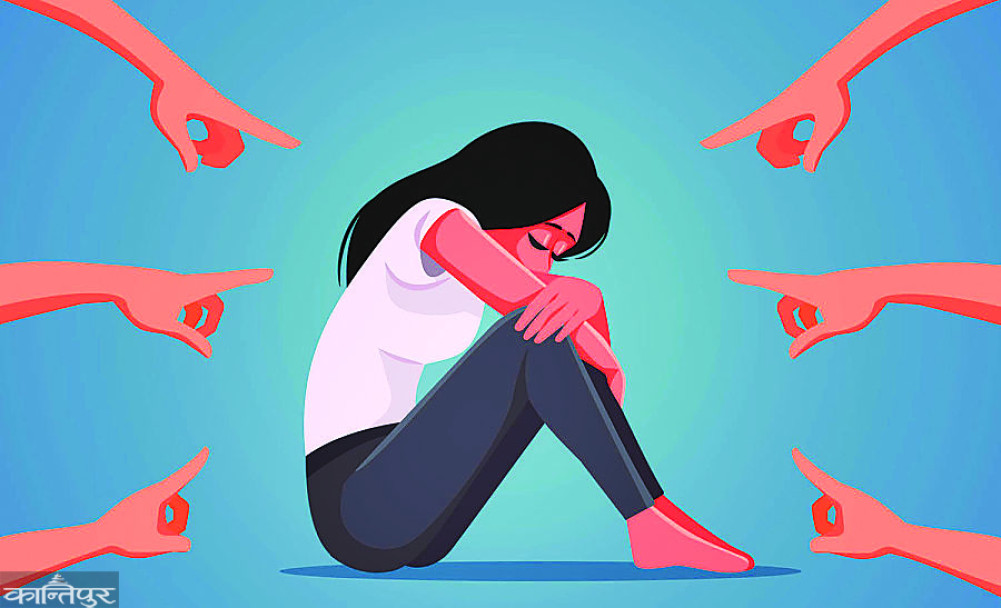
Only when the family provides emotional support, the school creates a safe environment, society reduces unnecessary pressure, and the state ensures structural support, can adolescent pressures be transformed into possibilities.
We use Google Cloud Translation Services. Google requires we provide the following disclaimer relating to use of this service:
This service may contain translations powered by Google. Google disclaims all warranties related to the translations, expressed or implied, including any warranties of accuracy, reliability, and any implied warranties of merchantability, fitness for a particular purpose, and noninfringement.
Sanu Shrestha (name changed), a student of class 10 in a private school in Kathmandu, had not been able to sleep well at night for the past few months. As the exams approached, she could not remember what she had read even though she sat with a book in her hand all day. ‘What will happen to my future if I fail the exams?’ This fear kept haunting her. As a result, she started talking less with her friends and lost her appetite. Not only that, she gradually began to consider herself a failure. Eventually, she reached a point where she could not go to school at all.
A representative character of a school-age teenager is Sanu. Many teenagers studying at the school level are being crushed by similar academic stress, family expectations and social comparisons.
Some time ago, the suspicious death of Nepali student Prakriti Lamsal, who was studying in Odisha, India, raised serious questions about adolescent mental health. After that incident, students even staged a protest, complaining about the insensitivity of the educational institution, lack of security, and lack of mental support. Not only the students directly affected by such incidents, but also other teenagers who hear the news of those incidents increase fear, insecurity, and negative thoughts about the future. In the language of psychology, this is called 'secondary trauma', where even the pain of others disrupts the mental balance of the teenager.
From a psychological point of view, adolescence is a very sensitive developmental stage. During this time, the emotional part of the brain (limbic system) develops rapidly, while the part related to decision-making, self-control, and long-term thinking (pre-frontal cortex) matures slowly. Due to this imbalance, teenagers are more emotionally reactive, sensitive to stress, and easily attracted to anxiety and depression.
According to the World Health Organization-2021, about half of the population has health problems before reaching the age of 14. However, most remain unidentified. Students in grades 8-10 in this age group are at increased risk due to the many stresses associated with exams, results, and the future.
Exam-centered evaluations, negative comments by teachers, public humiliation, and silence on bullying make schools themselves a source of stress. The Global School-Based Student Health Survey-2017 conducted by the World Health Organization and the Ministry of Health and Population of Nepal showed that secondary school students are at increased risk of anxiety, loneliness, and suicidal thoughts. The exam-centered education system creates chronic stress, which disrupts sleep, reduces concentration, and weakens emotional control. Psychologically, this condition is associated with ‘performance anxiety’ and ‘learned helplessness.’
The role of the family is crucial in such a situation for adolescents. Because the family is their first emotional support. Constant comparisons, high expectations, harsh reactions to failures, and lack of communication from parents weaken their self-esteem. This increases fear and failure, self-criticism, and frustration. However, in a family with supportive parenting, there is a culture of listening to children's feelings, considering failures as a learning process, and prioritizing effort over results. Such an environment strengthens the mental resilience of adolescents. According to the World Health Organization-2021, adolescents with an emotionally safe family environment are less at risk of mental problems.
The second strongest foundation for mental health in adolescence is school. However, school itself has become a source of stress due to exam-focused evaluations, negative comments by teachers, public humiliation, and silence on bullying. Psychologically, such an environment creates 'toxic stress', which not only weakens learning ability, but also confidence and mental health. In contrast, schools with positive teacher-student relationships, teachers who are aware of mental health, counseling services in schools, and anti-bullying policies can provide emotional security to adolescents.
The role of society is also equally helpful in creating mental stress in adolescents. Because in Nepali society, there is still a tendency to see success only in terms of the high marks a student gets, the good college he gets admitted to based on that, and the prestigious job he gets after his studies. Comparisons and comments from neighbors, relatives, and social media keep him under constant 'performance pressure'. In psychology, this is called 'social comparison stress'. This stress weakens self-image.
According to the Journal of Adolescent Health-2019, social rejection, bullying, and humiliation can cause depression and even suicidal thoughts in adolescents. Therefore, society needs to develop a culture that considers adolescent failures as a learning process, not a stigma. The role of the state, media, and health system is equally important in this. The state needs to include mental health in education policies from the school level, provide adequate counselors in schools, and expand adolescent-friendly mental health services. The media should present sensitive issues like student deaths or suicides in a responsible and solution-oriented manner, not sensationalism.
According to the journal 'The Lancet' published by the UK in 2023, investing in the mental health of adolescents at the primary and secondary levels has a positive impact on learning, productivity, and social stability in the long term. When the family provides an emotional foundation, the school creates a safe environment, society reduces unnecessary pressure, and the state ensures structural support, only then can the pressure of adolescents in grades 8-10 be transformed into potential. Therefore, investing in their mental health is an investment in the future of the country.