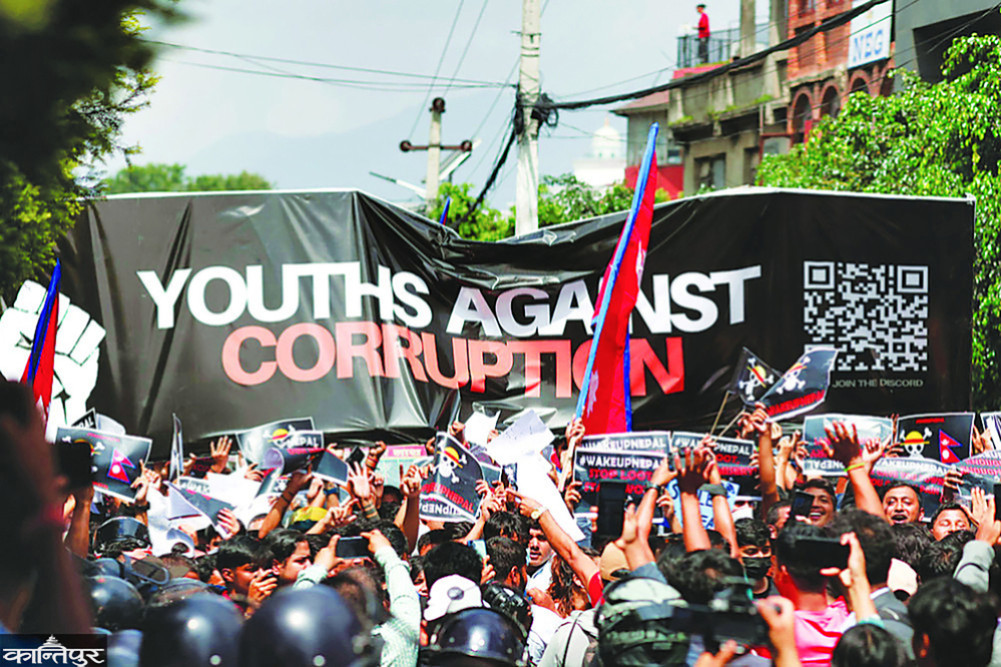
Only when youth leadership emerges from the virtual world of social media and starts working with ground realities, legal complexities, and long-term plans will the creation of a new and prosperous Nepal envisioned by the 'Gen-G' movement be possible.
We use Google Cloud Translation Services. Google requires we provide the following disclaimer relating to use of this service:
This service may contain translations powered by Google. Google disclaims all warranties related to the translations, expressed or implied, including any warranties of accuracy, reliability, and any implied warranties of merchantability, fitness for a particular purpose, and noninfringement.
Nepal has gone through many turning points in the name of political transformation. One of them is the Gen-G movement. It brought about a great stir in the thinking and consciousness of Nepali society. Building on the foundation of this movement, the country went to the polls.
In the past, politics was mainly the center of gossip and debate among the middle-aged and old. The young generation was disappointed with politics. They would queue up to get a passport for foreign employment. Alternatively, they would become fanatical activists of a party and throw stones and shout slogans on the streets. The youth understood politics as a dirty game of fighting and exercising power. However, the Gen-G movement changed the old narrative. It is understood that this generation has awakened a new, creative and strong participatory consciousness towards politics. Today's generation is not ready to get involved in the traditional, empty and emotional slogans of the old parties. They have started believing in result-oriented politics rather than the chatter of 'ideas' and 'principles'. For them, politics is not about speeches but about clear development, quality employment, accessible and modern education, reliable health care, good governance and ruthless control of corruption. This is what should be done.
Issues like equality of opportunity, social justice and appreciation of merit are being debated intensely from the streets to social media today. This is also why old and established political figures were defeated in the elections. A large number of young people with new faces and new ideas entered the parliament. It certainly seems to have institutionalized an issue of transformation. But, can it show maturity? There are many doubts about this.
There are serious social and economic reasons behind the sudden political change sought by the young generation.
First, there is the gap between educated youth and limited opportunities. The number of youth in the country is increasing day by day. Employment opportunities were not created according to their qualifications and abilities. Instead, political division and nepotism flourished.
Second, the trend of ‘me and mine alone’ became dominant. The extreme corruption seen in the old parties and leaders and the tendency to feed only the family and faction with state resources created resentment among the youth towards the old power structure. Which they also called ‘nepotism’.
Third, the crises of daily life deepened. The commercialization of education, the high cost of health, and the hardships they had to face while going to seek administrative services made the youth tired. The irresponsibility of the bureaucracy, especially in the service sector, added fuel to the rebellion.
Fourth, Gen-G has digital media and global access. This generation is at the forefront in accessing the internet and global structures. They watched on their mobile screens how other countries in the world developed, how they improved the living standards of the people using technology and how they established the rule of law. The learning and impact of this made them realize the importance of social justice, gender equality, inclusion, good governance and transparency. They chose the same path of change in Nepal too.
The youth and Gen-G movement has become a common wave worldwide and especially in the South Asian region, which seems to have even challenged or tried to overthrow the established and powerful power. However, while the world politics, development series and hunger for change are increasing, has there been an attempt to observe geopolitics and its impact? This is another question.
Nepal has a young Prime Minister Balendra Shah. The ruling Rashtriya Swayamsevak Sangh (RSS) is chaired by Ravi Lamichhane. Other ministers and MPs also seem to be young. This has created great enthusiasm and waves in politics. Is this wave alone enough for long-term change? This is the most serious question today.
Gen-G and the youth have energy, technological knowledge, and a strong will to change the country, as well as many possibilities. However, they clearly lack political and administrative experience. Making a wave in politics for a short time and running a state for the long term are different matters. Many revolutions and movements in the past were individual-centered and could not be institutionalized. The wave of a popular person can certainly help win elections or gather a crowd for a while. If there is no strong ideological and organizational foundation behind it, such a wave can collapse at any time.
Kejriwal's Aam Aadmi Party in India is the latest example of this. There are many examples in the political history of the world of political forces that have emerged in waves and disappeared in a short time.
It seems that for long-term success in politics, one must be serious about some important aspects. It is not always the case that elections are won only by the craze of social media. A strong organization connected to the grassroots from the ward level to the national level and a mechanism of trained workers are needed. Such a mechanism is not enough, a thread connecting them with the dimensions of development and employment must be mandatory.
Decision-making processes should not be individualistic. A party or movement should not be guided by a single 'celebrity', but should be run through a process based on a transparent and democratic system. The unnatural change seen in the MPs of the Rashtriya Swayamsevak Sangh (RSS) after winning the elections and coming to power has added excitement and concern. It seems that the Gen-G supporters themselves have started to disagree with the activities of the government and ministers. This is a serious issue.
Many young people want change overnight. But running a state is a very complex, legal and bureaucratic process. Deep legal and structural reforms are needed to completely eliminate corruption from the country. Foreign investment, establishment of industries and stability of economic policies are needed to create jobs. It takes years to see results. Improvements in the education and health sectors are also possible only through long-term continuous investment and planning. It is not immediately possible to change the government's work style and the bureaucracy that has been entrenched for decades in one fell swoop.
Therefore, the country's real and long-term politics is a responsible, serious and patient journey, very different from the momentary viral speeches on social media or the 'clips' of TikTok. Considering this aspect, a favorable policy and operational balance seems indispensable to remove systemic hassles from the grassroots level. If the parts are not correct and healthy, the rush to reach the destination quickly can lead to an accident in the state's running vehicle.
Finally, the political storm brought by Gen-G and the young generation in Nepal was welcome and inevitable. It has also put great pressure on the old parties to correct themselves and the new ones to move forward. With the political interest seen in young children and the increasing participation of the youth, it can be hoped that the future of Nepal is going into the hands of a beautiful and conscious class.
The new generation must also understand that enthusiasm without democratic maturity and policy knowledge can only turn into anger. Youth must be able to combine their mobility and the power of technology with serious study of institutional organization, legal literacy, and state governance. When youth leadership comes out of the virtual world of social media and starts working with ground realities, legal complexities, and long-term plans, only then will the creation of a new and prosperous Nepal envisioned by the ‘Gen-G movement’ be possible.