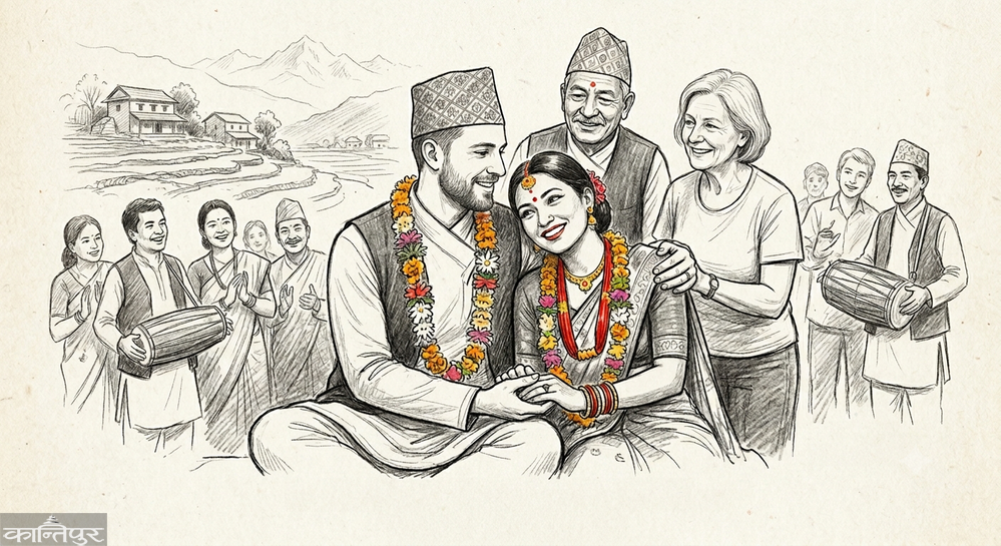
How favorable is it for a woman or man married to a Nepali to choose Nepal? Why doesn't the state adopt liberality and amend oppressive laws in the case of foreign spouses and children of Nepalis?
We use Google Cloud Translation Services. Google requires we provide the following disclaimer relating to use of this service:
This service may contain translations powered by Google. Google disclaims all warranties related to the translations, expressed or implied, including any warranties of accuracy, reliability, and any implied warranties of merchantability, fitness for a particular purpose, and noninfringement.
Millions of Nepalis have reached different corners of the world for employment, education and migration. Due to the attraction of tourism, the arrival of foreign tourists to Nepal is also equally intense. Increasing international travel and cultural proximity have tied the relationship between Nepali and foreign citizens to the thread of marriage. This has created a new wave of international marital relations in Nepali society.
After a marriage between a Nepali and a foreigner, the couple has to choose a country to establish a family and make it a permanent residence. The decisive factor for this is the 'suitability' of residence. It is natural for the couple to choose that country which is more welfare-friendly and where there is easy access to basic public services such as residence, business, employment and health, education. How favorable is it for a couple marrying a Nepali to choose Nepal? Or, how favorable has Nepal created an environment for such families to live here? What is the legal and practical environment here in the context of this burning question? What is the reason for this?
How is Nepal's compatibility? To understand that, let's look at the experiences of two Nepalis who married foreign spouses:
1. A friend working in an international organization abroad says – I married a Taiwanese woman while studying abroad. After that, I decided to stay in Nepal. Due to the harsh laws and practices here, I could not keep my wife and children together even if I wanted to. Finally, I gave up and arranged for my wife and children to live in her country. I said that I have the privilege of going, living and enjoying the facilities in her country.
2. Another friend says – My husband from a European country was working in an international organization in Nepal when we got married. He had a child here and grew up. Even after getting a birth certificate, he was forced to leave his grown-up children behind and come to her country. They say 'Nepal is the motherland' but to come here, you have to pay a fee and get a visa. It's not that I didn't have the opportunity to go and live in their country, but because I liked Nepal and my job was in a private organization, I decided to stay here. Later, after my husband's job contract ended, I was unable to get a work permit and had to live unemployed. Having to pay his visa fee continuously is financially difficult and the family is not able to live together.
Both these families have the same complaint - our husbands, wives and children are treated like foreigners. Not only are they not allowed to work anywhere, they are also charged a fee in dollars like other foreigners to enter the Durbar area of the valley even after showing their marriage registration certificate. They are not even allowed to open a bank account in their name and they were finally able to open a joint account. Wherever they go, they have to beg for mercy, beg for mercy, and their family is torn apart.
It is clear from the above examples – how is the country suitable for such families? Except for cases of direct foreign investment or citizenship, restrictions on getting employment in any field, formal or informal – adding property, opening a bank account, obtaining a driver's license, paying the same price as Nepalis in airfare, etc., have made it difficult for foreign spouses married to Nepalis to live a decent life without rights in Nepal. They have not been able to feel Nepal as their 'home'.
At the individual level, Nepali-foreign relations appear cordial. However, it is surprising that the behavior and legal system of the state towards foreign spouses of Nepalis is not only different, but also appears to be institutionally sadistic and xenophobic (perpetrators and foreign perpetrators). Our policies and laws and the behavior of the bodies and officials that implement them are not only tormenting one person, but also the entire family.
Available facilities
According to the current legal system of Nepal, there are two options available to foreign wives or husbands who are married to Nepalese. First, access to ‘(marital) naturalized citizenship’ for foreign wives and second, a ‘non-tourist visa’ for foreign wives who do not want to acquire such citizenship, which costs $15 per month. According to the Constitution of Nepal-2072 and the Nepal Citizenship Act-2063, the option of ‘access to citizenship’ available only to foreign wives appears to be unequal between foreign spouses in terms of human rights and gender, but it is generally accepted that the geopolitical situation of Nepal does not allow otherwise. The demand that the option of citizenship should also be available to foreign husbands is secondary, but the option has not been given.
Access to citizenship for foreign wives is theoretically an excellent solution. As positive and generous as it may seem, it is practically equally complicated. To obtain Nepalese citizenship, one must necessarily renounce one’s previous citizenship. Therefore, to enter the mother country later, one must obtain a visa on a Nepali passport. And, since there is no guarantee that it will be obtained easily for Nepalis, one may have to face problems. That is why foreign wives are reluctant to give up their citizenship and acquire Nepali citizenship. It seems that only Indian women who marry Nepalis have taken full advantage of this system. Therefore, the facility of citizenship for non-Indians is almost only superficial.
How many foreign spouses are there?
According to the data of the Ministry of Home Affairs available from 2009 to 2079 Bhadra, a total of 416,549 have been distributed, and most of them were taken by Indian wives, but the exact number of non-Indians has not been provided. Similarly, the annual report of the Immigration Department for the four years from 2020 to 2023 has mentioned that five thousand more (5,244) visas were granted to foreign spouses from about 90 countries to enter Nepal. Even if some of the visa applicants are re-applicants, the number of foreign spouses of Nepalis other than Indians seems to be limited to a few thousand. If some have not come to Nepal or have not obtained a visa, this number could be even higher. How many of these are men and how many are women? The exact figures have not been made public.
While the ‘Non-Resident Nepali Association’ also states that Nepalis are present in 90 countries, it seems that Nepalis have marital relations with almost every country they have visited. The countries that have issued the most marriage visas are the US, the UK, Japan, China and the Philippines in fifth place, while the countries that have issued only one visa each are Fiji, Honduras, Liechtenstein and Papua New Guinea.
Historical background
If we look at the modern historical background of the state’s treatment of Nepali foreign spouses, Nepal is seen to be on a reverse and backward journey from liberality to harshness. In the past, at least foreign wives were provided with a ‘free and unlimited’ marriage visa under the Foreigners Act-2015 and its Regulations-2032. When the current ‘Immigration Act-2049’ and the ‘Immigration Regulations-2051’, which replaced the said Act and Regulations, were implemented, the facilities they were getting under the old regulations were cut and visa fees were imposed. After that, many foreign wives who were enjoying that facility had to appeal to the Supreme Court. The Supreme Court issued an order saying that the facilities they were enjoying should not be cut, ‘the facilities already obtained under the old law should be continued/enforced according to the conditions of receipt,’ and the rights of foreign wives were restored.
Since they had already received such free visa facilities, they lost them, but after the new regulations were issued, the visa fee became mandatory for married foreign wives. At that time, the arrangement of having to pay $20 per month ‘created difficulty in even maintaining a family’ and other When a Chinese foreign wife filed a case claiming that she was not entitled to the same exemption as
(old) was against the right to equality, the Supreme Court held that ‘since the law-makers can consider such a matter while making laws and make necessary provisions to exempt visa fees for such foreigners, such a matter cannot be the basis for issuing a writ petition’ in 2056 BS in the case of Xue Hua Shrestha v. Ministry of Home Affairs, Decision No. 6838, the issue of making laws falls within the purview of the legislature (and the government). And, when the judiciary made its limitations clear, those bodies never reconsidered for reform except for revising the visa fee.
‘...the influx of foreign women into Nepal has been observed to be high and there is also an intention to make visa fees free through marriage but to evade visa fees by engaging in other professions without giving up foreign citizenship... so as not to adversely affect the revenue received from foreign tourists...’ The Immigration Department’s argument that the visa fee has to be imposed seems questionable, contradictory, and against the principle of basic human rights. Linking marital relations with revenue and tourism cannot be an indication of a welfare state, but rather those who abuse it should be brought to justice.
International Practice
The policies and laws of South Asian countries, including ours, which do not openly encourage green cards or permanent residency (permanent residence) and subsequent (naturalized) citizenship, appear to be stricter than those of developed Western countries. Other SAARC countries, except Bhutan, have made extensive and simple legal arrangements to facilitate the movement, settlement, investment and access to services of non-resident citizens, their families and foreign spouses of citizens in their countries. These arrangements are conditional, according to which foreign spouses get easy access to the facility of settlement and basic rights without giving up their previous citizenship and without acquiring the citizenship of these countries. In addition, Sri Lanka, Bangladesh and Pakistan have also recognized dual citizenship.
Solution
The question is – should a favorable environment be created for families with foreign wives and foreign husbands who do not want to acquire citizenship for the aforementioned legitimate reasons to settle in Nepal if necessary or should they be forced to migrate? The last census has shown that Nepal's population growth has been negative. A policy should be adopted to prevent Nepalis with such family structures from migrating and keep them in Nepal. Only 1.4 percent of Nepal's population is naturalized by marriage and the number of marriage visas issued in the thousands is insignificant in terms of demographic proportions. There is no reasonable reason to skimp on the provision of a visa or permanent residence with basic rights for a permanent member of a Nepali family. Nepal has already made extensive liberal arrangements for foreigners, non-resident Nepalis, or former Nepalese citizens who have invested large amounts of money. It is also necessary to adopt liberality and provide concessions through amendments to the oppressive laws for the foreign spouses of Nepalis and their children.