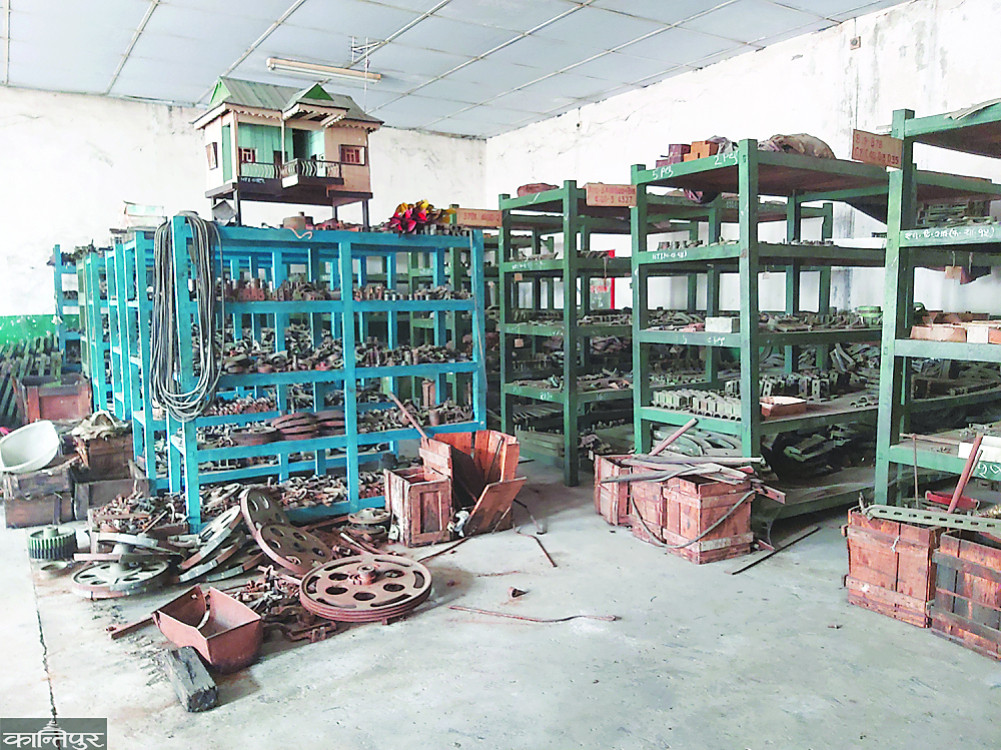
When soldiers, employees, and students wear Hetauda clothing marked 'Made in Nepal', Nepal will truly lay the foundation for a self-reliant economy.
We use Google Cloud Translation Services. Google requires we provide the following disclaimer relating to use of this service:
This service may contain translations powered by Google. Google disclaims all warranties related to the translations, expressed or implied, including any warranties of accuracy, reliability, and any implied warranties of merchantability, fitness for a particular purpose, and noninfringement.
When examining the self-respect and industrial history of the Nepali economy, the Hetauda textile industry within the Hetauda industrial zone appears as a living mirror. On the one hand, this mirror provides a golden reminder of our past self-reliance, and on the other hand, it also presents a low-level picture of policy deviation. Established on 16th Shrawan 2032 BS with the financial and technical support of the government of our friend China and starting commercial production in 2035 BS, this industry was once the industrial backbone of Nepal. This historic industry, which has been operating profitably for about 19 years since its establishment, had an internal capacity to produce 125 million (12.5 million) meters of cloth annually.
At its peak, this industry provided direct employment to more than 1,200 Nepali citizens. The industry also guaranteed housing, health, and education of its children to workers and employees. Therefore, the economic and social living standards of the workforce working here at that time were very strong and respected. However, due to political interference in the country, the disease of recruiting more party workers than necessary, failure to modernize technology in a timely manner, and over-politicization of trade unions, this glorious industry fell into a whirlpool of crisis. Finally, its production was permanently closed due to the suicidal government decision of 18 Magh 2057 BS.
Industry Minister's visit: New hope and confidence
Past mistakes are lessons of history, which show the way to the present. The recent on-site visit and inspection by the Minister of Industry, Commerce and Supplies at the premises of the Hetauda Textile Industry, which has been almost dead for a long time, has sparked a new debate on indigenous production and industrialization in the country. He has announced that the government is determined to revive this ailing industry by carefully studying the machines and physical infrastructure of the industry and will manage concrete policies and financial resources in the near future. That has instilled strong trust and hope in the government among the common citizens. Industrialists, farmers and well-wishers of the economy are optimistic that the minister's activism and policy-level hustle will truly revive this industry, which has been buried under a pile of promises.
Bananas of the Terai, Allo of the Hills and Lokta
In the past, this industry, which was based only on traditional cotton, should now be revived with an 'eco-friendly' and multi-dimensional model suitable for the 21st century. The strategic concept of 'farm to factory' should be implemented to link the revival of the Hetauda textile industry with the geographical diversity of Nepal and the value chain of the agricultural sector.
There is a large number of farmers cultivating commercial bananas in Chitwan, Nawalparasi, Sunsari, Jhapa and other districts of the Terai. After the banana fruit is sold, its disposal is now becoming a challenge for farmers in terms of waste and management. Hetauda textile industry can collaborate with small-scale industries that extract fiber from banana stalks by introducing modern technology. The fabric made from banana fiber is environmentally friendly, cool and can be sold at a high price even in the international market. This will provide additional economic benefits to the banana farmers of the Terai even from the waste material.
Allo and Lokta, which are naturally found in the hilly and mountainous regions of Nepal, are our indigenous raw materials. Allo fiber is considered the strongest and most unique natural fiber in the world. Hetauda textile industry can collect Allo and Lokta yarn by establishing 'backward linkages' with rural women, forest user groups and local cooperatives in the hilly regions. The garments produced by mixing the yarn with cotton yarn can establish Nepal's original brand in the global market. And, it creates a large number of local self-employment in the hilly regions. .
Production campaign
Nepal is currently importing over 60 to 70 billion rupees worth of textiles and ready-made garments annually through legal and illegal channels. This has created huge pressure on the country's trade deficit and foreign exchange reserves. If the Hetauda textile industry is operated at full capacity and produces textiles based on indigenous raw materials, then billions of rupees of imports of the country will be directly replaced in the initial stage.
To ensure a market for the produced textiles, the state should adopt a three-point mandatory national policy:
1. Legally guarantee that the annual uniforms of millions of personnel of the Nepal Army, Nepal Police and Armed Police Force will be made only from fabrics produced by the Hetauda textile industry.
2. Enforce the rule that civil servants, corporate personnel and every person holding public office across the country must wear clothes produced only by Hetauda textiles.
3. A policy should be made to supply the necessary clothing for millions of students in government and private schools and universities across the country from this industry.
When fiber is extracted from banana trees in the Terai fields and when allo is collected on the slopes of the mountains, the rural economy is greatly stimulated. There should be no delay in translating the strong will and confidence shown by the Minister of Industry into a technical and economic action plan. When soldiers, employees and students wear Hetauda clothing marked 'Made in Nepal', Nepal will truly lay the foundation for a self-reliant economy.