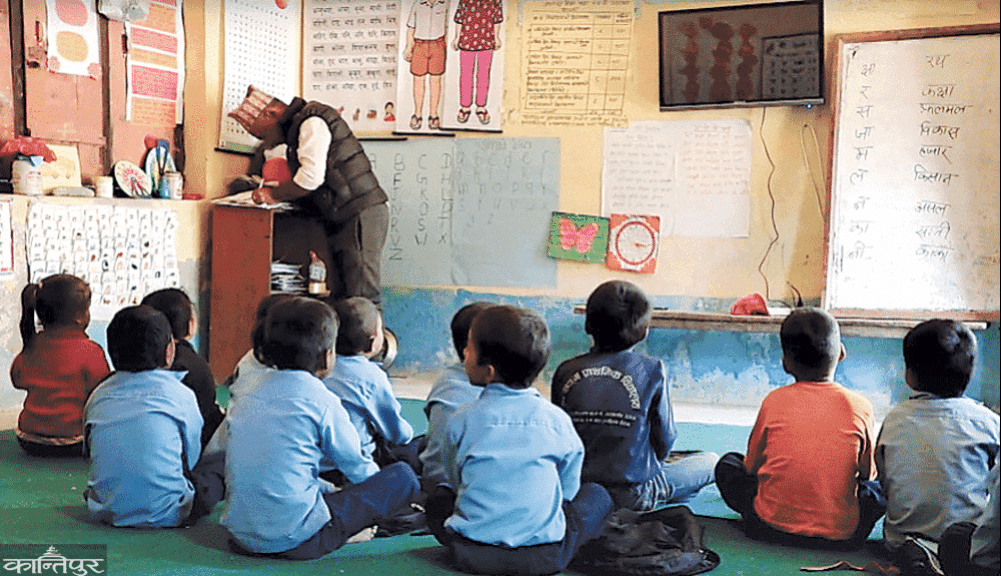
The classroom should not be just an administrative structure for delivering information and preparing for exams. It should be a culturally supportive environment connected to the student's life, language, community, and experiences.
We use Google Cloud Translation Services. Google requires we provide the following disclaimer relating to use of this service:
This service may contain translations powered by Google. Google disclaims all warranties related to the translations, expressed or implied, including any warranties of accuracy, reliability, and any implied warranties of merchantability, fitness for a particular purpose, and noninfringement.
(Aikland is an Associate Professor at Ekland University, Norway. She has been working directly and indirectly in Nepal's educational development for three decades.)
There has been a long-standing debate about the reform of Nepal's educational curriculum. While there is no dispute that curricula from schools to universities should be adapted to Nepali soil, there is a lack of a solid policy framework and strategic plan for this.
Nepal's education system has been influenced by foreign models, international standards, and examination-centered structures built in an external environment. While these reforms have been brought about with positive intentions to a large extent, one serious question remains unanswered. Has Nepal's education system truly been able to represent the lives, values, experiences, and aspirations of Nepali teachers, students, and the community?
The classroom should not be just an administrative structure for providing information and preparing for exams. It should be a culturally supportive environment connected to the lives, language, community, and experiences of students. A problem-centered approach seems to have long dominated Nepal's teacher education, research, and educational policies. This approach has tended to view teachers, communities, and local culture as obstacles to reform implementation, not as sources of development. Most of the debates and research in the education sector have focused on finding failures. In particular, they have focused on the questions of why reform initiatives have not been successful, why student outcomes have been poor, and why teachers have not adopted new methods. But not enough attention has been paid to the cultural and social aspects that form the real foundation of education. The biggest crisis facing Nepal's education system today is the gap between the classroom and local life. Our study of the lives and experiences of Nepali teachers in different districts deeply exposes this crisis.
The ideals, beliefs, and professional activism of Nepali teachers should be deeply connected to Nepal's own cultural and historical foundations. Teachers are not just mechanical characters who make students pass. Their approach to education should be influenced by life experiences, social relationships, community values, and philosophies. Problems arise in Nepal's education system when educational reform plans do not address or ignore the root causes of the problem. When teaching methods, curricula, and educational structures are not related to teachers' own values and experiences, the teaching process gradually becomes mechanical. Teachers begin to experience reform as external pressure rather than an opportunity for change. Then the classroom is transformed from a place of creativity and life experience to a place of mere rule-following. Local knowledge, customs, and experiences are gradually pushed to the sidelines.
Nepal's educational reform plans and education policies need to be tailored to the Nepali soil and culture. The education system needs to be adapted to the needs of the community. Moreover, Nepal's education needs to be determined from its own cultural, social, and philosophical foundations. This thinking should be at the center of the debate on local pedagogy and the curriculum should be determined.
Local pedagogy does not mean rejecting modern education, science, or global knowledge. It does not seek to isolate Nepal from the world. Rather, its aim is to make education relevant by communicating global knowledge with local realities.
Nepal has its own rich educational tradition. The Gurukul system, Buddhist philosophy, oral tradition, agrarian life, collective responsibility, and community-centered learning have formed the historical foundation of Nepali education. These traditions emphasize not only academic achievement, but also moral development, self-discipline, emotional maturity, social responsibility, and teacher-student relationships. These values are still very relevant today.
When lessons are connected to local contexts, education becomes more meaningful, effective, and transformative. Today, for many young people in Nepal, education is becoming more like a means to go abroad than a basis for nation-building. The competitive and examination-centered system has created a mindset that success means being able to leave the country. For many students, the knowledge and experiences they gain are not connected to local life, opportunities, and communities. This situation has called for serious self-reflection in Nepal's education system.
If education fails to connect students to their own society, history, and identity, there is a danger of creating emotionally alienated generations in the future. Globalization has brought opportunities, but with it has also increased pressure to abandon one's roots. Therefore, empowering local perspectives in education is not just an emotional urge, but also a national necessity.
Education is never culturally neutral. Every education system carries answers to the profound questions of what is a good life? What knowledge is valuable? And what kind of society should be built? Nepal's cultural tradition has developed its own rich perspective on these questions. The tradition of linking teacher-student relationships, self-discipline, coexistence with nature, and practical responsibility to education can still provide important educational guidance today. Instead of dismissing these traditions as outdated or irrelevant, the debate should focus on how they can be connected to modern education.
Local curriculum development or educational reform cannot succeed by ignoring local social and cultural realities. Policymakers must no longer simply impose uniform structures, but build frameworks that respect local languages, knowledge systems, and community experiences. Creativity, critical thinking, and innovation develop by connecting with identity, not by erasing it. The same applies to teacher education.
Traditional teacher training programs often seem disconnected from the lived experiences and cultural backgrounds of students and teachers. Curricula and teaching methods are constructed outside the actual social context of the classroom. Teachers are trained to teach content, but there is little experience in Nepal of giving them sufficient opportunity to ask questions about how to connect education to their own community, values, and identity.
The local education classical approach places teachers' experiences and cultural contexts at the center of teacher education. It encourages narrative learning, relevant teaching, and critical dialogue between local and global knowledge. Most importantly, it restores a sense of ownership and respect in the teaching profession.
Educational research also needs to be taken in a new direction. There has long been an attempt to explain Nepal's educational reality through external theoretical frameworks. International perspectives can be useful, but attempts to understand Nepali society through Western concepts alone yield incomplete conclusions. Local research must find conceptual structures within Nepal's own philosophical, social, and cultural foundations.
This question is not just about research methodology. It is also a question of power relations. Who defines educational success? Who controls knowledge production? Who decides what constitutes quality education? If our research is limited to measuring whether external reforms have succeeded, it may ignore the real experiences of teachers, students, and communities. A local perspective seeks to understand the goals, aspirations, and worldviews of those involved in education.
Most importantly, the classroom itself must change. The classroom should not become merely an administrative structure for delivering information and preparing for exams. It should become a culturally supportive environment connected to the lives, languages, communities, and experiences of students. When lessons are connected to local contexts, education becomes more meaningful, effective, and transformative. This does not undermine educational quality. Rather, students can more deeply understand knowledge that is connected to familiar experiences. Giving teachers the freedom to incorporate local contexts makes learning more vibrant and effective.
Nepal’s education system is at a critical juncture today. The reason for this is that the education system here is out of touch with local realities. The path that Nepal must now choose is to build an education system that is based on its own culture but can communicate with the world. The debate on education reform is not just a debate about choosing between tradition and modernity. It is a debate about building a balanced society with social justice and a bright future. Nepal's future education system must enable students to compete in a global society and also connect them to their own identity, history and society. An education system without roots cannot preserve the identity of the nation in the long term.
If Nepal truly wants transformative education reform, it must listen to the voices of its teachers, communities and cultural heritage. Real educational progress is not possible by simply importing external models. That is possible when Nepal starts valuing the knowledge and experience within its own classrooms, communities and traditions.
Local pedagogy is not an anti-progress concept. Perhaps this is the most important way to make Nepal's education system modern, humane and meaningful in the long term.