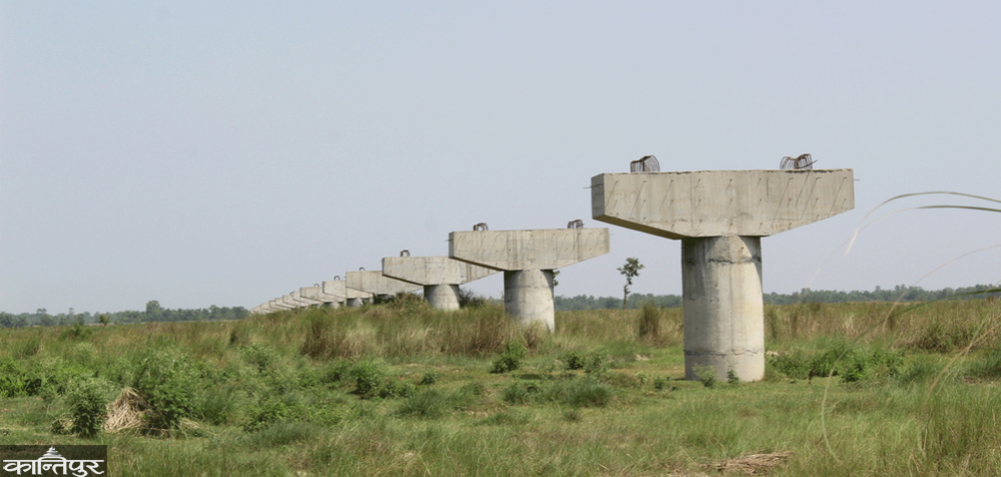
Delays in development in Nepal are not just a technical problem, but also a matter of good governance and political will.
We use Google Cloud Translation Services. Google requires we provide the following disclaimer relating to use of this service:
This service may contain translations powered by Google. Google disclaims all warranties related to the translations, expressed or implied, including any warranties of accuracy, reliability, and any implied warranties of merchantability, fitness for a particular purpose, and noninfringement.
Roads, bridges, drinking water, public buildings and other infrastructure are considered the backbone of development. But, ironically! Most major projects in Nepal are not completed on time. Some projects remain incomplete for decades, while some even collapse before completion. This has not only caused billions of rupees in losses to the state, but has also seriously damaged the trust of the people.
The most famous example of construction delays in Nepal is the Melamchi Drinking Water Project. The concept of this project, which was launched with the aim of providing clean drinking water to the Kathmandu Valley, came around 2047 BS. However, it took almost three decades to complete the project. During this period, 18 prime ministers, 24 ministers and 27 secretaries changed. Due to frequent changes in contractor, political interference, corruption, natural disasters and poor management in the construction of the project, both the time and cost increased.
Billions of rupees have been spent on the Melamchi Project so far. According to some reports, despite spending more than 27 billion, the expected service has not been provided effectively. What is even more sad is that even after it is operational, the problems of bursting pipes, flooding structures, and spending millions on repairs are recurring. This indicates that the 'culture of delay over construction' is becoming stronger in Nepal.
Delays in development construction in Nepal are not just a technical problem, but are also linked to good governance and political will. The situation with road construction is no different. Many national highways in the country have been under construction for years. During the rainy season, mud and potholes force travelers to take risky trips. For example, the Narayanghat-Butwal road expansion project is moving forward only after repeated extensions. Even though the bridge construction has been completed, the overall road expansion has taken a long time.
The quality issue is also serious in many road construction projects in Nepal. Some roads collapse within a few months of completion. The blacktop peels off as soon as the rains begin. This raises questions about the quality of materials used in construction, technical monitoring, and the contracting process. In some cases, the trend of taking contracts at low cost and leaving the work incomplete has become widespread.
Nepal is also facing a big problem in bridge construction. The incidents of some bridges collapsing before their completion have terrified the people. The condition of bridge construction in rural areas is even more pathetic. Even after years of signing the project agreement, not even 30 percent of the work has been completed. There is a similar problem in the construction of public buildings. The state's investment has become idle due to the failure to complete buildings such as government offices, hospitals, schools and stadiums on time.
The main reasons for construction delays in Nepal are multifaceted. The first and most serious reason is political interference. Political pressure is more effective than technical decisions in most development projects. Which contractor will get the work? Who will get an extension? Whose bill will be passed? Political access also has an impact on which contractors will get the work? With the change of government, the project chief, secretary, minister and policies change, so long-term plans become unstable. This weakens the continuity of the project.
The second big problem is corruption. The smell of commission, collusion, and irregularities has been lingering in the construction sector for a long time. In some cases, there is a tendency to get the work done by placing contracts at low prices, later increasing the cost, and compromising on quality. Allegations of corruption are frequently raised from the purchase of construction materials to the passing of bills.
Weak planning and inadequate preparation are also other reasons for construction delays. Some projects are started without detailed study for political announcements or popularity. When the detailed project report is weak, the design has to be changed during the construction process. Sometimes environmental approvals are not obtained, sometimes land acquisition is pending, and sometimes projects are started without ensuring the budget. This creates a situation where work is stopped midway.
Incompetent and irresponsible contractor companies are also a big problem in Nepal's construction sector. Some contractors win many projects at the same time but do not have the necessary manpower, equipment, and financial capacity. As a result, none of the projects are completed on time. Some companies have done some work initially and left the project idle for years. Such contractors get new contracts again due to political patronage.
Late payments and administrative hassles also affect construction work. Construction companies have stopped work due to non-disbursement of funds from government agencies on time. Delays in file processing, approvals, and budget disbursement slow down the pace of projects. When construction companies do not receive payments for months, problems arise in paying workers' salaries, purchasing materials, and operating equipment.
Weak monitoring and inspection is another serious aspect. The government mechanism to monitor the quality of construction work is ineffective in many places. Some engineers and technical staff are even accused of collusion. The lack of regular technical inspections, material testing, and strict evaluation of work progress has encouraged substandard work. As a result, roads collapse within a few months, bridges crack, and buildings have to be repaired before they can be used.
The most worrying aspect is impunity. Strict legal action is rarely taken against contractors who do not complete work on time, build substandard construction, or delay projects. Even if they are blacklisted, they tend to get contracts again through a new name or another company due to their influential access. This has developed a mentality of 'doing the work even if it is not done'.
The tendency to start projects without technical studies has also caused problems. When the detailed project report is weak, the design has to be changed during construction. This increases both cost and time. Projects built without considering the risk of natural disasters have often been damaged by floods and landslides.
Delays in development construction in Nepal are not just a technical problem, but also a matter of good governance and political will. Unless there is a transparent contracting system, strict monitoring, responsible leadership, and a clear system of punishment and reward, examples like Melamchi will continue to be repeated.
Nepal must now enter a culture of ‘completing work rather than starting work’. Development projects should not be seen as a means of political propaganda, but as a means of improving the living standards of the people.