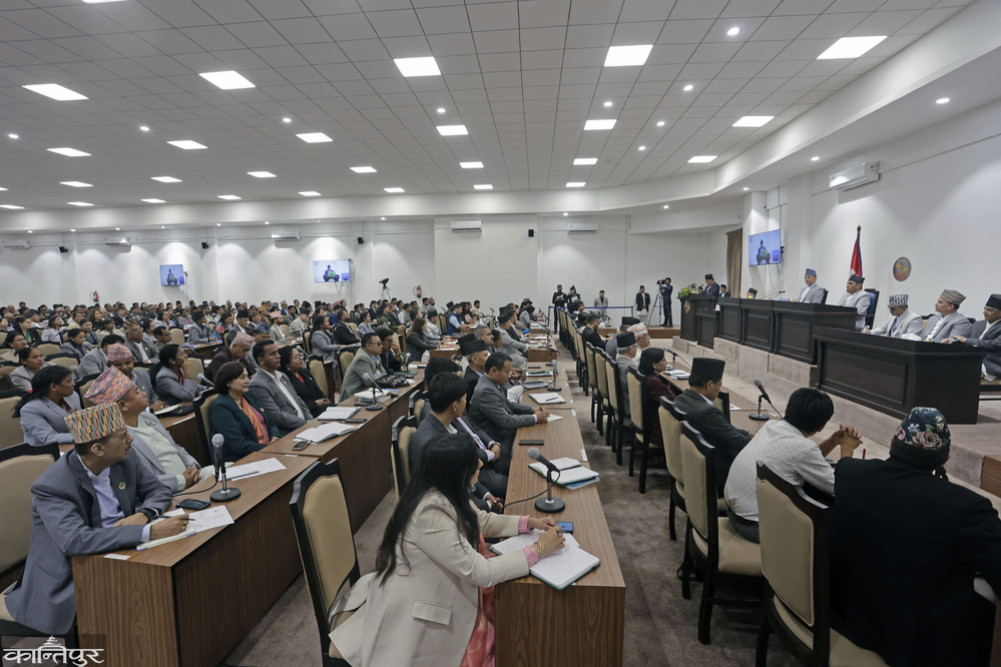
Whether in the ruling party or the opposition, if women parliamentarians are not vigilant and cooperative on common issues of women's rights, the rights they have acquired so far can easily be lost. And, the remaining rights cannot be obtained.
We use Google Cloud Translation Services. Google requires we provide the following disclaimer relating to use of this service:
This service may contain translations powered by Google. Google disclaims all warranties related to the translations, expressed or implied, including any warranties of accuracy, reliability, and any implied warranties of merchantability, fitness for a particular purpose, and noninfringement.
At a formal event at the Rashtrapati Bhavan, the then Speaker of the House of Representatives, Onsari Gharti, who was sitting with the then President Bidya Devi Bhandari and Chief Justice Sushila Karki, said, "I have done all the work that a male Speaker does, but as a female Speaker, I cannot do as much as a male Speaker. I have to be more careful, work harder, and do more."
It may seem surprising to hear, but this is the truth. If public office is considered only in terms of 'earning money', then the matter is over. Otherwise, if we are to judge our public office and role, women should be more careful than men in the same position and role. Various experiences, facts, and research have shown that women in public office and role should work harder to judge their 'constituency'.
The task of ensuring rights in the constitution and law and creating a 'dedicated' state mechanism for women was not easy yesterday, and it is not easy today either. For this, women affiliated with various political parties have written these rights in parliament by putting their positions and responsibilities at stake, collaborating with rights activists from other parties and civil society, 'dialogue' with their male counterparts, sometimes fighting, sometimes together. The 'constituency' of women MPs is not only that of their elected constituency, but of all Nepalis. The job of making laws, monitoring the work of the government, and raising their voices on issues of public concern is the responsibility of all MPs. All MPs, regardless of class, gender, community, and geography, must shoulder these responsibilities. However, the constitution has made provision for representation of backward classes and communities in parliament due to existing caste, gender, and other discrimination in society in certain positions from the same class and community. Based on this provision, one-third of women are represented in parliament today, and the representation of Dalits and other backward groups and people with physical disabilities has increased compared to yesterday. Sensitive issues of women's rights, including inheritance, lineage, participation, reproductive rights, and access to justice, have been ensured in the constitution. Special structures and systems such as the Constitutional Women's Commission, fast-track justice for victims of violence, and the Gender Violence Prevention Fund have been created.
Ensuring rights in the constitution and law and creating a 'dedicated' state mechanism for women has never been easy, and it is not easy today. For this, women affiliated with various political parties have written these rights in the parliament by putting their positions and responsibilities at stake, collaborating with rights activists from other parties and civil society, 'dialogue' with their male counterparts, sometimes fighting, sometimes together. It is the responsibility of the women in parliament now to protect these rights written in the constitution and law through the relentless efforts of senior women leaders, monitor and be vigilant in their implementation, and cooperate vigilantly to obtain additional rights. Whether in the ruling party or the opposition - if women parliamentarians do not remain vigilant and cooperate on common issues of women's rights, the rights obtained so far can easily be lost. And, the remaining rights cannot be obtained.
Learning from history and the present, a mechanism for coordinating women parliamentarians has been created in the regulations of the federal parliament (House of Representatives and National Assembly). However, the question has arisen – are they unaware of the proposal to abolish the Women’s Coordination Committee in the Parliament’s Rules of Procedure and the current female MPs’ unnatural silence on the issue? Are they unaware of this issue or has the relevance of coordination and collaboration among MPs ended? If you think that ‘coordination among women MPs is not necessary’, then it is necessary to read the history of the achievements achieved through collaboration among women once again and understand it from senior female leaders. If, as before, the fear has increased under the male leadership of the so-called big political parties that ‘women will not follow the instructions of the political party if they show solidarity on common issues’, then it should be understood that more coordination and collaboration is necessary among female MPs.
Women’s common issues, collaboration and achievements in history
The democratic movement of 2007 BS, the movement to end the Panchayat system in 2046 BS and establish a multi-party system, the movement for democracy in 2062/63 BS and the establishment of the republic, and the writing of the 2072 BS constitution – women were also active participants in all these political transformation struggles. However, in terms of enjoying the achievements after the political change, history shows that women's issues have never found a place anywhere until joint pressure is created. Every time women from Nepali political parties have felt excluded, they have collaborated and formed a common stance and forced the male leadership to address the exclusion. For example, after the end of the Rana regime, there was zero representation of women in the advisory group that drafted the interim constitution. Only after the women of the then political parties Nepali Congress and Nepal Communist Party jointly protested the zero representation were 4 women nominated to the advisory group. The constitution formed after the establishment of the multi-party system in 2046 BS did not identify and include the issue of giving equal rights to children in ancestral property, despite women's demands. Even then, women from the then political parties raised their voices, fought on the streets, and filed cases in the Supreme Court. The court ruled in favor of women.
Women's rights activists who understood that 'a common ground is necessary for coordination and cooperation' did not try to form a women's group in parliament at that time, but the male leadership did not accept it. In 2057 BS, the 'World Parliament Forum' ruled on the establishment of a forum for coordination among women parliamentarians in the parliaments of all member countries. After that, for the first time, a common forum of women parliamentarians was established in our parliament. That forum played an important role in creating a common understanding on women's rights in the 11th Amendment to the National Constitution (2059 BS) and in creating a clear stance on women's rights in their respective political parties and advocating for it. It should be considered an achievement of cooperation, the 11th Amendment to the National Constitution became very progressive from the perspective of women's rights and gender equality. It addressed, albeit partially, the recognition of women's rights to ancestral property, the right to divorce, and the right to reproductive (abortion) rights for the first time.
Even after the parliament dissolved in 2059 BS was restored in 2063 BS by the strength of the Second People's Movement, coordination and collaboration continued between the women leaders of the then political parties and women parliamentarians. As an achievement, on 2063 BS, a four-point resolution proposal on women's rights was jointly submitted by four people, including then UML MP Bidya Devi Bhandari and then Congress MP Kamala Panta. The resolution proposal, which included the issues of 'ensuring at least one-third women's representation in all state bodies, ending all gender-discriminatory laws, allowing children to obtain citizenship based on their mother's identity, and ending all forms of violence against women', became a major milestone in the direction of establishing women's rights in Nepal in law. Even after the resolution was passed, women were not included in the commission that drafted the interim constitution formed in 2063 BS. Again, women's rights activists from all political parties had to wage a week-long street struggle. Only then did the then political leadership include women in the commission. The women's representation in the same commission made it possible to include the provisions of the resolution proposal on women's rights passed by the House of Representatives in the interim constitution. These four resolutions included in the interim constitution have also been recorded in the current constitution.
In the Constituent Assembly formed in the 2064 elections, a 'Women's Caucus' was formed for cooperation among women MPs. The 'caucus' was an effective mechanism for coordination, cooperation, and collaboration to create a common understanding among MPs about the status, challenges, and prospects of women's rights and a common stance on women-friendly provisions in the constitution and related laws. Therefore, the one-third female representation seen in the legislature today and the increasing participation of women in structures including the executive and judiciary, legal achievements in favor of preventing violence against women, and gender equality being established in the lineage have a long background. At that time, those issues were possible due to the activism and courage of women leaders who took risks in the parliament to coordinate, collaborate, and lead.
In the second Constituent Assembly formed after the dissolution of the first Constituent Assembly, the then female members of the assembly and rights activists did not fail to form a women's Caucus for such coordination and cooperation. However, the male political leadership, who were afraid of the cooperation and coordination among women and the common stance on women's rights, did not allow the 'caucus' to be called 'Sac' and to form such a forum. The fear that ‘if women take a common stand on common issues, they will take away men’s rights, they will take equal rights’ was seen in the then political leadership. This shows that our political parties and leadership are still not sensitive to gender rights and women’s rights.
Lost opportunities due to lack of cooperation between women MPs
There have been calls for a separate mechanism for women’s coordination in parliaments formed after the constitution was made. However, an effective mechanism like that during the first Constituent Assembly could not be created, due to which we lost some important achievements in women’s rights. For example, after the constitution was made, the country got its first female president, and in accordance with the provision in the constitution that ‘the President and Vice President should be of different genders or groups’, a man became the Vice President. Everyone agreed. However, when a man became the President after 2079 BS, all women expected that now a woman would become the Vice President. However, that did not happen. Although it was said in a soft voice that ‘the Vice President should be a woman’, the political leadership and the government formation team elected a man as the Vice President, saying ‘it would be better if he was of a different group’. If the women who were expressing their dissatisfaction separately had come together and taken the stance that ‘we will not give up the rights we have once received, no matter which party we belong to, there should be a woman Vice President’, perhaps the country would have had a woman Vice President regardless of which political party they belong to. And, for the future, it would have set an example that both women and men should always be represented in the posts of President and Vice President. This achievement has been lost today due to the lack of all-party coordination and cooperation among women. And, there is a fear that it has been lost forever.
The author’s own experience in parliament also says that if there were a mechanism for coordination and cooperation among women MPs, regular discussions on women’s rights and a collective stance on common issues, the existing gender discrimination in the citizenship bill could have been eliminated. The issue of imposing/not imposing a time limit when filing a complaint in a case of girl rape, ensuring women’s representation in various mechanisms, pressure for ending violence against women and justice for victims, or advocating for a women-friendly budget and programs, there was room for many improvements through a collective stance in favor of the protection and implementation of any women’s rights. However, the women's power divided in political parties is not able to stand together and take a collective stand on the issue of protecting women's rights. Due to this, the rights obtained are also being lost and the current discriminatory laws have not been improved.
Lessons and the way forward
There are two lessons from the history and events mentioned here. First, laws in favor of women's rights cannot be made without cooperation among women. And it is not enough to make laws in favor of women. Continuous joint vigilance should be maintained for the protection and implementation of rights. Second, male leadership is still not sensitive to women's rights. Many laws related to women's rights written in the constitution have not yet been implemented, but are at risk of being taken away. Therefore, women themselves must be collectively active to protect women's rights. Without an all-party mechanism, women cannot raise their collective voice, and a single stand is not effective. Without a collective stand, there will be no progress in women's rights and gender justice. The same issue applies in parliament. This is also a matter of more interest and concern for women's lawmakers than male lawmakers.
यिनै सिकाइलाई मध्यनजर गरेर नै संसद्को विद्यमान नियमावलीमा ‘महिला समन्वय समिति’ को व्यवस्था गरिएको थियो । समन्वयको यो संयन्त्र केही राजनीतिक दलका पुरुष नेतालाई मन परेको थिएन । त्यसैले योभन्दा पहिलेको संसद्मा महिला नेताको प्रयासका बाबजुद यो समिति कार्यान्वयनमा आउन सकेन । हालको संसद्मा युवा महिला र पुरुषको बाहुल्य छ । राजनीतिक नेतृत्व पनि महिला अधिकारप्रति थप संवेदनशील होला भन्ने लाग्छ । त्यसैले महिला अधिकारको क्षेत्रमा कार्यरत सबैको अपेक्षा छ– संसद्बाट महिला समन्वय समिति खारेज होइन, कार्यान्वयन हुन्छ ।
केही सांसदले अनौपचारिक छलफलमा ‘प्रतिनिधिसभामा रहेको महिलासम्बन्धी समितिले यो काम गरिहाल्छ नि, किन छुट्टै समन्वय चाहियो’ भन्ने तर्क गरेको सुनिन्छ । विधेयक र समसामयिक विषयमा केन्द्रित संसदीय समिति र महिला सांसद समन्वयका लागि बनेको सर्वदलीय संयन्त्रको कार्यक्षेत्र र सहभागिताको प्रकार नितान्त फरक छन् । संसदीय समितिले सबै महिला सांसद समेट्दैन । अनि महिला अधिकारका विषयमा साझा सवालको पहिचान गर्ने र साझा अडान लिने विषय सर्वदलीय समन्वयको संयन्त्रबाट मात्रै सम्भव देखिन्छ । फेरि सबै महिला सांसद पुरुष राजनीतिक नेतृत्वको अगाडि आफ्नो विचार र अडान प्रस्ट राख्न पनि सक्दैनन् । तर, सामूहिक रूपमा भने महिलाहरूले दह्रो अडान राख्न सक्छन् । महिलाहरूका लागि समन्वय संयन्त्र महिला सांसदकै नेतृत्व विकास र सशक्तीकरणको माध्यम पनि बन्न सक्छ । संविधान संशोधनको गृहकार्य भइरहेको हालको सन्दर्भमा त यस्तो सर्वदलीय महिला सांसद समन्वय संयन्त्र झनै सान्दर्भिक र प्रभावकारी हुन्छ । वर्तमान संविधानमा नागरिकता लगायतका विषयमा लैंगिक विभेद कायमै छ, संविधानमा लिपिबद्ध महिलाको अधिकार सबै कार्यान्वयन भएका छैनन्, सहभागिताको सवालमा कानुनी क्षिद्र कायम छन् भने संशोधनका क्रममा महिलाले प्राप्त गरेको अधिकारसमेत खोसिने जोखिम छ । अग्रज महिलाहरूले बनाएको भर्याङमा चढेर एउटा उचाइमा पुगेका हामी महिला सांसदको जिम्मेवारी भर्याङ भत्काउने होइन, अझै उँचो बनाएर भावी महिला पुस्तालाई महिला अधिकारका क्षेत्रमा थप उचाइ प्राप्त गर्न सहज बनाउनु हो ।
नेपाली महिला, विशेषतः युवाहरूले संविधानप्रदत्त महिला अधिकारको रक्षा, थप अधिकारको सुनिश्चितता र कार्यान्वयनमा महिला सांसदहरूको सक्रियता, पहलकदमी, निगरानी र नेतृत्व हेर्न/अनुभव गर्न खोजेका छन् । महिला सांसदबीचको समन्वय र सहकार्यबाट मात्रै उनीहरू यो जिम्मेवारी पूरा गर्न सक्छन् ।
समन्वय र सहकार्यको नेतृत्व सत्तापक्ष, प्रतिपक्ष जुनसुकै दलले लिँदा पनि फरक पर्दैन । महत्त्वपूर्ण विषय हो– महिलाका साझा सवालमा साझा प्रतिबद्धता, अडान र सोहीअनुसारको परिणाम देखिनुपर्छ । पूर्वसभामुख ओनसरी घर्तीले भनेझैं महिला भएकै कारण थप चनाखो, जिम्मेवार र जवाफदेही बन्नुपर्ने खास कारण यही नै हो ।