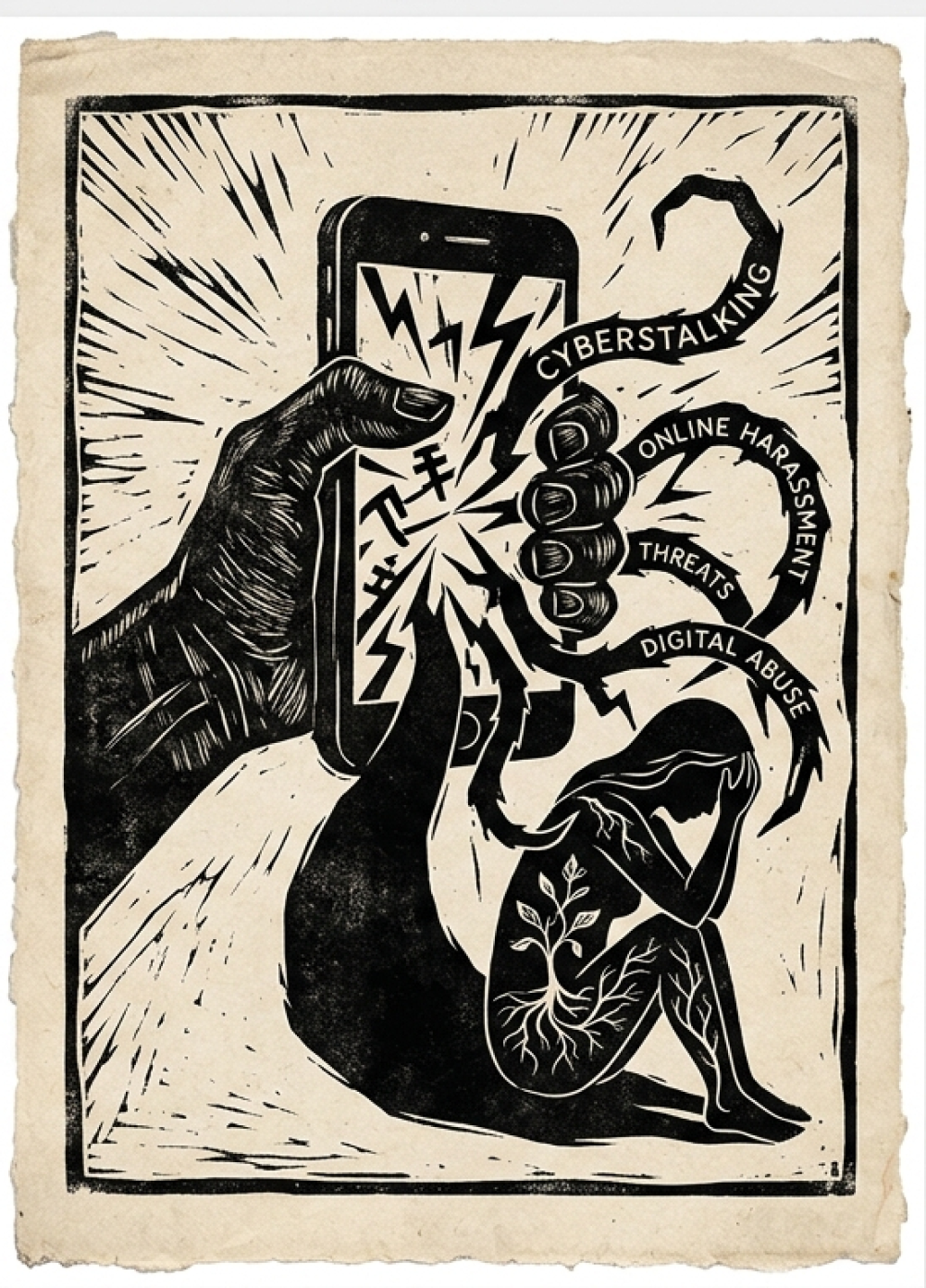
In recent times, physical as well as verbal harassment of women has increased alarmingly. Women journalists, activists, artists, or politicians are becoming victims of hate comments every day.
We use Google Cloud Translation Services. Google requires we provide the following disclaimer relating to use of this service:
This service may contain translations powered by Google. Google disclaims all warranties related to the translations, expressed or implied, including any warranties of accuracy, reliability, and any implied warranties of merchantability, fitness for a particular purpose, and noninfringement.
We know Nepal by various identities – multi-ethnic, multilingual, the birthplace of Buddha and the country of Mount Everest. Similarly, Nepal is also called the ‘land of goddesses’. If we look at the statistics, about 51 percent of the population here is made up of those so-called goddesses. The form of the goddess is found everywhere in our temples, kitchens and farmlands. Religious myths say that Sita is found here when plowing the plow.
Deuti Bajai, Dakshinkali, Manakamana to Gadhimai, there is a never-ending stream of devotees at the Shakti Peethas. However, this glory of the goddess is limited only to idols and mythological stories. The irony is that one type of our goddesses is worshipped in the sanctum sanctorum of the temple, while another type of goddesses are sometimes robbed and sometimes burned alive. Nowadays, this violence has taken the form of violence and has reached the small screen of the mobile phone.
It is said in the Manusmriti – where women are worshipped, there the gods rejoice. But today's digital world's 'male gods' are found to be enjoying the character assassination of women. Here, violence is not only committed by men against women, but also by women against women in various ways. Nowadays, the easiest weapon to humiliate someone has become a vulgar insult and a poisonous comment.
Having an opinion is a crime
In recent times, 'verbal' harassment of women has increased alarmingly along with physical harassment. Being female journalists, activists, artists or politicians, they are becoming victims of 'hate comments' every day.
We don't have to go far. If we open social media, we can read the responses coming in the feed of activists and singers like Raksha Bam, Tanuja Pandey, Amisha Parajuli, Sarishma Thapa, Samiksha Adhikari or Alina Chauhan. The 'hate speech' made by Paun in response to public figures like Sumana Shrestha, Ramkumari Jhankri or Nisha Adhikari reflects the mental poverty of our society. Does freedom of speech mean attacking the dignity of others? The sad thing is that the 'digital judges' here do not hesitate to abuse even dead bodies.
In recent times, 'verbal' harassment against women has increased alarmingly, along with physical harassment. Because they are female journalists, activists, artists or politicians, they are becoming victims of 'hate comments' every day. Our previous generation of sisters faced 'even teasing' in the streets and alleys, who teased and whistled. Today, those teasing characters are not found in the streets, but in the comments of Facebook and the inbox of Instagram. Compared to Instagram and Facebook, the limit of 'hate speech' has been crossed on 'X'. If violence continues to increase at this rate, it cannot be said that the next generation will not have to go straight to a psychiatrist after using social media.
When Inisha Bik's body remained frozen for twenty-seven days, it seemed that the sensitivity of our society was also frozen like that ice. When a young woman raised her voice against the rape committed against her, instead of facilitating justice, our outdated thinking and poisonous comments put her in a dilemma of whether to live or die. Not only that, when a minor rape case was filed against a player, the entire society was divided, where one side kept blaming the minor without providing for her future. They had to create a situation that made it difficult to live in this society after being rehabilitated.
Our generation experienced and saw both physical and digital violence, but the concern is for the next generation. Will the children growing up in the midst of this digital chaos feel safe on social media? Or, will they also live in fear of becoming victims of similar character assassination?
However, the government and the security apparatus are not completely asleep in the midst of this horrific situation. The data shows that thousands of complaints have been filed regarding cybercrime. This illustrates the scale of the problem and the efforts to find a solution. However, the main question remains unanswered, will our mechanism only be active to conduct a ‘postmortem’ after the incident has occurred? Or, will we also take precautions and make strict legal arrangements to prevent the incident from happening? Until the state and society emphasize ‘prevention’ more than ‘reaction’, these digital platforms will remain unsafe for girls.
A song from the street play ‘Batibato’, recently performed by the ‘Katha Ghera’ group in Karnali and the Far West, became very popular – ‘Daughter, old woman, daughter-in-law, mother, before the goddess, man is a woman, man is a woman.’ This song was not just a collection of words, it was the suppressed voice of every Nepali woman. We are saying, we do not need to be made into goddesses and locked in temples, it is enough to ‘guarantee’ a violence-free society by simply treating us as human beings. The real need of the day is to respect people by giving them their status rather than insulting them by wearing a turban.
Finally, ‘hate speech’ and ‘cyberbullying’ are not just technical problems, they are the product of cultural and moral deviations deeply rooted in our society. These representative incidents that we are seeing and experiencing with our eyes are just the surface of the glacier, beneath which countless suppressed cries are hidden. Therefore, it is no longer enough to simply show fear of the law or be proactive after the incident occurs. It is too late for the government to take media literacy and digital safety programs to the village and school curricula.
We envision a Nepal where not only our multicultural, multi-religious and geographical diversity is discussed, but every citizen, especially women, is equally safe and respected in both the physical and digital worlds. Until the dignity of being a human being is placed above the mantle of a goddess and the use of technology is not linked to human sensitivity, our democracy and freedom will remain incomplete. Therefore, it is imperative to take steps to build a safe and dignified digital society today and from now on.