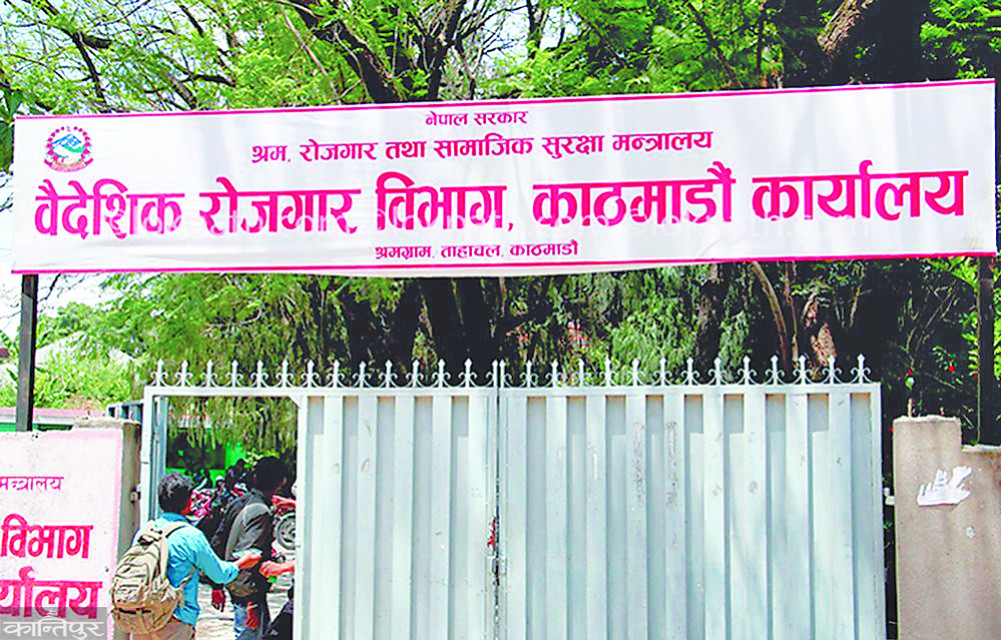
If the current system of putting all types of workers going for foreign employment in one basket is eliminated and a risk-based system is adopted, the practice will be effective, agile, and easy.
We use Google Cloud Translation Services. Google requires we provide the following disclaimer relating to use of this service:
This service may contain translations powered by Google. Google disclaims all warranties related to the translations, expressed or implied, including any warranties of accuracy, reliability, and any implied warranties of merchantability, fitness for a particular purpose, and noninfringement.
There is a provision that Nepali citizens who want to go to any country for foreign employment must obtain a mandatory labor permit from the Government of Nepal. As the number of Nepalis going for foreign employment has increased rapidly, the ‘Foreign Employment Act, 2064’ was enacted to manage it. In Nepal, the Department of Foreign Employment, Labor Office and Nepali missions abroad have been providing such permits. Over time, the method of providing labor permits is being revised. Currently, this system has been made completely online. In addition, the concerned bodies and officials involved are working for continuous improvement.
Foreign employment is not just a Nepalese story. According to the International Labor Organization, by 2024, 281 million people worldwide will be involved in foreign migration and employment. With the increasing labor migration, countries sending workers are adopting various measures to make it systematic. Especially Asian countries are taking a serious interest in this. Specific mechanisms such as the ‘Global Compact on Migration’, ‘Colombo Process’, ‘Abu Dhabi Dialogue’ have been established to coordinate foreign employment and bring global uniformity. In particular, the Philippines, Sri Lanka, India and Bangladesh have adopted various specific measures to facilitate their citizens going for foreign employment. India has adopted a system of obtaining labor permits only under the ‘Immigration Test Required’ category through online registration. In this, a system has been implemented where citizens who have studied only up to school education have to obtain labor permits on the recommendation of the Indian embassy abroad if they want to go abroad on a work visa. The model of the Philippines and Bangladesh is similar to Nepal. Sri Lanka, on the other hand, has made training and labor agreements mandatory through the ‘Sri Lankan Bureau of Foreign Employment’. The Philippines previously managed foreign employment through the ‘Philippine Overseas Labor Office’ (POLO), but now it has established a separate ministry, the ‘Department of Migrant Workers’, to handle labor-related work, which confirms that it has given more importance to this sector.
The labor approval system implemented in Nepal is in a uniform format, requiring all citizens to complete the same process for working abroad. This means that the process is the same for everyone, regardless of the country they go to for any work. Before going for foreign employment, certain processes must be completed. This includes medical examination, orientation, insurance, and labor agreement. Only then is a labor approval granted. The labor approval process can be done both institutionally and individually. While manpower companies carry out the necessary processes institutionally, individuals must complete such processes before going for employment individually.
It is essential to expand manpower, resources, and service capacity in embassies and diplomatic missions. Labor approval has mainly tried to ensure the safety of workers in the destination country. This system originated as a concept of the welfare state. The current system assumes that all workers are at equal risk. In fact, not all workers are at equal risk. Generally, domestic workers, construction workers, or low-skilled and first-time workers are at greater risk, while highly skilled, educated, or workers moving to developed countries are relatively safe. They are also able to take safety measures themselves. For example, the current system requires both doctors and domestic workers to complete the same process to obtain labor permits. This system has resulted in unnecessary expenditure of the state's limited resources. The government can effectively provide necessary services to the target group within its scope of work.
It is time for Nepal to review its current labor policy to segment labor permits rather than lumping them into one basket. For this, it is convenient and practical to change the current system in Nepal and implement a risk-based labor approval system. Such a labor approval system can be classified into three levels –
1. Intensive process for high-risk and first-time workers, mandatory labor approval and strict monitoring.
2. Adopt a simplified process for medium-risk groups.
3. Only registration, data collection and minimal formalities for workers going to highly skilled or safe countries. Also, implement a fast and easy process for workers going abroad again.
Such a risk-based system removes unnecessary regulation, reduces irregularities, and creates a streamlined process and a worker-friendly environment. Most importantly, it saves government resources. Providing equal services to all by the welfare state does not address inequality. In a society with historical inequality, some need intensive protection, while minimal care is sufficient for others. Focusing limited resources on the most vulnerable citizens is the foundation of effective governance.
Nepal's attention should now also be focused on the destination country. The real problem begins when workers arrive abroad. Such as non-payment of wages as agreed, double contract agreements, violation of working conditions or abuse, etc. However, Nepali missions abroad have very few human resources to address all these problems, which is why they are unable to respond quickly. As a result, Nepal's labor diplomacy is becoming inadequate. The Philippines' labor diplomacy is excellent because of its quick response to the destination country. Adequate human resources and resources are its strength.
Nepal has been providing commendable services even with limited resources. However, it is not free from criticism and is not satisfactory. Therefore, it is essential to expand human resources, resources and service capacity in embassies and diplomatic missions. The protection of workers will be more effective if a mechanism for responding to labor-related issues, competent and accessible legal assistance, and rapid rescue services can be made timely and effective.
It would be appropriate to modify Nepal's labor approval system to make it modern, flexible, and risk-based. By providing intensive protection to high-risk workers and adopting a policy that provides an easy path for safe and skilled workers, the foreign employment sector can become effective, transparent, and worker-friendly. This will help Nepal become an exemplary country among labor-supplying countries.