History is witness that any development work undertaken without involving the people, without identifying their needs, without making the people aware, without organizing and involving the community cannot be fruitful. It cannot be result-oriented.
We use Google Cloud Translation Services. Google requires we provide the following disclaimer relating to use of this service:
This service may contain translations powered by Google. Google disclaims all warranties related to the translations, expressed or implied, including any warranties of accuracy, reliability, and any implied warranties of merchantability, fitness for a particular purpose, and noninfringement.
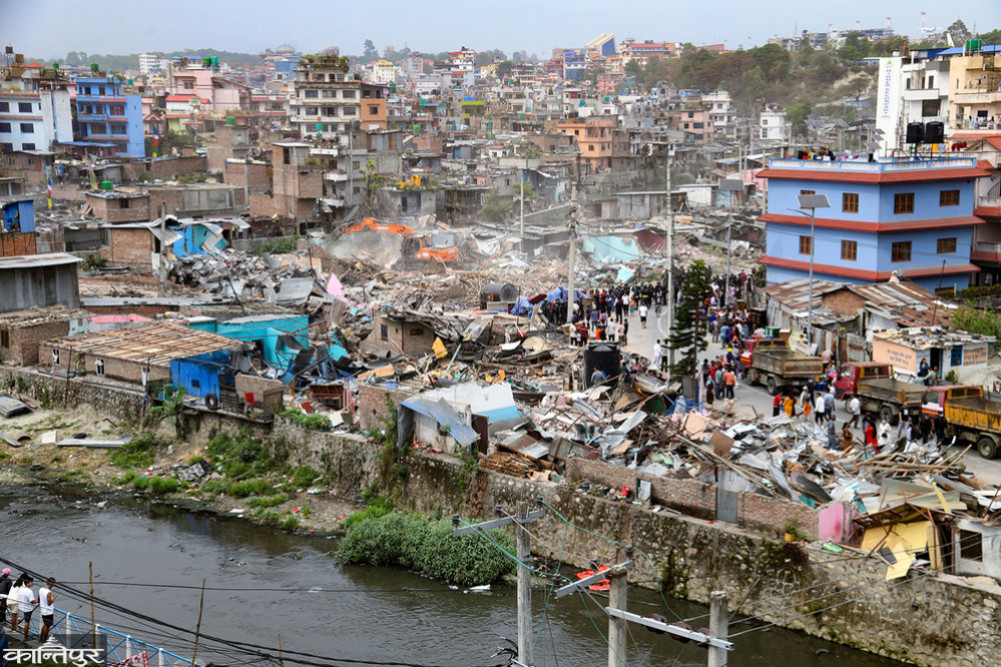
As the government under the leadership of the Rashtriya Swayamsevak Sangh (RSS) was forming for a month, a bulldozer was used in the slums of the squatters living on the banks of the Bagmati, Manohara, Bishnumati, Rudramati and other rivers in the Kathmandu Valley. Everyone was speechless when the government suddenly started using bulldozers in the slums with just a few hours' notice.
The government, eager to demolish the houses of the people in a catastrophic manner, destroyed the slums of the citizens in a moment. It seemed that the slums were battlefields and the residents of the slums were unexpected war victims, who were coming out in a line in search of shelter and food. While watching these scenes, a kind of discourse was also being created on social media, 'Destruction is necessary for development', that is, 'Development begins with destruction.'
Does development begin with destruction? Before discussing this question, let us discuss some discourses and concepts of development. Development is a multidimensional concept. If we look at the physical concept of development, it is an evolutionary concept, which refers to continuous or regular change or growth. Similarly, according to the social science concept, development is a creative concept, which creates some new material objects or immaterial ideas.
In the 1970s, development economist E. F. Schumacher defined development as qualitative changes in immaterial aspects such as education, institutions, and discipline.
Similarly, Nobel Prize-winning Indian-origin economist Amartya Sen has also explained development by linking it to the development of human capabilities. He has linked development to human freedom. Therefore, the physical change or constructive process that we understand in a simple sense cannot explain development.
In short, development can be understood as physical, economic and social change in a positive direction. When we borrow the words of our country's scholars about development, the name of conservationist Dr. Hark Gurung comes to mind, he has defined development as 'change in a positive and expected direction'.
Similarly, development scholar Dr. Devendra Raj Pandey has also argued that development should be understood as human development that increases the wealth of the state, the creativity, entrepreneurship and efficiency of resource utilization of individuals.
Development economists have also accepted the growth and promotion of human knowledge, capacity and efficiency as a component of development. And development is also a political process, which actively involves the people in the context of economic and social transformation. Sociologist Chaitanya Mishra has also defined development as a political process that organizes the people and ensures their participation.
We are often misled when it comes to development. Physical construction has been taken as the standard of development. Wide roads in the city market, airports, commercial complexes, tall buildings, beautiful gardens and well-equipped housing, etc. have been considered synonymous with development.
We have adopted the same physical construction as the discourse of development since the past. Accordingly, we understood development as a commodity given by the state. Why have we not been able to deliver the dividends of political change to the people in the development journey of the past seven decades? In the last three decades of this period, physical changes have taken place in the name of development, but they have not been able to affect production and the daily lives of the people.
After all, development could not be thought of from the people's level. Even in the context of project selection, the discourse of the welfare of all/majority was not adopted. Certainly, in recent times, there has been a huge investment in infrastructure sectors such as roads, bridges, airports, government buildings, city markets, etc., and it is seen that physical infrastructure has also been built.
When the development that the state is supposed to do is preceded by 'destruction', it risks making the community more distant and neglected than connecting it with development. However, while building such infrastructure sectors, the needs of the people and the areas that will make the economy dynamic could not be identified. What is the production-oriented sector of the economy? Our infrastructure investment has not been able to give results because we have not paid attention to it. Saying this, how does investment in infrastructure give results immediately? The question may arise.
The only answer to this is that the needs and priorities of the people are not included in the construction of those physical assets. Because our development could not move forward based on local needs and priorities. What the big parties at the center and their leadership see and imagine has become the development thinking. At the local level, too, the superficial thinking of local people's representatives has become the development plan.
When 'destruction' comes before the development that the state is supposed to do, it risks making the community more distant and neglected than connecting it to development. It makes development a matter of state and government aspirations. People are not connected to such development. So how can development that is done by destroying people's homes be considered people-oriented? How can such development benefit the community? How can collective benefits be obtained?
In fact, our development does not recognize people. In the discourse of ‘development’ that was created globally after the end of World War II, it seems that the monetary institutions established at that time with the aim of making the world economy dynamic and carrying out the work of post-war reconstruction were created through the World Bank and the International Monetary Fund. In accordance with the Britannia Wood Agreement, the World Bank began to provide financial and advisory assistance for the economic revival and reform of underdeveloped countries. In accordance with the same concept, ‘development’ was also introduced in Nepal. In this way, the discourse of ‘development’ that was introduced with financial assistance expanded rapidly and development came to be portrayed as something that the haves give to the have-nots. When development is perceived as aid or something that one gives to another or a task to be done, the issue of people’s mobilization becomes secondary. For a long time, there was no community activism and organized participation in the development of Nepal. As a result, the development so far has neither been able to create large-scale employment and include the local people, nor has it been able to connect the local economy to the mainstream.
In particular, the people do not need structural development like physical infrastructure like roads, airports, railways, ships, view towers, but ‘progress’ that connects the people’s daily lives and leads them towards prosperity and progress. Development without progress does not touch the people. Therefore, now the dynamics of development also need to be changed.
Unfortunately, it has happened that even the government that has received a powerful public opinion is working to destroy the homes of the same people for ‘development’. Once again, physical construction-oriented work is being considered as the form of overall development.
Dreams are being woven through ‘destruction’ for that so-called development. History is witness that any development work carried out without connecting the people, without identifying the needs of the people, without making the people aware, without organizing and participating the community cannot be fruitful. It cannot be result-oriented.
The people’s ownership must be established in every investment made by the state. If that does not happen, then the state's investment will turn out to be water in the sand. And, any dream of development that is pursued by the people will be limited to the same mirage.