Petrol pumps in the middle of dense settlements, party palaces without fire safety, gas shops, and weak wiring are the city's 'time bombs'.
We use Google Cloud Translation Services. Google requires we provide the following disclaimer relating to use of this service:
This service may contain translations powered by Google. Google disclaims all warranties related to the translations, expressed or implied, including any warranties of accuracy, reliability, and any implied warranties of merchantability, fitness for a particular purpose, and noninfringement.
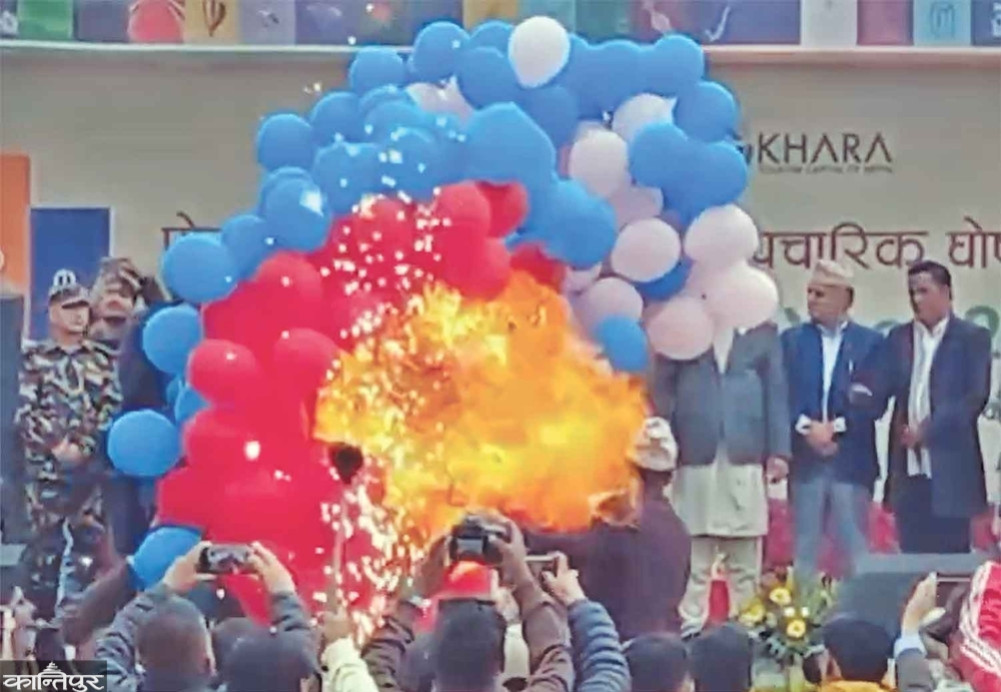
At the ‘Pokhara Visit Year-2025’ announcement meeting, there was a program to light a lamp by pressing a switch and release a hydrogen-filled balloon. A fire incident occurred during the program, injuring the then Finance Minister Bishnu Poudel and Pokhara Mayor Dhanraj Acharya. A week passed in the debate on his burn wounds and treatment facilities. The incident of the then MP Chandra Bhandari’s burn was also discussed everywhere on the streets, in the parliament.
The development of human civilization to date would have been impossible without fire. Fire burns, and it should be used with caution – everyone knows that, however, serious damage has been caused by accidents.
When the cold or heat increases, the number of burn incidents and patients reaching and being admitted to hospitals increases. It becomes difficult for patients to get a hospital bed, even if the hospital adds ordinary beds, it cannot add intensive care beds. Public representatives, social workers and organizations are focusing on increasing the incidence of burns by distributing firewood and other fire-related materials rather than providing warm clothes or protection from fire.
Doctors in the emergency room classify burn patients as superficial, deep and very deep based on depth and determine the severity based on percentage based on area. According to the ‘National Action Plan for Forest Fire Control, Preparedness and Response-2082’, the National Disaster Risk Reduction and Management Authority has analyzed the incidents since 2013 and placed 9 districts at high risk and 13 at medium risk. Cities including the valley are like time bombs due to petrol pumps, gas shops and weak wiring amidst dense population. Party palaces without fire safety are scattered.
Statistics from the Department of Health Services say that more than 79,630 people suffer burns every year, including small and large ones, and about 2,000 die. The highest number of people were 20,278 in Madhesh Province due to fire or acid burns. There were 14,439 in Bagmati, 13,572 in Lumbini, 8,867 in Koshi, 8,487 in Gandaki, 7,471 in Sudurpaschim and 6,615 in Karnali.
In Nepal, most burn incidents are caused by fire, 25 percent by hot oil or water and 15 percent by electricity. 90 percent of these burn incidents are seen in rural areas. The mortality rate for burns to the external parts of the body is 20 to 25 percent and for burns to the respiratory tract is more than 60 percent. This mortality rate can be reduced if there are sufficient resources, equipment, intensive care units and specialist manpower.
Women are more involved in household chores, from cooking to animal husbandry and weeding. Carelessness and There are statistics that women are more likely to get burned and die due to clothing. In the Terai, ghur is used for heating, in the mountains, wood fire is used. And, in the city, heaters, briquettes, and macal are mostly used. Women often wear loose and loose clothes such as saris, lungis, maxi, and pachyura at home and at work, which are easily caught by fire and spread. Two-thirds of the deaths in burn cases are women.
Doctors in the emergency room determine the severity of burn patients by classifying them as superficial, deep, and very deep based on depth and by looking at the percentage based on area.
In superficial burns, only the surface of the skin is burned. The wound becomes red, the area becomes hot, very painful, and the redness disappears or fades when the red area is pressed. It usually heals on its own in 5 to 7 days with dressing alone. If the blisters on the burned skin are large, moderate and small, it is a deep burn. In a deep burn, blisters form, the skin peels off and becomes painful. If the wound becomes deep, surgery is necessary.
In very deep burns, the burned area becomes red, does not fade when pressed, the skin becomes dry, hard and thick, and the pain decreases. Since the burn does not heal on its own, skin grafting surgery is necessary to remove the burned skin.
In very deep burns, the burned area becomes red, does not fade when pressed, the skin becomes dry, hard and thick, and the pain decreases. In adults, 20 percent of the burn, and more than 10 percent of the burn in children and the elderly is considered serious because not only the burned area but also other parts of the body (lungs, heart and intestines) are affected. Those with severe burns must be admitted to the hospital immediately.
If a burn occurs, the patient should be placed in running cold water as soon as possible or within 3 hours. Running water absorbs the heat of the wound and prevents it from getting deeper. In chemical burns, it should be cooled for a longer period of hours. The main thing to use after a burn from fire or anything is water. The water should not be very cold either, the burned area should be cooled with running water at a normal temperature for 20 to 30 minutes. This will prevent the internal burns from getting deeper.
Placing ice, tomato, turmeric, ghee, cow dung, toothpaste, nauni, etc. on the burn wound can cause further harm. Small burns that are not deep will heal in 8 to 10 days with the appearance of small blisters and application of ghee or tomato, but deep wounds must be cooled with water. There is a risk of infection including tetanus when applying ash and cow dung.
Do not panic and run while the fire is burning. When you run, the fire gets oxygen and burns even faster. When you reach a safe place, stop, drop and roll the fire if there is no extinguishing agent. If you do this, you should get down on the ground and fight to put out the fire. If the fire does not go out even after doing this, you can quickly cover it with a thick blanket.
Due to the lack of complete information about unsafe environments (such as cooking methods, living spaces, access to children, preventive measures) and lack of knowledge about first aid, the number of burn incidents is increasing rapidly across the country. Therefore, awareness can prevent burn incidents.