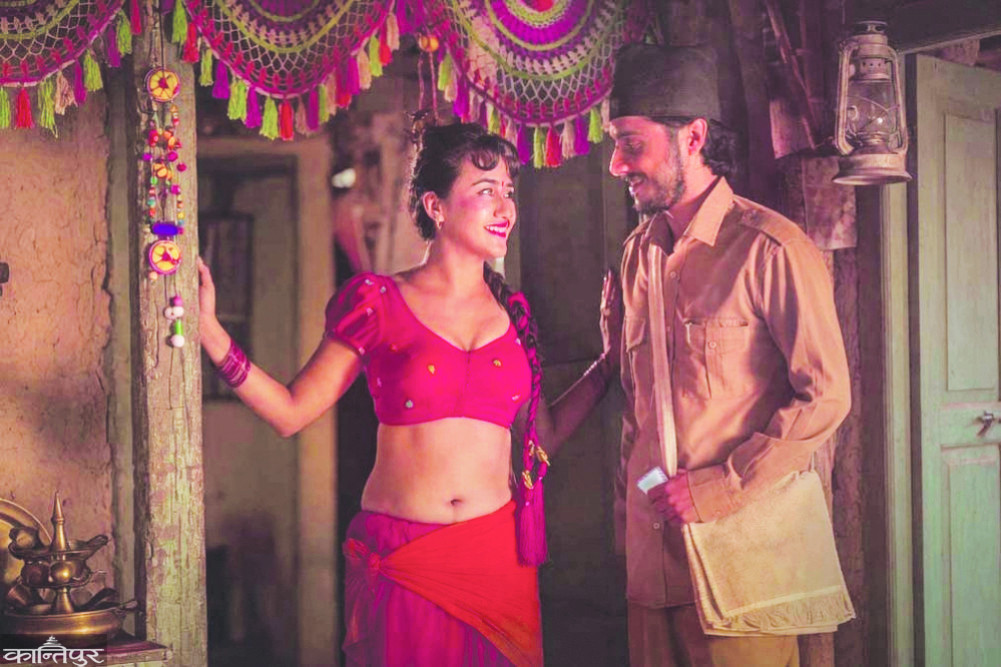
The Badi community is not just a 'settlement', but a vibrant community with a vast history and culture. However, the film 'Lalibazar', made on the Badi, covered the Badi community with a single blanket, where all the characters and surroundings look the same.
We use Google Cloud Translation Services. Google requires we provide the following disclaimer relating to use of this service:
This service may contain translations powered by Google. Google disclaims all warranties related to the translations, expressed or implied, including any warranties of accuracy, reliability, and any implied warranties of merchantability, fitness for a particular purpose, and noninfringement.
Who tells the story, how does it tell it, and for whom? These questions are important. Whenever stories are written, told, or shown about the Badi community, they are often not seen or written through the eyes of the Badi themselves. They are presented through the eyes of outsiders, according to market demands, and at the price of the audience's tears.
When the discussion of the film 'Lalibazar' started in the market and the trailer was released, a great turmoil began in my mind as a member and citizen of the Badi community. Deep sensitivity made me nervous.
Telling a story is one thing. But whose story is it and who does it represent? That is another matter. A creator should prioritize the life experiences and experiences of the characters, but today the market sells more 'brand' and 'glamour' than the story. The established narrative that a film works by exposing the wounds of marginalized communities and making the blood that flows from them the subject of performance always shocks me. I have no close relationship with the latest literature and creations written about the Badi community. Or rather, all those creations did not put me at the center while telling my story, let alone understand my sensitivity.
We say that art, literature and creation are the mirror of society. However, it is no longer enough to be just a mirror. It should now become a medium to shock society and show the way to change. There is still a lot of discussion and controversy in the market regarding the film 'Lalibazar', which has recently been released after various controversies and disruptions. As a representative character and citizen of the Badi community, I also had and still have many questions and expectations while watching this film. However, after watching the film, I have come to a conclusion - this film has its own limitations, commercial interests. Nevertheless, it is my democratic right to accept it as a 'creation'. And, 'Lalibazar' is once again standing in the courtroom.
Giving priority to the life, suffering and experience of a character is the religion of the story. However, in today's market, more 'products' are sold than 'stories'. It is necessary to be more sensitive than the stories of marginalized communities. Stories can be told, and should be told. However, the experiences and sufferings of the person to whom the story belongs should be presented honestly, keeping the person at the center. It seems that 'Lalibazar' has tried to fulfill this sensitivity in its entirety. However, putting the Badi community in one basket is the first weakness of this film.
Could the film not recognize the diversity of this community due to its narrow study scope? The Badi community is not just a 'settlement', it is a vibrant community with a vast history and culture. However, the film only covered the Badi community with a single blanket, where all the characters and surroundings look the same. The oppression of the state is the same in the lives of the main characters of 'Lalibazar' and Asmita. However, the geography and the lives lived are different.
I would like to ask the angry friends standing on the street, appreciating their feelings – is the final destination of creativity the court? We are in a democracy, where ‘creative freedom’ is important. However, the self-respect of the entire community should not be hurt. Looking back at the history of the Badi community, it is not just a history of pain, but also a history of art and culture. Since the Lichchhavi period, this community was entrusted with the responsibility of entertaining the state and society through singing and dancing. Dancing and singing in the courts of kings and feudal lords on occasions such as festivals, weddings, fasts, feasts, etc. was the main profession of that time. While the dancing and singing of the women of the village were considered ‘adab’ (politeness), the men worked in making musical instruments and pottery. But, irony! The community that brought happiness to the society was stigmatized as ‘sex workers’. Original professions were taken away, the state did not give any alternative.
The state did not give us land, what about land? It did not even give us citizenship. Our ancestors were forced to feed their hungry stomachs and were pushed into the swamp of sexual exploitation. This was not their desire, it was a ‘structural violence’ deliberately created by the state. If the Badi community could write their own history, would they write themselves as sex workers or sexually exploited?
There is a scene in ‘Lalibazar’ – another character in the story, ‘Maharani’, is sitting on the floor of the classroom and studying. This forced me to go back to my childhood. I grew up in a remote village in Jajarkot. For me, being a Badi meant being a second-class citizen, standing outside the school window and studying. And being forbidden in schools, temples, pandheros and cholo chogheros.
There was a stream near my house, which would take at most 10 minutes to reach. But, I never went to fill water in the light. Because, in the light, I had to be humiliated. Not only humiliated, but sometimes I had to be beaten. I was untouchable for the water-filling pandherni there. To avoid that extreme caste discrimination and brutal mental torture, I would either climb uphill for 2 hours to fetch water from the well. Or I would reach the tap only after everyone was asleep in the middle of the night. This was the ‘strategy’ to avoid humiliation.
‘Lalibazar’ has tried to capture the emotions of the audience, it has succeeded in making people cry in the hall. The film has tried to show the time of 2045/46 BS. However, the language used there, some English words and costumes do not give a glimpse of the real Badi settlement of that time. The Badi community has its own language. Although it tried to capture the geography and language around Bardiya, the film has not succeeded in that. There are objections in some dialogues, such as a brother telling his sister – ‘I will give my name to my niece to get her birth certificate, you should say that I forced you to have this child.’ Another dialogue is – ‘It is the custom of the Badi community to sell daughters.’ These dialogues are extremely vulgar. The main character going to knock on the doors of every man in the village to name his daughter has only emotionally exaggerated the story.
In the name of showing reality, most writers and directors focus the camera on the bodies of Badi women more than on their suffering. In ‘Lalibazar’ too, it feels like there has been more effort to create ‘visual material’ than to make Madhuwala’s character sensitive. The kind of ‘objectification’ of Swastima Khadka’s body has fueled the patriarchal view of women in capitalist society.
The character of Madhuwala (Swastima Khadka) showed the struggle of a mother, but could not fully do justice to the overall self-respect of the Badi community. The liberation of the Badi community cannot be done by one person, as ‘Lalibazar’ has tried to show. We do not need sympathy, but equality/equality.
‘Lalibazar’, which came to the fore after various controversies and legal troubles, has once again been brought to the courtroom. Appreciating the feelings of the angry friends standing on the street, I would like to ask – is the final destination of creation the courtroom? We are in a democracy, where ‘creative freedom’ is important. However, the self-respect of the entire community should not be hurt. We all need to be equally sensitive, aware and responsible in this. Creation should question and shock society. And, society can also question creation. However, the alternative to that cannot always be the courtroom. Putting creation in the courtroom is to strangle the throat of thought. Let us dialogue, criticize, boycott if we don't like it, but the tradition of using the state machinery to restrict or block creativity does not benefit anyone. We should try to become the 'creator' of creativity, not the 'sir' (judge).
There is a dialogue in 'Lalibazar', 'We do not exist outside Lalibazar, even today we have to fight the battle of existence, our entire battle is still to come.' Unless the state makes structural reforms, hundreds of 'Lalibazar' stories will remain. Let 'Lalibazar' be the beginning of the debate, not the end. I say again - let us criticize, but let freedom of thought survive.