The national government's proactivity in addressing the complex problems of metropolitan cities in terms of policy, planning, and investment is weak. Therefore, managing metropolitan cities in Nepal is challenging.
We use Google Cloud Translation Services. Google requires we provide the following disclaimer relating to use of this service:
This service may contain translations powered by Google. Google disclaims all warranties related to the translations, expressed or implied, including any warranties of accuracy, reliability, and any implied warranties of merchantability, fitness for a particular purpose, and noninfringement.
When looking at the state of urban development in the Kathmandu Valley, one clear weakness is evident – the lack of a vision to understand and implement urban development and regional planning as a broader, integrated and long-term process.
The development of any area in urban development and regional planning can be classified into four major structural patterns. Initially, there is a monocentric model, where all activities are concentrated in one center, which increases pressure and leaves other areas behind. And in the absence of a plan, this transforms into unplanned sprawl, causing land destruction, expensive infrastructure and complex transportation. Then a multicentric but inconsistent (multipolar) pattern emerges. It has many centers, but there is no coordination or strong relationship between them. When each center works separately and competitively, the regional balance can be disturbed and there is a risk of double investment of resources. In such a structure, the infrastructure network is scattered, which hinders the achievement of the goal of integrated economic development. The most effective coordinated polycentric structure is polycentric. Here, each unit or ‘cell’ has its own unique identity and scope of work, but they are strongly interconnected through transport, natural and communication corridors. Population pressure is decentralized and balanced economic development of the entire region is possible.
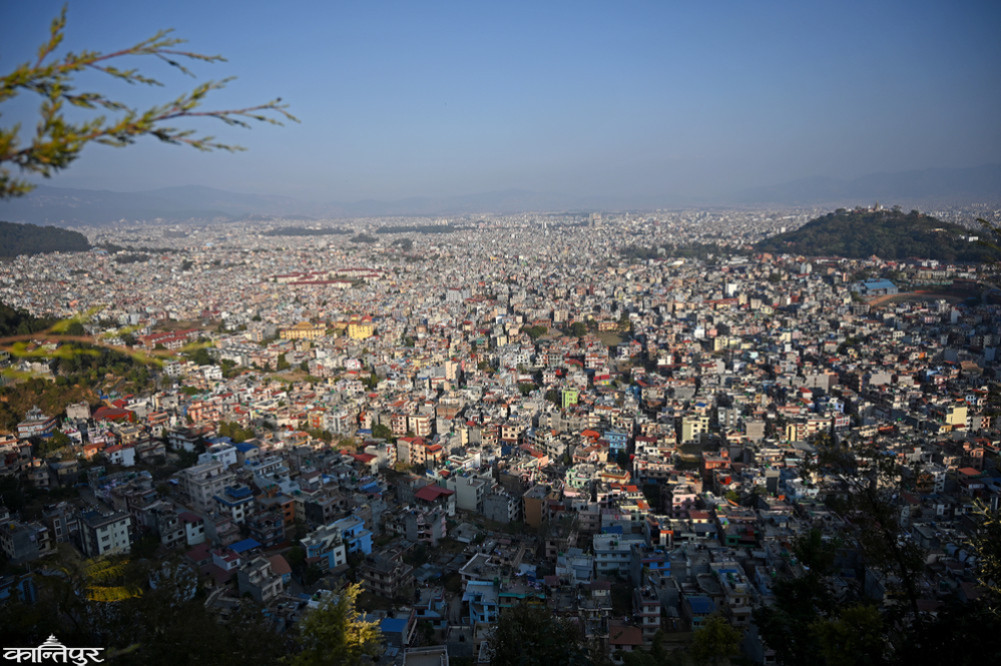
When analyzing the current urban development of the Kathmandu Valley, it is seen that it has developed in a mixed form, not limited to any one pattern. However, overall, ‘unplanned sprawl’ and ‘polycentric but inconsistent’ patterns dominate. Historically, the valley was based on a ‘monocentric’ pattern, where Kathmandu Metropolitan City developed as the main center and economic, administrative and service activities were concentrated there. However, over time, due to population growth, migration and urban expansion, Kathmandu, Lalitpur, Bhaktapur and the surrounding areas also moved towards urbanization. Although this gradually pulled the valley towards a polycentric form, the lack of clear functional division, coordination and planned development between these centers has not been able to lead it towards making it a ‘coordinated polycentric’.
The valley has become a clear example of ‘unplanned urban sprawl’, where settlements have spread without a plan, agricultural land is being converted into plotting in an uncontrolled manner and infrastructure development is running behind it. The Kathmandu Valley is currently in a transitional state, completely mixed with unplanned sprawl, towards a discordant polycentric structure.
A metropolis is a country's powerhouse, and if metropolises do not function in a country, that country will not function. In the case of the valley, a polycentric or multicentric metropolitan structure can be important for future urban development, in which different cities are developed by connecting them. And, not all activities are allowed to be concentrated in one city. In such a structure, while Kathmandu remains the main metropolitan center, cities like Lalitpur, Bhaktapur, Kirtipur, Tokha, Banepa can be connected with special roles. Areas like Thankot/Naubise in the west can be developed as national transport and trade gateways, while the areas in the east can be transformed into economic and innovation corridors.
Considering its geographical and strategic importance, a coordinated multi-centric framework should be adopted through 'metropolitan discipline' by systematically developing various service centers or discouraging monopolistic development or disorderly sprawl. This will ensure a balance between productive urban cells and natural resources, ensuring proportional economic opportunities and citizen amenities at the regional level. In this way, by functionally connecting and developing different cities, the valley can be decongested and economic activity can spread in a balanced manner.
A metropolis is the powerhouse of a country, and if metropolises do not function in a country, that country will not function. The economic, social, and infrastructural impact of a metropolitan area like the Kathmandu Valley is nationwide. Therefore, metropolitan issues are not just local issues, they are basically national issues. But in practice, such metropolitan issues do not seem to be given sufficient priority at the national level. The national government's proactivity in addressing the complex problems of metropolises seems relatively weak in terms of policy, planning, and investment. This is why the management of metropolises in Nepal is becoming challenging.
Another important aspect of urban development is green-blue infrastructure. It presents the concept of connecting natural and semi-natural systems within the city as a single network. By connecting rivers, watersheds, forest areas, parks, and open spaces in a planned manner, the ecological balance of the city can be maintained. The Shivpuri Nagarjuna National Park in the northern part of the valley is a very important area in terms of watershed and forest system. Similarly, the Godavari and Phulchoki areas in the south are considered important for biodiversity and green conservation. Connecting these areas with river corridors and building a network of green-blue infrastructure will make a significant contribution to flood control, water management, biodiversity conservation and urban environment improvement.
To achieve ‘higher levels of urban development’, the valley must adopt a metropolitan approach that views the entire region as a living and interconnected system. This requires coordinated governance, spatial restructuring and the development of multi-centric urban nodes instead of a single central city.
The transformation from a dense and fragmented structure to a resilient and adaptive metropolitan system will depend on the incorporation of ecological principles, the promotion of balanced regional development and the strengthening of institutional capacity. Only through such changes will the Valley be able to rise above its current state and transform into a sustainable, effective and organically developed urban system. This can ensure long-term development.
Urban development and regional planning is a broader process that advances physical infrastructure, economic growth and environmental sustainability in an integrated manner.