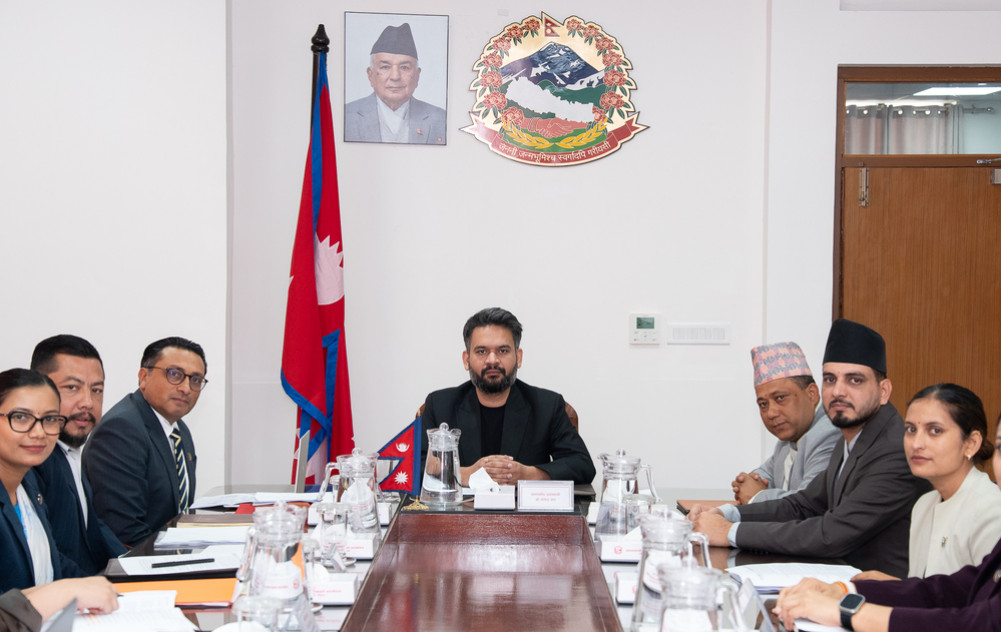
His focus is on taking strong steps to free the federal capital Kathmandu from the squatters who live by setting up huts on the river banks and the 'Hukumbasi' who occupy the river banks in the guise of squatters. The public is amazed by his bright face and eager demeanor.
We use Google Cloud Translation Services. Google requires we provide the following disclaimer relating to use of this service:
This service may contain translations powered by Google. Google disclaims all warranties related to the translations, expressed or implied, including any warranties of accuracy, reliability, and any implied warranties of merchantability, fitness for a particular purpose, and noninfringement.
Less than a hundred days after Balendra Sah assumed the office of Prime Minister, ‘good governance’ has begun in the country . The government has set two days off a week – Saturday and Sunday – for its employees. They will now receive their salaries after the end of the month in fifteen days. His attention is focused on taking strong steps to free the federal capital Kathmandu from the squatters who make a living by pitching huts on the river banks and the ‘hukumbasi’ who occupy the river banks in the guise of squatters. People are amazed by his sharp and ready demeanor.
Prime Minister Balendra has already called a session of the elected parliament and given the opportunity to the elected members of parliament to take the oath. After the oath-taking of the elected members of parliament, the session of parliament has been adjourned . Before the next session begins, he sent half a dozen ordinances to President Ram Chandra Poudel to issue Since it takes time for bills to be passed by the parliament and become an act, Prime Minister Balendra chose the short route of an ordinance. President Poudel has certified those ordinances with some hesitation and some ease. In the sensitive political situation prevailing in the country, President Poudel probably had no other option.
The National Independent Party, led by Balendra Sah, had won almost a two-thirds majority in the parliamentary elections on 21 Falgun. If Balendra had not rung the bell of the Rashtriya Swatantra Party, the country's established political parties would have won this election as well. Balendra, who defeated the Nepali Congress, which fought a long struggle for the establishment of democracy, and the Communist Party of Nepal (Unified Marxist-Leninist), which was unified as a Marxist-Leninist during the 2046 People's Movement, and Prime Minister KP Oli, in his own constituency, became the natural candidate for the post of Prime Minister. Today, he has become the Prime Minister with his own earnings. The officials and leaders of the National Independent Party are seen bowing down before him.
Balendra's relationship with the National Independent Party as the head of the government is clearly 'functional'. Prime Minister Balendra does not seem to have a deep 'intimate' relationship with any of the Rashtriya Swatantra Party MPs. It is clear that Wallen's relationship with the National Independent Party as the head of the government is 'functional'. Prime Minister Balen does not seem to have a deep 'intimate' relationship with any of the RSP MPs. According to an RSP MP, the party leaders and MPs are hesitant about Prime Minister Balendra. What is on Balendra's mind? It is not easy for anyone to find out. According to some of his friends, no one has understood the engineering of Balendra, an engineer by profession. He has hidden his personality under the cover of clothes. According to the discussion, Prime Minister Balendra had 'talked to party chairman Ravi Lamichhane for one and a half hours' in a meeting at his government residence. He was playing with his daughter for that one and a half hours. Finally, Chairman Lamichhane left the residence without meeting Prime Minister Balen. Is this incident fictional or real? That is a matter for Prime Minister Balendra and Chairman Lamichhane to explain. However, people who understand Balendra's personality are not in a position to say no to it. It seems that Nepal's prime ministers spend even their personal time on politics. If Balendra keeps his personal time safe, there is no reason to make fun of it.
The most important incident happened only last Thursday. In a meeting of the Constitutional Council held to appoint the Chief Justice to lead the Supreme Court, it recommended the fourth-ranking judge of the Supreme Court, Manoj Kumar Sharma, as the Chief Justice, as per Prime Minister Balendra's proposal. After this decision, negative reactions came from figures in the justice and legal sectors. Moreover, even interim Prime Minister Sushila Karki, who treated Balendra like her 'son', had to criticize Balendra. The mainstream media and social media were filled with negative reactions from constitutional and legal experts. Prime Minister Balendra did not make such a decision on the spur of the moment. But why did he do something that was detrimental to himself?
What kind of society does Balendra want to build as Prime Minister? Which 'model' of development does he want to develop the country by? He does not seem to have spent time on such issues. It has been revealed that Balendra does not like to make boring speeches. Artists who sing good and interesting songs do not want to get involved in useless unproductive discussions and debates. However, if anyone thinks that he has taken the post of Prime Minister based on these qualities of his, that is a delusion. He did not become Prime Minister based on his personal qualities alone. He has understood the importance of divine power and 'traditional' power in Nepali politics. He also has a deep knowledge of the international situation.
At this time, people's liberal consciousness and their faith in the value of life have weakened all over the world. At such a time, various forces have come forward to advance Walendra's ambitions. He has not opened any party himself. His economic outlook is also not clear. He has a good knowledge of one subject - power comes from the barrel of a gun. It is clear that Walendra's 'necessity' and 'inevitability' are linked to the power of a gun. There is no point in repeating this.
In the context of current Nepali politics, everyone who is interested in the interests of the country needs to understand this subject - the history of democracy is full of great and surprising events. However, no matter how surprising the events are, the existence of the people's democracy cannot be hijacked by anyone. No matter how fierce the internal disputes or the pressure of the authoritarian regime, no one can shut the mouth of the people in this day and age. No matter how simple and straightforward the people are, they have a sense of resistance. Their self-respect and personal freedom are very valuable to the people.
When the National Independent Party, which contested the elections under the leadership of Balendra, formed the government with almost two-thirds of the votes, the leaders of the major political parties of the country including the Nepali Congress, UML, and Nepali Communist Party have become nameless. However, even in today's political situation, the major parties are not politically inactive. However, this activism among them is not enough. Some supporters of the Rashtriya Swatantra Party seem to have the mentality that they have defeated the country's prestigious parties. They should understand this issue - victory and defeat among political parties are not considered a new issue in a democracy. A change in the equation is not unnatural in democratic politics. Any government formed at the center now should pay more attention to the provincial balance.
Nepal's politics is currently deeply influenced by a limited number of elites and elites. In Nepal's politics, it is not enough for any leader to be popular among the people. For this, there is no alternative to fighting against the interests and conspiracies of the representatives of the elite who do not want to govern in accordance with the principles and norms of democracy.
Unfortunately, even after the restoration of democracy in 2046, the dominance of the elite in people's politics has continued. The fibers of politics have begun to fall under the control of the elite. Whether it is the Congress or the UML or the Nepali Communist Party or the recently started making noise - the elite has already dominated the national parties. Nepal's politics has not yet reached the stage of modernity. Important leaders of all parties should understand this issue.
The class that acquires wealth legally or illegally has a strong hold on all political parties in Nepal. This class seems to have a stronger influence on the country's newest party - the National Independent Party. It is a common game for the scoundrels who use the influence of some personalities involved in Nepal's politics to make and bring down governments. What can the people expect from politicians and leaders who are self-sufficient even at a time when the people are caught in the grip of an economic crisis? Nevertheless, we must hope that a leadership conscious of the country will emerge in the political arena of Nepal and that the country will accelerate development. However, the basis for this hope has not yet been seen. A leader cannot simply express hope for development, he must take an active initiative for change. For that, he must have complete dedication to the country.
Democracy without political parties cannot be imagined. However, if political parties fail to uphold the dignity of the people in the name of democracy, democracy will be fragmented. Just because the people win once for a political party does not mean that they hand over their sovereign rights forever.
The dire economic and social situation we are in now cannot be changed in a simple way. Journalist Lincoln Stephens writes in his book ‘Revolt is Not Reform’ – a single burst of anger and passion against corruption is not enough. To completely end corruption, people’s anger and passion need to be sustained.