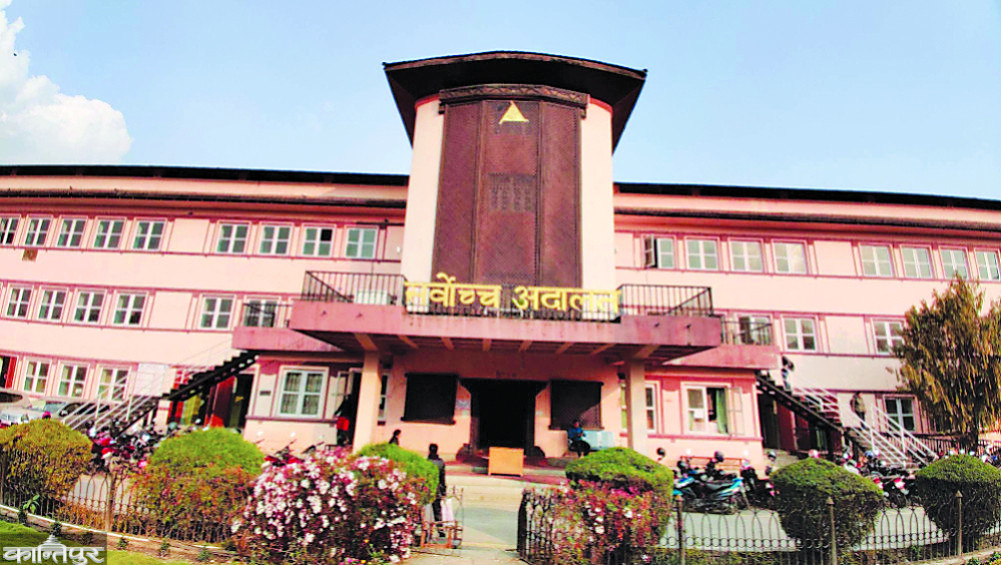
The fact that the court is run by an acting Chief Justice and the long-term leadership vacancy is not only an administrative weakness, but it is a vivid illustration of how the serious imbalance in the constitutional structure renders the organs of the state inoperative.
We use Google Cloud Translation Services. Google requires we provide the following disclaimer relating to use of this service:
This service may contain translations powered by Google. Google disclaims all warranties related to the translations, expressed or implied, including any warranties of accuracy, reliability, and any implied warranties of merchantability, fitness for a particular purpose, and noninfringement.
The apex body of the judicial system, the Supreme Court, is currently without a leader. After former Chief Justice Prakash Man Singh Raut retired on 18 Chaitra 2082 due to his age limit of 65, the senior-most judge of the Supreme Court, Sapna Pradhan Malla, is serving as the Acting (Acting) Chief Justice in accordance with the constitution. Acting Chief Justices are not a new practice for Nepal. Before this, Damodar Sharma, Deepak Kumar Karki, and Harikrishna Karki had served as Acting Chief Justices for a long period. Harikrishna Karki became the 30th Chief Justice of Nepal in 2080 after serving for 5 months. The Constitutional Council has been experiencing delays in appointing the Chief Justice, and changes in the arithmetic, quorum, and decision-making methods of the Constitutional Council through ordinances. As in the past, this practice has been seen this time too, on the one hand, the Constitutional Council has not been able to appoint the Chief Justice, while on the other hand, the government has passed the Ordinance on the Function, Duties, Powers and Procedures of the Constitutional Council.
The Constitution of Nepal has determined a clear process for the appointment of the Chief Justice. According to Article 129(3) of the Constitution, a person who has served as a judge of the Supreme Court for at least three years is eligible to be the Chief Justice, while Article 284(3) stipulates that the Constitutional Council must recommend the appointment one month before the position of the Chief Justice becomes vacant. In addition, there is a provision for the President to appoint the Chief Justice on the recommendation of the Constitutional Council, which ensures the independence and balance of the judiciary. However, in practice, these mechanisms have become leaderless as the judiciary has become entangled in the game of political consensus and balance of power.
If the appointment process is still not completed on time, the judiciary There is a risk of running the court for a long time again . The fact that the court is run by an acting Chief Justice and the leadership is vacant for a long time is not only an administrative weakness, it is a vivid example of how the serious imbalance in the constitutional structure makes the organs of the state inactive .
The fact that the court is run by the acting Chief Justice and the long-term leadership vacancy is not only an administrative weakness, it is a vivid example of how the serious imbalance in the constitutional structure renders the organs of the state inoperative. The Chief Justice is not only the person who gives judicial decisions, he is also the administrative head of the court . He plays a decisive role in case management, distribution of responsibilities among judges, policy decisions and judicial reform initiatives . When such a position remains vacant for a long time, it is natural that there will be delays in the decision-making process, lack of coordination and lack of stability in reform efforts . Its direct impact is seen in the finality of cases . It further weakens the judiciary, which is already struggling with the problem of delays . Such a situation further weakens public trust in the judiciary . The credibility of the court depends not only on its decisions but also on institutional stability and leadership . When the Supreme Court itself is running under temporary management, the public is asking, 'Is the justice system strong?' Is the judiciary trustworthy?' raises questions like this.
The failure to appoint a Chief Justice has also posed a challenge to the principle of separation of powers. Montesquieu, in his book 'The Spirit of Law' in the 17th century, had said that there should be a division of power among the organs of the state, otherwise there would be 'tyranny'. In a democracy, the balance between the judiciary, the executive and the legislature is very important. In addition, the separation of powers is also considered an important basis of constitutionalism. If the judiciary is not seen as independent, there is a risk of increasing the influence of other organs. In the current situation, not holding a meeting of the Constitutional Council, bringing an ordinance to adjust the arithmetic, and appointing someone because of an individual The delay in the process or the failure to appoint the Chief Justice due to various other reasons has raised the question of whether the executive has started to lose its grip on the judiciary. It cannot be denied that the courts have overturned decisions on political or anti-government cases in the past. Such a practice can lead to the erosion of judicial independence in the long run, which is not a good sign for a democratic system.
What is the root cause of the failure to appoint the Chief Justice? The answer to this is not simple. Lack of political consensus, power struggle/arithmetic within the Constitutional Council or questions arising in the appointment process? It seems that the combination of all these reasons has created such a situation. Even though the Constitution has provided structure and authority, political will is indispensable for its effective implementation. When political will is weak in implementing the Constitution, then the constitutional mechanisms become inactive. For example, the Constitution appoints a new Chief Justice a month before the post of Chief Justice becomes vacant. Even if it is recommended, it is doubtful that the Constitutional Council's leadership and officials will not make the constitutional mechanisms inactive. Famous Indian politician BR Ambedkar said that even a good constitution is considered a bad constitution if it is not implemented, and even a bad constitution is considered a good constitution if it is implemented. Therefore, a government that is expected by a large population has no right to deviate from its constitutional duties. Who is appointed as the Chief Justice is not the main issue, the Constitutional Council should recommend the Chief Justice, this is the main issue.
Therefore, the leadership of the judiciary is not just a formal matter of filling a position. The lack of leadership in an institution like the Supreme Court can seriously affect the quality of justice, decision-making process, institutional stability, judicial independence and credibility in the long term. The leadership of the judiciary is not only a means of administrative coordination, it is an institutional guideline, a shield that determines the pace of reform, and a basis for confidence. In addition, it is not just a matter of fulfilling constitutional formalities but also a fundamental principle of democracy. It is also a responsibility to protect values, justice, freedom, accountability, and good governance. Therefore, if the Constitutional Council does not fulfill its obligations on time, it will have a direct impact not only on the institutional structure, but also on the citizens' faith in justice.