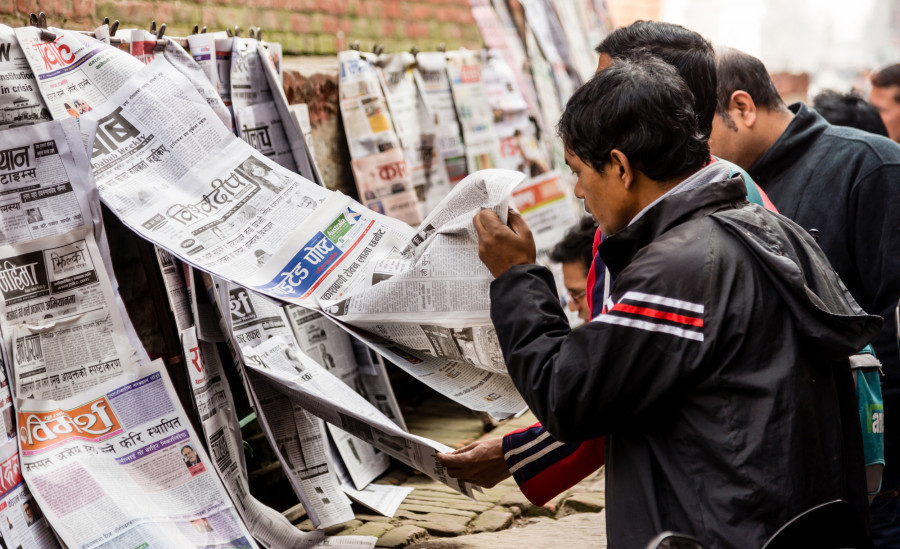
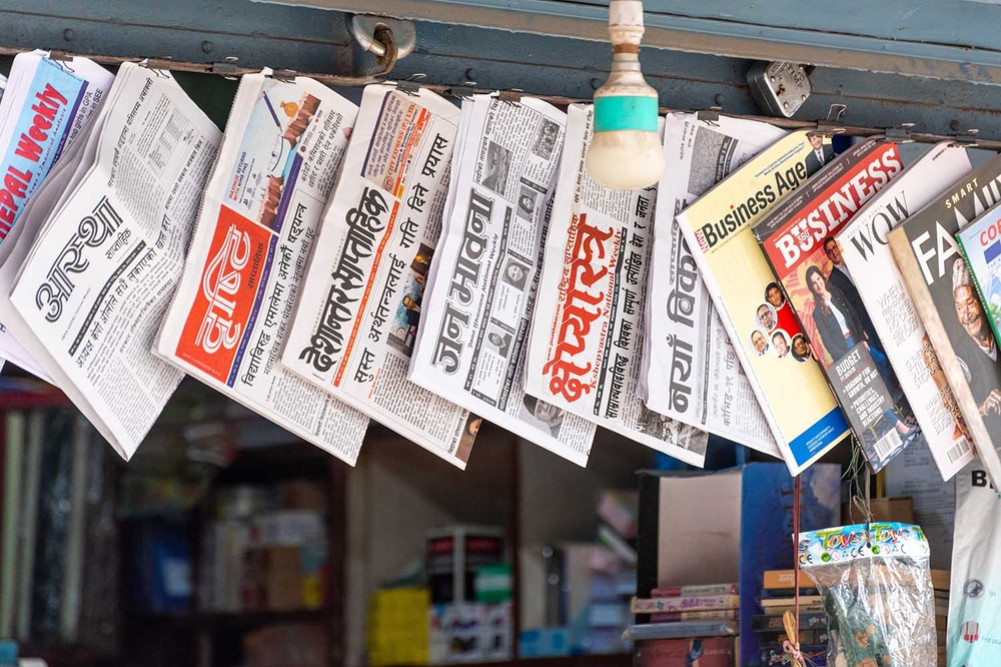
The Bhadau movement and the subsequent election results have opened the door to transformation for Nepali media. But it will not remain open forever.
We use Google Cloud Translation Services. Google requires we provide the following disclaimer relating to use of this service:
This service may contain translations powered by Google. Google disclaims all warranties related to the translations, expressed or implied, including any warranties of accuracy, reliability, and any implied warranties of merchantability, fitness for a particular purpose, and noninfringement.
When the National Independent Party won the election last Falgun with a huge majority, Nepali voters not only chose who would govern now, they also sent a clear message. The citizens, who were tired of the same faces repeatedly remaining in power for years but not making any fundamental changes in their lives, sought a break in the vicious cycle of decades. The election, which was based on the street movement of the young generation known as Gen-G in Bhadra 2082, was held on its strength, and the Nepali people voted in favor of accountability. The Bhadra movement and the subsequent elections not only changed the political landscape of Nepal, it also changed the way the common man views society and politics. In addition, it also provided an opportunity for Nepali journalism to introspect. Will Nepali journalism embrace this unprecedented opportunity? Or will it ignore it like in the past? Did Nepali media organizations also listen to the message given by the common man? Nepali media should also review this from the context of the election itself. There can be, and certainly are, different interpretations of the election and its results. Analysts and media organizations naturally tend to focus on the results and parties – who won, who lost, what kind of change, why the change, who will become a minister? Etc. Such analyses certainly have their place. It is not unusual for such analyses to be abundant on television, print, and social media. But another important issue that cannot be contained in the explanation of electoral arithmetic and party competition is the feelings and pain that citizens are trying to express, which has become even deeper due to the growing gap between political promises and common life. Gen-G did not take to the streets and demand a different or new party. They were seeking a review of the relationship between power and accountability. The government, civil society and the media were only saying that they should work with the lives of the common people at the center. That is also the mandate given by the election
When Gen-G took to the streets, they did not demand any different or new party.
. They were only saying that all institutions – government, civil society and the media – should work with the lives of the common people at the center. That is also the mandate given by the election. This issue applies not only to those who have reached office, but also to those who constantly write, demanding accountability from them. They were looking for a review of the relationship between power and accountability
It is true that the structure and functioning of Nepali journalism have been surrounded by political parties in its modern history. A cabinet reshuffle is getting more ‘coverage’ than the issue of how an infrastructure project failed. A party's 'press conference' easily becomes the news agenda, but a youth's preparation to go abroad due to lack of employment, a farmer's problem of not being able to sell sugarcane, or a rape case that has not been resolved for a long time are not getting the same importance. For a long time, Nepali media has considered journalism conducted only around political parties and the government as accountability to the people. Even organizations that have emerged as an alternative to traditional media are not free from this flaw. The 'Routine of Nepal Bandh', which has created its own kind of influence among the young generation, is facing sharp criticism due to news that seems to have advocated for Balendra Shah rather than independent journalism. No media organization is exempt from this criticism, not even Kantipur. But this is not a collective accusation. It is not that Nepali journalism has done nothing, it has also sought accountability a lot.
Journalists must write about politicians with rigor and consistency. But it is necessary to change the habit of how to do ‘coverage’ and how to ‘frame’ the news. Instead of asking ‘Which leader said what?’, we should write ‘Which leader promised what?’ Who voted believing in that promise? And what difference did it make in the lives of those voters?’ The meaning and relationship of power should be with the lives of ordinary people. In countries where accountability has become rare, in-depth journalism is needed. We should constantly monitor the power and honestly report on whether the power has delivered as promised or not. means that the news should focus on people and issues rather than parties and leaders. If a farmer in Chitwan asks, ‘Did the new government’s agricultural commitment bring any change to his life?’ then that topic should have been given a place. The dilemma of a youth in Dhanusha who said, ‘There is no alternative to going to the Gulf’ should have been given priority. A family in Dharan voted for change and whether they got the answer to the question ‘What has changed?’ should have been the main topic of the news. There are investigative reporting that exposes corruption, reports that show state failure, and journalists who work honestly even under difficult pressure. Nepal’s mainstream journalism is better than other South Asian countries. Institutional pressure on editorial freedom is constantly increasing in India. Nepali journalism has preserved a tradition of meaningful pluralism and accountable reporting, which cannot be denied. This is not so much a moral failure as it is an institutional deviation. The reason for this is not difficult to understand. In the absence of sufficient efforts for reform, this deviation has become the identity of Nepali media. One message given by the results of the last election is that there is a kind of distaste for this identity of Nepali media among readers, especially the youth. But it is not that trust in the media cannot be regained. But the door of this possibility will not remain open forever. If we look at the recent history of Nepali journalism, we do not find any strong basis for instilling trust, on which this profession can use an opportunity. The difficult issue is how to bring about changes in the way journalism is done. Reliability is much higher than the procedural issue of what to print and what is printed. It is a matter of the relationship with the source, the reader and the government. The media is organizationally close to the parties it is supposed to hold accountable, and the proximity is reflected in its news—even if that is not intentional. At the present time, the argument for freedom is not only moral. Readers are watching closely—whether the media understood their message or not. There is a more concrete problem within the profession, which the journalism world hesitates to name. The practice of ‘revolving doors’ in Nepali journalism has been well documented. Journalists who deliberately avoid questioning a leader or corporate house throughout their reporting careers and later take appointments with those same individuals and organizations and rise to advisory roles or other positions. This practice encourages staying close to power and appearing useful rather than holding the government accountable. Conflicts of interest have become commonplace in this context. This is also a major reason for the erosion of public trust in the press. If there is to be any honest reckoning with the structural problems of Nepali journalism, it must be included.
But the problem is not limited to journalists. The media ownership structure in Nepal has also created a lack of accountability to some extent. There are many examples of media institutions emerging as influence-creating enterprises rather than journalism. The influence of leaders seeking favorable coverage, business houses seeking protection from scrutiny, has led to the media being seen as a weapon to be used for influence rather than a public service.
When ownership is structurally compromised, editorial freedom becomes a matter of negotiation at best, a mere fantasy at worst. Journalists working within such institutions face an impossible choice – do you do journalism that you truly believe is in the public interest? Or do you try to save your job? This is not a crisis of personal ethics, it is a crisis of belonging. It is a crisis of legitimacy rather than ownership. These issues must be clearly addressed in any serious debate about the future of Nepali journalism.
The energy of any movement does not always remain at its peak. This issue also applies to the civic energy seen in the protests of last Bhadra. Movements are either meant to challenge institutions, merge with them, or transform them. Or, they can even fade into oblivion. Looking at Nepal's recent history, it is also true - what happened to the energy of every major movement after the restoration of democracy in 1990? Where did it go? The youth who led the movement last Bhadau are not yet trapped in 'patronage' politics or party mire. If we can talk about their experiences and accept accountability as a daily practice rather than a routine, Nepali journalism has an opportunity to reach out to the youth before 'patronage' politics and party loyalty take over. There is also an opportunity to earn their trust.
But this opportunity has a time limit. Political structures have their own burdens. The new faces in power will not only build relationships with journalists and media organizations, they will also make full use of social media, which is as powerful as any news organization, to shape public debate. Old behaviors will find new excuses and justifications. The old ‘patronage’ culture will be replaced by a new kind of ‘patronage’ culture. The question is whether Nepali journalism will find a new path or emphasize difference, so that what this profession aspires to do can be truly put into practice.
If Nepal’s major media organizations have earned trust over the decades, it was not because they were powerful. That trust was given because they were useful, useful in understanding/explaining the stories of the community. They were trying to hold leaders accountable. They were helpful in portraying the direction and condition of the country and society realistically. That was the unwritten contract between journalism and the common people, and the present time is reminding journalism of that original contract.