Our mountains are melting and our sources of water, from agriculture to agriculture, are being depleted. That is why we are facing unimaginable disasters of different nature every year.
We use Google Cloud Translation Services. Google requires we provide the following disclaimer relating to use of this service:
This service may contain translations powered by Google. Google disclaims all warranties related to the translations, expressed or implied, including any warranties of accuracy, reliability, and any implied warranties of merchantability, fitness for a particular purpose, and noninfringement.
Politics is not just about managing the present, it is also an unbroken succession that completes the unfulfilled dreams and resolutions of the past.
The House of Representatives of 2079-2082 suffered a tragic fate. The rebellion of Bhadra 23 led to the dissolution of the parliament less than 33 months later. That dissolution became like the story of a young man who lost his life in the bush. The extent to which the parliament itself was a factor in that untimely end will be decided by the court of history, but we must accept the bitter reality that the premature end left many important issues of public concern unresolved.
In the previous term, many important bills related to the state structure such as the school education bill, civil service, police, and Guthi could not reach a conclusion. At the same time, the seeds of a long-term debate were sown in the parliament. Due to the climate change crisis, a common preparation was started that Nepal should take the lead in strong internal preparations and international coordination for a long-term solution to the natural disasters we have been facing in recent decades. Realizing this reality, we, some of the young parliamentarians of the then parliament, had tried to bring climate change into the mainstream of the state by forming a permanent structure of the 'Climate Parliament' in Nepal. That was not a short-term slogan, but a far-reaching step that Nepal, which was being punished through no fault of its own, must take before the world for 'climate justice'. For that, we had put forward a historical concept for Nepal, which was being practiced by neighboring and friendly countries.
In the past, there were many formal/informal discussions on this issue inside and outside the parliament. I will leave it to their discretion to decide how much the leadership of the then parliament and the government understood or did not want to understand the depth of this issue. But ironically, the initiative to reach a concrete conclusion could not be institutionalized with the untimely end of the parliament.
Nepal, which has the lowest carbon emissions in the world, is the most affected by climate change. Our mountains are melting and our sources of water from agriculture to water are being depleted. That is why we are facing unimaginable disasters of different nature every year. Be it the nature of the devastating floods in Melamchi, the Kagbeni floods and the heavy rains in the Upper Mustang region, or the floods seen in the areas around the Everest base camp, all are linked to the terrible effects of climate change.
Looking at international practices, it seems that such parliamentary structures have made the policy implementation rate effective by 30 to 50 percent. The climate crisis is not a simple problem that can be solved by a one-time budget or a ministry alone. It is a long-term challenge that will last for generations. Nepal has been presenting the issue of climate change in an effective manner in international forums in recent times. The visit of UN Secretary-General Antonio Guterres to Nepal and the topic presented by the then Prime Minister Pushpa Kamal Dahal at COP-28 drew attention to Nepal's melting mountains. The agendas put forward by Nepal at COP29 are equally important. Special climate finance for mountain regions, a strategy for upgrading from LDCs to developing countries, easy access to adaptation and mitigation projects, and grant-based compensation for losses are relevant. These agendas have not only highlighted the sensitivity of Nepal's mountainous geography, but have also made the injustice that Nepal is facing while being at the forefront of the climate crisis despite its low carbon emissions a topic of global debate.
Despite all this, do we have a permanent mechanism to continuously monitor these high-level agendas within the country and ensure their implementation? No. Nepal has good climate-related policies, laws and plans, but their implementation is very weak. Plans written on paper alone are not enough to deal with the climate crisis. This requires a structure with solid administrative and political will.
Climate change is not just an environmental issue. It is a question of development, economy, health and survival. The issue that has caused the most suffering even with minimal carbon emissions is climate injustice. Its solution cannot be found only by raising its voice on the international stage. A strong institutional structure is needed within the country. Therefore, it is urged to bring the issue of a climate parliament into the debate with the formation of the new parliament.
Looking at international practices, it seems that such parliamentary structures have made the policy implementation rate 30 to 50 percent more effective. The climate crisis is not a simple problem that can be solved by a one-time budget or a ministry alone. It is a long-term challenge that will last for generations.
The statistics are even more frightening. In eight countries of the Hindu Kush Himalaya region, about 18 million people lost their lives prematurely in 2016 due to air pollution alone. I had clearly stated this reality as a panelist at the first Hindu Kush Himalaya Parliamentarians' Conference held in Kathmandu in 2082 Bhadra. There should be no delay in making the roadmap for regional cooperation that the conference has drawn through the five-point call meaningful. It would be appropriate to establish a permanent structure like the 'Climate Parliament' in Nepal to institutionalize that regional cooperation at the domestic level and keep climate issues at the center of policy priorities.
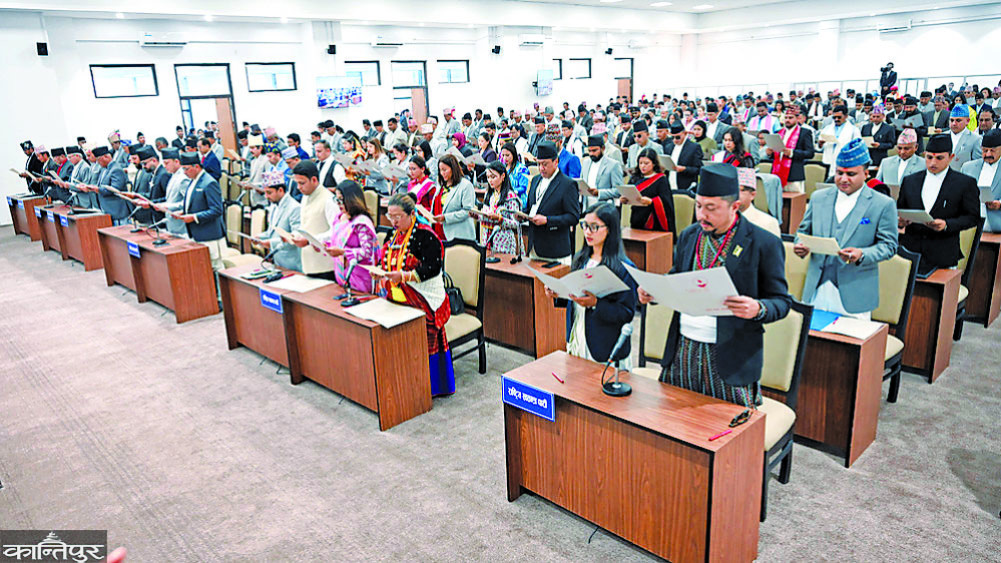
There is no vested interest here except that this debate should not stop until the process of our settlements becoming deserts due to climate change is stopped and until our voices are heard in international forums. I believe that the new parliamentarians will rise above party circles and seek a solution to this common crisis through a structure like the 'Climate Parliament'. My position and that of others who debate this may have changed, but my hand of caution and cooperation will always continue to move forward for the suffering geography from Sindhupalchowk to Mustang and their future.