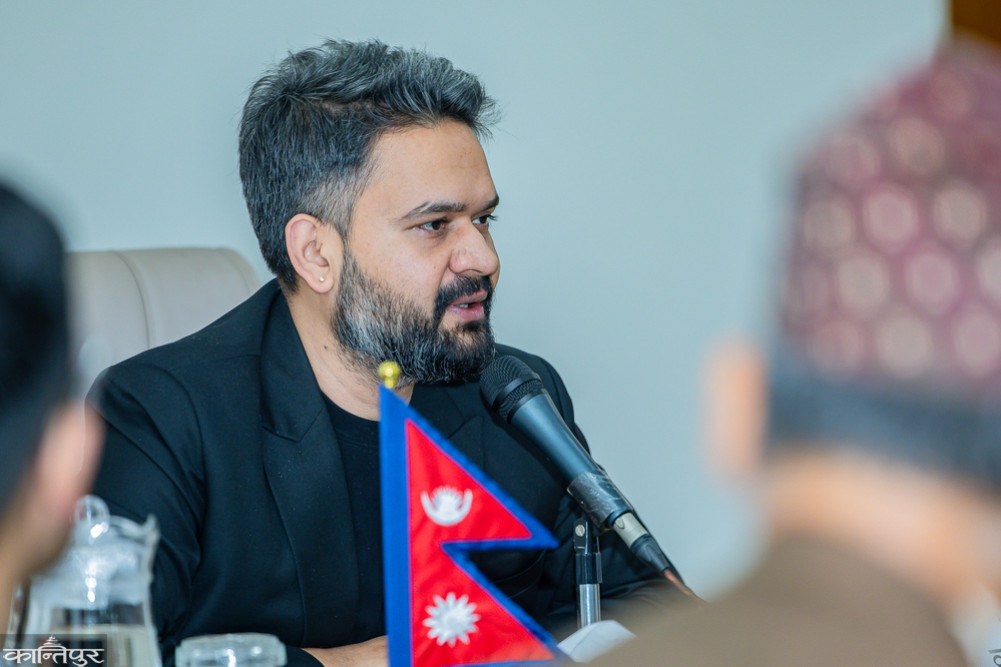
What is the meaning of knowledge in democratic governance? Is the ability to make decisions based on ego, passion, and impulses 'knowledge'? Or is it 'knowledge' to make mature decisions and implement them with the trust of the people? Or is it 'knowledge' to brutally evict squatters without preparing for their resettlement?
We use Google Cloud Translation Services. Google requires we provide the following disclaimer relating to use of this service:
This service may contain translations powered by Google. Google disclaims all warranties related to the translations, expressed or implied, including any warranties of accuracy, reliability, and any implied warranties of merchantability, fitness for a particular purpose, and noninfringement.
On Friday, the day of Buddha Jayanti, when Prime Minister Balendra Shah (Balen) was preaching to the people to ‘light the lamp of knowledge’, at the same time, his bulldozers were razing a Buddhist monastery along with the settlement in a slum area near Balkhu. The operator of the Sange Choiling monastery pleaded with the bulldozers not to raze it on Buddha Jayanti. However, the orderlies, who were assigned to strictly implement the ‘decision from above’, did not listen to that plea and destroyed the monastery in a moment.
The Balen government has been launching an intensive campaign to vacate the encroached slums on the river banks of the valley for the past few days. With the second phase of the campaign, not only the Buddha statue has been abandoned. Hundreds of destitute people have been left homeless. At least two people are said to have committed suicide due to depression. And, many others are suffering from deprivation, disorganization and uncertainty in temporary camps. Schools of school children have been reduced to rubble. Children who have missed their studies are in psychological distress. Pregnant women and the elderly have been made into a cat's nest.
While the cries and cries of the slum dwellers continue to disturb the minds of the people, Prime Minister Balen has appeared in a 'philosophical avatar'. 'Our journey should be in search of the light of knowledge, it should be on the path of problem-solving', he gave a message of greetings on the day of Buddha Jayanti, 'The true revolution does not begin with 'A', but with 'Knowledge' and that 'Knowledge' is knowledge.'
Seeing Balen, who is influenced by Buddhist philosophy, it seems that the voters have praised the leader who inspired Nepali society to walk the path of knowledge by bringing him to the pinnacle of power. However, when one tries to find harmony between this philosophy and his style of governance, one does not find it at all. And, one is shocked. What kind of ‘knowledge revolution’ is this, which does not listen to the cries of the victims, does not see humanity?
Balen is the leader of a democratic governance system. What is the meaning of knowledge in democratic governance? Is the ability to make decisions based on ‘ego’, impulses and impulses ‘knowledge’? Or is it ‘knowledge’ to make mature decisions and implement them with the trust of the masses? Or is it ‘knowledge’ to make the squatters rise up without preparing for their rehabilitation? Or is the slogan of the ‘knowledge’ revolution just a malicious intention to bake the bread of patriotism under the guise of Buddha’s teachings? How appropriate is it that a ruler who has the insensitivity to demolish a monastery on the very day of Buddha’s birthday advocates the path of knowledge? After creating another disaster in the name of saving the Sukum people from a disaster, Balen is under siege from questions.
In terms of philosophy, the 'Knowledge Revolution' is a powerful 'statement' that advocates peace and wise change, not violence. However, when the 'Knowledge Revolution' cannot be transformed into reality, it becomes only a symbolic verbal pomp.
Gen-G activist Raksha Bam questioned Balen's 'Knowledge' revolution. She wrote, 'A true revolution begins with 'A', Prime Minister, and that 'A' is compassion.' Then the philosophical conflict between the 'Knowledge' and 'A' revolutions began on the Internet. In particular, Buddhist philosophy advocates a balance between wisdom and compassion. Buddhist philosophy says that knowledge without compassion does not give light. Rather, it pushes us further into darkness. That is, knowledge and compassion are two sides of the same coin. Knowledge shows the direction, while compassion gives the momentum.
It is a pleasant thing that Balen has set himself on the path of knowledge on the day of Buddha Jayanti. But, are his behavior and governance style oriented on that path? Just as UML General Secretary Shankar Pokharel asked what the blueprint for the 'knowledge' revolution is, Balen has to be asked, is his knowledge revolution in his thoughts or in practice?
When you see Balen, who is influenced by Buddhist philosophy, you immediately think that voters have praised the leader who inspired Nepali society to follow the path of knowledge and brought him to the pinnacle of power. But when you try to find a harmony between this philosophy and his style of governance, it is not found at all. And, the mind is torn. Balen is not touched by questions. He does not feel the slightest need to take responsibility for the questions raised against him. He will speak, but he does not speak. But, the common people cannot remain silent by saying this. After being given the opportunity to rise to the pinnacle of power by voting 'silently', now the citizens have started questioning Balen's behavior and working style.
Balen gave the way to question a month ago from the oath-taking ceremony. He started attacking the constitution and constitutional norms at that time. The day he took oath as Prime Minister, a question was raised in a low voice, is the oath constitutional or a symbolic attack on the constitution? The question was justified, because the executive head of a secular nation had taken the oath by mocking the constitution while performing religious rituals.
Balen, who became Prime Minister with extraordinary public support, is still a 'popular' character to this day. When Balen, who emerged amidst a strong outpouring of public support, took the oath violating the spirit of the constitution, only questions were raised in a low voice, and he was scolded. Most understood it as a respect for tradition and a cultural expression. However, Balen had already started disrespecting the constitution from the very day he assumed office.
On the day of the first meeting of the parliament, he further violated democratic culture. Balen has emerged as a beacon of hope for the Nepali people who have been hurt by the party system. The expectations of the public are high for him. It was natural that the public wanted to hear Balen from the first meeting of the parliament. The public expected that Balen, as the Prime Minister, would thank the voters and clarify the priorities of his plans and programs. In a parliamentary democracy, it is also the minimum democratic culture for the Prime Minister to stand on the rostrum of the parliament and express his views. However, none of this happened on the first day of the parliament. Balen appeared in the parliament wearing a T-shirt under a black coat, not even in formal attire, but did not speak. Judging by Balen's initial one-month governance style, he is not very interested in communicating with the people through parliament. Instead, he intends to exercise arbitrary power from the rooftops of Singha Durbar or Baluwatar. The way he is promulgating ordinances by postponing the parliament session that has already been called, the initial signs of what kind of governance he wants are already starting to appear.
It is not such a big 'incident' for any government to issue an ordinance. This is a provision of the constitution. The constitution allows the issuance of ordinances to remove legal obstacles in special circumstances. But, is the Balen government in a special situation at this time and did it have to deceive the parliament and bring an ordinance? The Balen government has almost two-thirds support in the parliament. He has enough support to pass any bill. Despite this, the way Balen has bypassed the parliament and imposed the rule of the ordinance. If this is understood only in the sense of trying to speed up delivery and shorten the process, it will be incomplete. Its essence is the devaluation of parliamentary practice. This will not only reduce the role of the sovereign parliament, but also weaken the public debate on policy making. Which is not a pleasant matter for the democratic value system.
A month has passed since Balen became the Prime Minister. However, the general public has not yet been able to understand him. There is confusion among the citizens about his 'mysterious' personality. The occasional messages on the network have become a window to peek into his personality. Balen is known by the Nepali youth as a rapper. The residents of the capital recognized him as a brave mayor who was not afraid to make decisions . How much work did he do when he was mayor, how much could he not do ? An objective review is necessary . However, his identity was established as a 'working mayor' . Now, even after becoming the Prime Minister, he is trying to create the image of a 'working prime minister' by making rash decisions in the style of a mayor.
Balen's governance style as Prime Minister has been both praised and criticized . Some say, 'Balen's unprecedented decision-making ability and some of his governance reform works have set a new standard .' He has praised his style of making decisions and implementing them immediately . Meanwhile, many people who have encroached on public land in the name of Sukum residents have been 'exposed' . Even after more than 1,500 political appointees are to be removed from their posts through the ordinance, he has been praised on the internet .
While some are praising Balen's domineering style, criticism and concern are also being expressed equally. Those who believe in democracy and the rule of law are worried about his impulsive style of work. Some have criticized Balen for repeating authoritarian rule and for making autocracy more fascist-oriented under the guise of democracy.
The government, on the other hand, has claimed that by removing the squatter settlements, it is an effort to protect public property and prevent possible human losses from floods. The government says that removing the settlements is not a matter of displacement, but a step to protect from disasters. But rights activists say that in the name of protecting from disasters, the government has caused another disaster. The real question is not whether to remove them or not, but how to remove them. Rights activists have protested that the government has trampled on the right to life by using a bulldozer in an impulsive and immature manner without necessary dialogue with the squatter families and without making prompt arrangements for rehabilitation.
Amidst the criticism and praise, one reality is that even his well-wishers/supporters who wanted to let Balen work have started to be annoyed by his silence. Nepali society is certainly fed up with the long speeches of leaders. Nepali society no longer likes long, rambling speeches. But, can there be an exemption in a democracy not to speak to the Prime Minister? The Prime Minister is that position for which speaking is not an option, it is the minimum basis for accountability.
Sometimes there can be strength in silence. It can also be strategic. The people, tired of listening to the rambling speeches of leaders, may prefer leaders who speak less. Speaking less also reduces errors. The possibility of unnecessary disputes is reduced. In this sense, speaking less or not speaking at all can be strategic. However, constant silence, ignoring important meetings and forums can be counterproductive for the political leadership. Have Balen's recent impulsive decisions, which have indulged in exercising power while ignoring systemic reforms, increased confidence in him? Not at all. On the contrary, his style of devaluing methods and surprising silence have increased doubts. It has been confirmed time and again in the past that rule cannot be sustained on the basis of military force and psychological terror. This style increases anger and hatred towards the ruler. Which ultimately leads to chaos, violence and counter-violence. Balen should at least reflect on this in time.
At present, the capital is in the midst of a state of terror. As the slums continue to collapse, the residents of the corridor have put up their wealth certificates on their doors, fearing that a bulldozer will run over their homes on impulse. How will the Balen government bridge this gap of fear and distrust? Preach the path of walking the path of Buddha and follow the Buddha's philosophy in practice are two different things. The most important responsibility of the powerful Prime Minister Balen at this time is to restore the lost faith by bringing the people out of fear. For that, he must first break the mysterious silence.
Balen has got an extraordinary opportunity for systemic governance reform. Approved by the people, he has both the suitability and opportunity to establish himself as an accountable and democratic Prime Minister. Despite such an opportunity, he has moved forward on the path of becoming a 'ruler' under the guise of exercising power. To become a servant of the people who protects democratic values or a 'ruler' who enjoys exercising power? Balen should reconsider his style of governance without delay. Only then will the justification of his 'knowledge' revolution be established. If the 'knowledge' revolution is his guide in the true sense, then it should now be reflected in his policies, behavior and style of work. From there, the real height of his politics will be revealed.