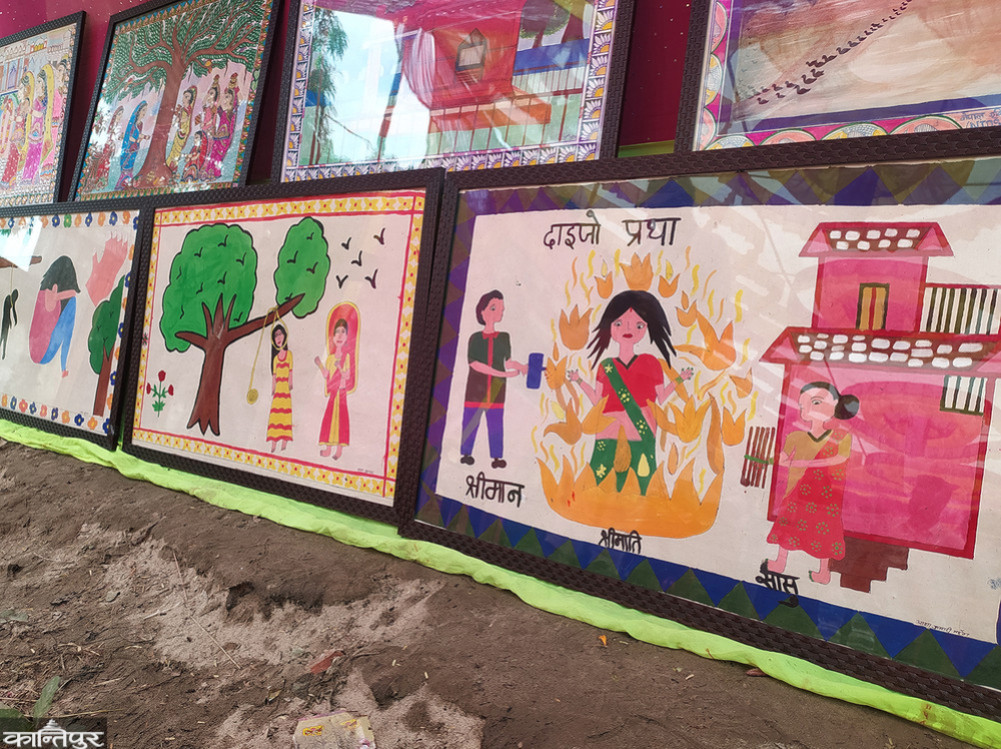
Although some priority has been given to gender equality through the peace process, the normalization of violence in armed conflict has had the most negative impact on women.
We use Google Cloud Translation Services. Google requires we provide the following disclaimer relating to use of this service:
This service may contain translations powered by Google. Google disclaims all warranties related to the translations, expressed or implied, including any warranties of accuracy, reliability, and any implied warranties of merchantability, fitness for a particular purpose, and noninfringement.
A few days ago, the new Deputy Speaker, Rubi Kumari Thakur, made her stance on dowry public and announced that she would boycott it completely and would not participate in dowry-giving and -giving marriages. This is a very commendable stance. Although her stance on dowry is part of the normal conduct of any civilized society, there is a separate background to praising her in this article.
Insensitive political leadership
After the peace process began after the Maoist conflict, a study showed that violence against women was increasing in Nepal. Although some priority was given to gender equality through the peace process, the normalization of violence in armed conflict had the most negative impact on women. Dowry-related violence was seen as the main factor in the increasing violence against women.
Feeling that the physical security of half the population is more important than the constitution, I suggested that political parties should take the initiative to end violence against women in the meeting of the major parties. At that time, I happened to be involved in a project that took the initiative to bring all the major political parties together on one platform to find consensus on the controversial issues of the new constitution. Feeling that the physical security of half the population is more important than the constitution, I suggested that political parties should take the initiative to end violence against women in the meeting of the major parties. I emphasized that it is not possible to rely solely on NGOs to resolve such a sensitive issue.
During the discussion, since the problem of dowry is very serious in Madhesh, a proposal was made to launch a collective campaign on this issue there. However, some representatives of the Madhesh-centric parties said that it was not possible to launch an all-party campaign on the issue of dowry in the Madhesh environment. As I understood it, the campaign to end dowry would be against the interests of the elders of Madhesh. The leaders of Madhesh were worried that if the Thalas got angry, their votes would decrease. For this reason, the political campaign to end dowry could not be launched.
Rihanna burnt alive
The consequences of political insensitivity to the dowry issue were immediately apparent. In 2014, when Women's Day was being celebrated in luxurious hotels in Kathmandu, news came from Nepalgunj that 19-year-old Rihanna Sheikh was burnt alive by her husband. The reason was - dowry. Her husband had demanded a motorcycle, a watch and a buffalo from Rihanna's family. When that demand was not met, the husband started to physically torture Rihanna. He would burn Rihanna all over her body with cigarettes. One day, he set Rihanna on fire. At that time, she was seven months pregnant.
The most heartbreaking aspect of reading this news was - after burning Rihanna, her family left her in the room to die. Hearing her crying in pain, the neighbors rescued Rihanna. If she had died, it would have been over (which would have been a very sad matter in itself), but how could Rihanna have endured the pain without any treatment, with her body charred by fire?
Rihanna's husband was deported to India because he was affiliated with a political party. After coming into the limelight, some political leaders went to Bir Hospital to meet Rihanna. But they did not take any initiative to arrest Rihanna's criminals, nor to end the root cause of her dowry. Poor pregnant Rihanna's weight had dropped to 20 kg. Some personal initiatives were taken to provide her with nutritious food. But the powerful leaders who went to meet Rihanna did not contribute anything to her health treatment.
Having seen such insensitivity of leaders to the problem of dowry in the past, the general stance taken by the new Deputy Speaker is also commendable. The main reason for the increase in violence against women in Nepal is the tendency of political parties to protect the perpetrators of violence against women. The context shows how low the priority of this problem is for the leadership, as the Nepal government does not even have comprehensive data on women suffering from dowry.
Dowry problem across the country
The context shows how low a priority this problem has been for the leadership, as the Nepal government does not even have comprehensive data on women suffering from dowry. The problem of dowry is not limited to Madhesh, it is present across the country. I have tried to discuss this by adding some of my personal stories. I had the opportunity to study for a bachelor's degree at the famous Lady Shri Ram College in India. The principal there, Meenakshi Gopinath, was known as a staunch feminist. One day, she angrily said in the assembly, "If you study in such a prestigious college and are able to afford it, you will tear up your degree."
According to her, thousands of farmers in India committed suicide because they could not give dowry to their daughters. If even educated women do not change the practice of dowry, then their degrees have no meaning.
Her opinion deeply impressed my young mind. I decided to apply what she said to myself and my close friends. I thought that if not only the dowry but also the wedding itself was not spent at all, perhaps it would reduce the social pressure on the financially weak families to pay for their daughters' wedding expenses.
A few years after finishing college, it was time for the wedding. First came the turn of my childhood friend. She was a very capable engineer from a wealthy family. It was not possible to get her married without spending any money, but as per my suggestion, she wore very little and simple jewelry for the wedding. Since it is customary to give a bed, a chest of drawers, and a sofa set to daughters at weddings, she told her family that if she wanted to give a gift, she would not do it at the wedding, but would give me money later.
Our aim was to set an example that if capable daughters from wealthy families got married wearing limited jewelry and without taking any dowry, then poor families could also do the same. Since she herself was a good earner and conscious, that friend had strong confidence to fight against the evil practice of dowry.
But that confidence disappeared within a few weeks of the wedding. She met me and said, 'The advice you gave is wrong. After the wedding, some of the husband's relatives came to the room to see what she had brought, but there was nothing there.' Her husband's relatives had also looked at her jewelry. 'How small? Why are you wearing so little?' They had told their friend's mother-in-law. Under social pressure, her friend's mother-in-law said, 'If she didn't have it, she would have worn the big set we gave her.'
If the situation of such educated and financially independent women is like this, what will happen to others? This shows that the social pressure of dowry is equally prevalent not only in the villages but also in the cities. In the capital Kathmandu, the commercial Marwari families still confidently demand 'tilak', perhaps because they are rich, and it is not considered a crime. My friend, a new bride, was very upset and stressed after hearing this opinion from her new family. According to her friend's experience, what was given at the wedding is different, no matter how much is given to the daughter later, it has no meaning. If she doesn't give it at the wedding, it has no respect for the daughter-in-law and her family.
This evil practice has also started in the tribal communities, where there was no dowry tradition. Even the leftist leaders who offer an alternative to democratic marriage are now organizing ugly weddings that promote the dowry culture, as was shown in the video that went viral during the Gen-G uprising last year. These examples show that the problem of dowry is widespread not only in Madhesh, but throughout the country.
The virus of society
At first glance, the question may arise as to what is wrong with giving the best gift one can to one's daughter in marriage. But this is linked to many oppressions in our society. In our society, the belief that 'have a son' is mainly related to the burden of dowry. In order to survive this burden, many girls are also killed in their wombs in our society, which has been found to be increasing these days. According to a study, one in every fifty women in Nepal is missing in proportion to the population. What psychological impact does this situation have on all women?
Not only female foeticide, many young women in Madhesh have to suffer like Rihana due to dowry. Many murders due to dowry are covered up as kitchen accidents and the perpetrators are not punished. Again, in Madhesh, women are also deprived of education due to dowry. Parents are forced to save money for dowry rather than educating them.
In today's extreme consumerist culture, when the dowry tradition continues, many families are forced to take on debt for their daughters' marriages. There are examples of many fathers and daughters committing suicide due to not being able to repay such debt.
Therefore, dowry is a terrible virus in our society, which has poisoned our society. In such a context, if we think about what goes wrong when we love our daughter and give her gifts at her wedding, we should remember the many innocent daughters who are killed on the pretext of dowry. It is also important to remember the fathers of many daughters who are forced to commit suicide. Again, in Madhesh, women are also deprived of education due to dowry. Parents are forced to save money for dowry rather than educating them.
Ending the dowry system
Our experience so far has shown that the expansion of education alone does not end dowry. It is said that in some areas, the more educated people are, the more dowry is taken.
Overall, since the problem of dowry is multifaceted, the solution also needs to be multifaceted. First of all, the government should effectively implement the constitutional right to give equal ancestral property to daughters, not dowry. After giving equal property, dowry itself should be irrelevant.
In addition, dowry, as the Deputy Speaker said, should not only be excluded, but also criminalized as a vice. Currently, our law only considers direct dowry as a crime. The practice of giving and receiving dowry voluntarily has been given legal legitimacy by linking it to Hindu religion and culture (the Social Reforms Act 2033 allows for giving dowry up to ten thousand). However, some recent studies have shown that the dowry practice is not from Hinduism but from the British colonial period in India.
Due to the social pressure of dowry, even if it is not directly asked for, all the daughters' families are forced to give dowry, even for their own reputation. Therefore, it is necessary to criminalize not only those who directly ask for dowry, but also the practice of giving and receiving dowry voluntarily as a crime.
The practice of dowry is also against international human rights and women's rights laws signed by the Nepalese government. Once the law itself starts considering dowry givers as a crime and taking action, its social pressure linked to social reputation will also automatically decrease.
However, the subject of dowry is not my expertise, it is just a reflection of limited experience. Many other experts may have better ways to completely end dowry. But it is not because of a lack of expert suggestions that dowry has not been ended, but because of a lack of political will.
After the new Deputy Speaker raised the issue of dowry, I looked at some documents of the Rashtriya Swayamsevak Sangh (RSS), which is leading the government. Since the father of a daughter of Madhesi origin who says he will ‘improve the country’ is the Prime Minister, I thought there would be concrete proposals regarding dowry. But I did not find the issue of dowry given priority in any of the RSS’s manifesto, 100 agendas, and national commitments. Until the situation where daughters are forced to suffer due to dowry ends in Nepal, will the Prime Minister’s vision – ‘I want to see Nepal smiling’ – be meaningful?