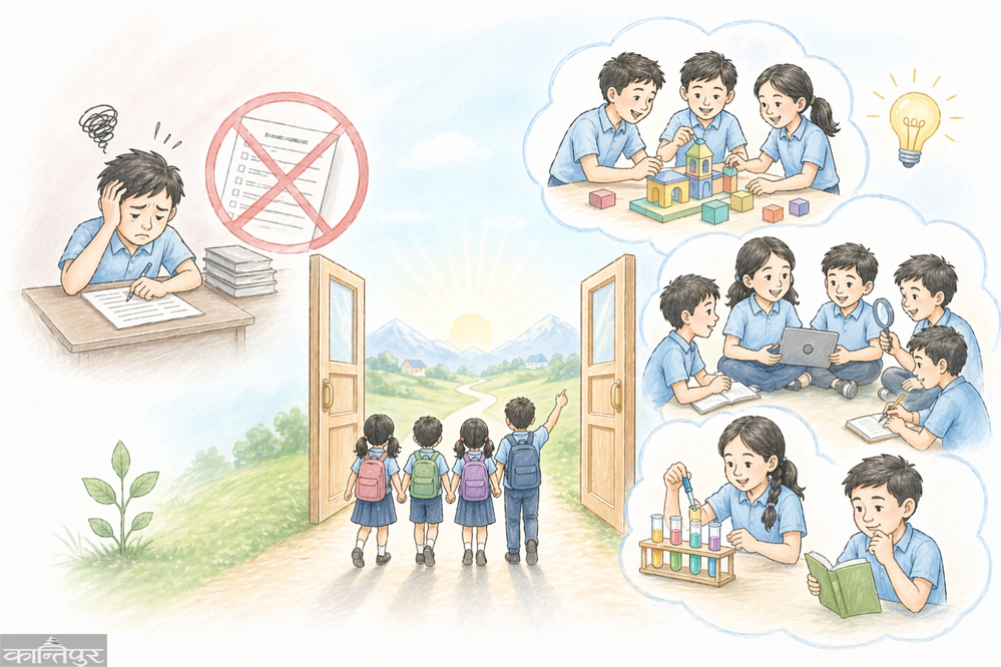
The primary goal of an exam is to test whether a student has learned something or not. Learning something does not mean storing it. Rather, it means being able to use it. An honest test of knowledge should not be ‘Can you remember it?’ but ‘Can you do something new with it?’
We use Google Cloud Translation Services. Google requires we provide the following disclaimer relating to use of this service:
This service may contain translations powered by Google. Google disclaims all warranties related to the translations, expressed or implied, including any warranties of accuracy, reliability, and any implied warranties of merchantability, fitness for a particular purpose, and noninfringement.
The government's new directive to replace internal written exams from grades 1 to 5 is a great promise. This reform has been taken forward to reduce stress in children. If we understand this issue well and make a true assessment, we can also change Nepal in the future.
Nepal is going through a political transformation at this moment. We all need to ask ourselves - what kind of Nepali citizens do we want to be in the future?
We need to think about assessments designed to produce real results, moving beyond traditional exams to make our children capable of solving real-life problems. When I first came to Harvard, my presentation was weak in all classes. Even though the assignments were clearly written, I used to have this dilemma: 'What should I include in my submission?'
The assessments here were different. What does 'good work' look like here? What are my classmates, teaching team, exams, and assignments asking for? It took me almost a year to understand this.
I realized that the coursebook was not demanding concept reproduction through exams. Instead, it was demanding that I communicate my knowledge creation through facts and present it as ‘What can I create?’ through knowledge. I now realize that these experiences changed my ability to create and the way I live by learning.
That experience sparked some thoughts in me that my learning experience in Nepal and India was being evaluated only by written exams. It tested only one skill, that is, memorization.
Let’s look at the purpose of exams. Its initial goal is to test whether our students have learned or not. Learning something does not mean storing it. Rather, it means being able to use it. That is why an honest test of one's knowledge should not be 'Can you remember this', but 'Can you do something new with this?'. The current written examination system in Nepal has not achieved these objectives.
In particular, this 100-mark written examination has pushed back our ability to create and innovate. I am convinced of this. Our current examination system rewards only the ability to remember. The real potential of Nepali youth is being wasted on outdated memorization practices.
We are trying to bring back our memories by selling our years of curiosity and experimentation. Our ancestors left us a legacy of real experimentation and art. Materials like the sickle, the sarangi and the doko were born out of necessity and invention.
Today we see imported materials, copied inventions and a second-hand lifestyle all around us. These are all our ‘copy-paste 100-point exam results’.
If these traditional exams fail to achieve their goals, how do we build a learning system? What to test? What to reward?
Two things are most important to make students innovators and creators in the Nepali community – the basis of creative ability and the assessment of students based on learning experiences.
Relevant and individual project-based assessment requires students to prepare creative facts based on their learning. It is too late to bring this style, which is being adopted by educational institutions around the world, to Nepal.
We should create an assessment mechanism based on diverse materials such as group projects, essays, materials reflecting their thought processes, written exams, etc. created by students. They should also be rewarded on that basis.
The process of moving from one assessment exercise to many exercises is certainly not easy. This requires reflection on how the curriculum is prepared and used. Innovation in curriculum design is essential. At the heart of this proposal is the transformation of our goals. Every lesson and unit should take students from understanding to creation.
We read about the definition of pollution in science and environment textbooks. Students are asked the question – ‘What is air pollution? Explain with some reasons.’
Instead – ‘What changed your perception of air pollution after you spoke to the local ward officials? How?’
Such creative exam questions provide a good opportunity for students to answer based on their own learning experiences. Such questions also encourage personal experience, creative thinking and fact-based invention.
It changes the classroom. Teachers facilitate, students gain meaningful experiences, and knowledge is constructed, not handed down.
Such factual assessments change the way we teach, learn, and live. Bloom's Taxonomy, the global benchmark for educational improvement, reminds us that knowledge is only the beginning. The highest level of learning is when students create something from what they know. Tests alone are not enough to measure a student's ability to create something from their knowledge.
It is equally important to evaluate the student's experience. In my personal observation, large universities like Harvard ask their students to write a written evaluation of the course two or three times each semester. This is a high priority for them. These assessments determine whether the intended outcomes of the educational material have been achieved or not. It also helps teachers understand student expectations and adjust the teaching team as needed. I think this general feedback style can solve many problems in the Nepali education system as well.
If Nepali educational institutions want to create subjects that their students find important, they should first ask the students about it. After all, students are the biggest stakeholders in their education. Their ‘output’ is important to make education timely and creative.
The need for change is greatest now. Artificial intelligence (AI) can memorize facts faster than any student who has just taken the SEE exam. If memorization or recall of information is the only basis for the exam, then we have already lost to AI.
If we keep this system as it is, Nepal will lose in two ways—first, the memorization of Nepali students will have no meaning in the rest of the world. Second, those students will not even know how to solve the real problems of their own country.
Educational reform is a very big and serious issue. It has its own complexities. Therefore, we need to think a lot about ‘re-designing’ the assessment system. And, we need to focus on this work.
The way we are assessing Nepali students now needs to be re-evaluated. And, the educational system should be designed accordingly.
(This article is published as part of the Thought Series prepared in collaboration with ‘The Nepal Discourse’. ‘The Nepal Discourse’ is a program organized by Harvard University and MIT, which focuses on setting Nepal’s strategic vision for the coming decade)