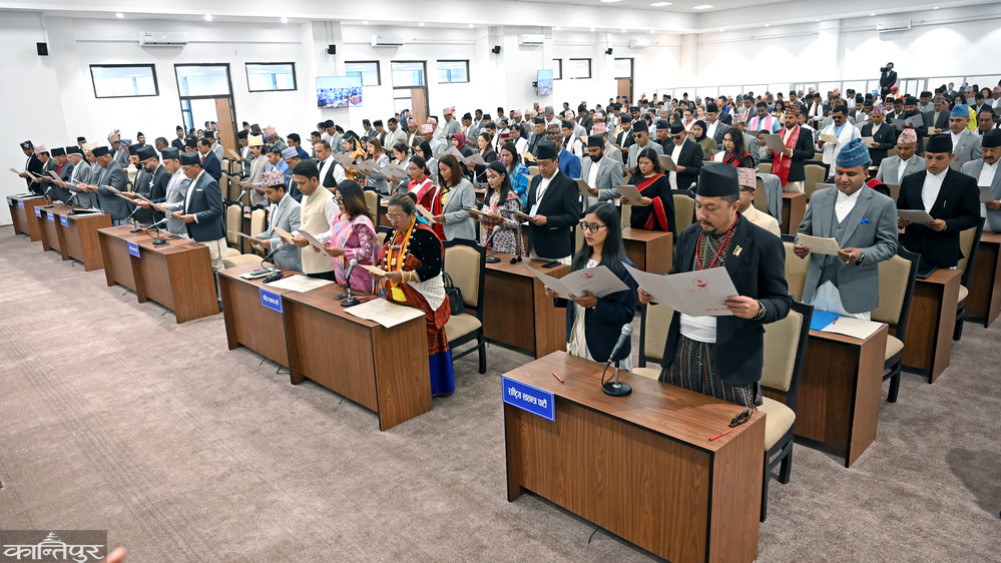
In Nepal, although MPs risk losing their positions if they disobey the party whip, there is no immediate action taken against those who disobey the will of the people or make wrong decisions. This is why MPs are dependent on their party.
We use Google Cloud Translation Services. Google requires we provide the following disclaimer relating to use of this service:
This service may contain translations powered by Google. Google disclaims all warranties related to the translations, expressed or implied, including any warranties of accuracy, reliability, and any implied warranties of merchantability, fitness for a particular purpose, and noninfringement.
The educational qualifications of politicians including MPs and ministers in Nepal have been a subject of much discussion and debate. It is natural for the people to look for educated people in the places where policies and rules that will have a long-term impact on the country are formulated and implemented. But democratic representation in parliament cannot be viewed only in terms of degrees, formal education or expertise. After all, what kind of MPs are we looking for? Who or what do they represent and how do they do it? The constitution has tried to answer this question through its own structure. But in practice, that concept has not been fully implemented. Therefore, the main question now is how to put the representation envisioned by the constitution into practice.
It can be understood that the desire for educated and expert MPs is for self-aware MPs who take decisions keeping in mind the long-term interests of the country rather than self-interest or momentary gains. The common citizen may not be aware of the specialized issues discussed in parliament, such as finance, education, health, and so on, and MPs may have to use their discretion to make immediate decisions even on urgent matters. In such a situation, it is natural to look for MPs with knowledge and expertise. But if MPs are given such discretionary power, can they take decisions that they consider good but are unpopular or contrary to the will of the people they represent? Or, can such decisions be considered democratic? In a democracy, the people have the right to express their wishes in parliament, as they wish, and therefore the belief that people's representatives should prioritize the will of the people over their own opinions is equally strong.
In this view, MPs play the role of only the people's ambassadors or spokespersons. Their main job is to understand the will of the people and present it to parliament more than their knowledge or expertise. For this, a person who becomes an MP needs the ability to listen and speak well and to stay in touch with the people more than education. But not all people have the same desires and it is not easy to understand what the public wants on every issue. In such a situation, there is confusion about whose views to represent.
If it is believed that the desires or wishes of the people are determined by their characteristics such as gender, religion or community, then the parliament becomes a miniature form of society or a miniature nation. According to this idea, the parliament should proportionally reflect every class, gender, caste, profession, religion, etc. of society. Accordingly, the argument is that the desires of women, Dalits or tribal communities can be represented by MPs from the same group. But this does not mean that all members of each group have the same desires.
The presence of relatively new, educated and professionally experienced MPs in the House of Representatives formed by the recent elections has increased. The question now is how to use their knowledge, experience and discretion in parliamentary practice rather than their presence. MPs are not limited to such a discretionary, envoy or reflective role. They are often seen in mixed roles. They can represent the desires of the people who elected them on some issues, exercise their own discretion on other issues and in some cases put forward the issues of their community. The issue of whose opinion to listen to in which situation becomes a political question of representation.
Although there are various theories on this question, the practice of Nepal's parliamentary system is somewhat different. First, MPs are accountable not only to the people, but also to the political party to which they were elected. No matter how educated or expert an MP is, they are often forced to obey their party's whip on important issues. In Nepal, although an MP risks losing his or her position if he or she disobeys the party's whip, there is no immediate action taken against him or her for disobeying the will of the people or making a wrong decision. That is why MPs are dependent on the party.
On the other hand, in this type of parliamentary system, the people can hold the political party and the MPs of that party collectively accountable. Since the entire party is accountable for the actions of each representative in an election, a kind of collective discipline is maintained. Even in recent elections, political parties have gone beyond traditional manifestos and issued documents such as pledges and civic pacts, which are an attempt to present electoral commitments not as a mere unilateral declaration, but as a public contract that voters can later hold the party politically accountable. However, in Nepal's parliamentary practice, there is no formal system to measure the extent to which such manifestos have been implemented or to implement the points in the manifesto literally. Similarly, in such a system of committed representation, the issue of what kind of manifesto the party has made and how it presented it becomes more important than the individual ability of the MP.
So what kind of representatives does Nepal need? In what situations do the education and expertise of MPs come in handy and how can they be used?
The constitution itself has tried to answer the question of what kind of representation should be in our parliament. The bicameral federal parliament consists of the House of Representatives and the National Assembly. Of the total 334 members of the two houses, less than fifty percent, or 165, are directly elected by the people. The remaining 110 members of the House of Representatives are elected through proportional representation. Thus, the constitution has organized the House of Representatives of Nepal as a mirror that reflects not only the directly elected people's representatives, but also the entire Nepal. Directly elected members of parliament can speak for the people of the area they represent, and proportionally elected members of parliament can present the issues of their community or the entire country.
Similarly, in the National Assembly, 56 members are indirectly elected by the electoral college of people's representatives on the basis of provincial and inclusiveness, while the remaining three are nominated by the President. In speech and rhetoric, this assembly is also called the Assembly of Experts. In fact, the constitution may have provided for the indirect election of the members of the National Assembly so that they do not have to worry about elections and political interference, so that they can take unpopular but long-term decisions and exercise their discretion. Similarly, if there is no provision for the National Assembly to unilaterally reject any law with the aim of controlling the rights of the indirectly elected house, then the House of Representatives will have a major role in the financial bill as well.
The presence of relatively new, educated and professionally experienced MPs in the House of Representatives formed from the recent elections has increased. The question now is how to utilize their knowledge, experience and discretion in parliamentary practice rather than their presence. Since the main role of the parliament is legislative, the constitution mandates that only the Finance Bill be a government bill, but all bills are presented by the government, with exceptions. In the laws made in this way, the views and interests of only a few government ministers or the unelected bureaucracy may prevail rather than those of the people's representatives. Therefore, only if the next government and parliament can increase the role of people's representatives in lawmaking can the public's will and the expertise of representatives be properly utilized. The RSVP should also give its MPs some freedom from the whip in lawmaking.
Although government bills are more prevalent in the Westminster parliamentary system than in the presidential system, the government can provide the parliament with a legislative agenda in time before each annual or every session to seek suggestions or understand each other's legislative priorities. Similarly, before registering a bill, the government can also register the draft, white paper or working paper of that bill in the parliament and conduct pre-legislative review. The parliament itself can also review the laws that have been passed from time to time (post-legislative scrutiny) and, if any changes need to be made, amend the laws by submitting a report to the government or taking the initiative on its own. According to the House of Representatives regulations, the rule that MPs must register amendments within 72 hours of the bill being presented has not given MPs time to meaningfully study the bill and submit suggestions. The parliament can correct this issue itself.
Similarly, the closed list of proportional representation elections and the candidacy of the National Assembly can also be improved. Although the nominations based on relatives of leaders or political access are less common this time, there has been opposition that they are based on social and economic access. On the other hand, although an independent National Assembly is not possible in a country with a multi-party system, political parties should put forward personalities who have contributed and experienced in various fields of life such as education, medicine, art, business, etc. In this way, strong representation in the Parliament of Nepal is possible only if the constitution is transformed into an inclusive, accountable and prudent representation practice.