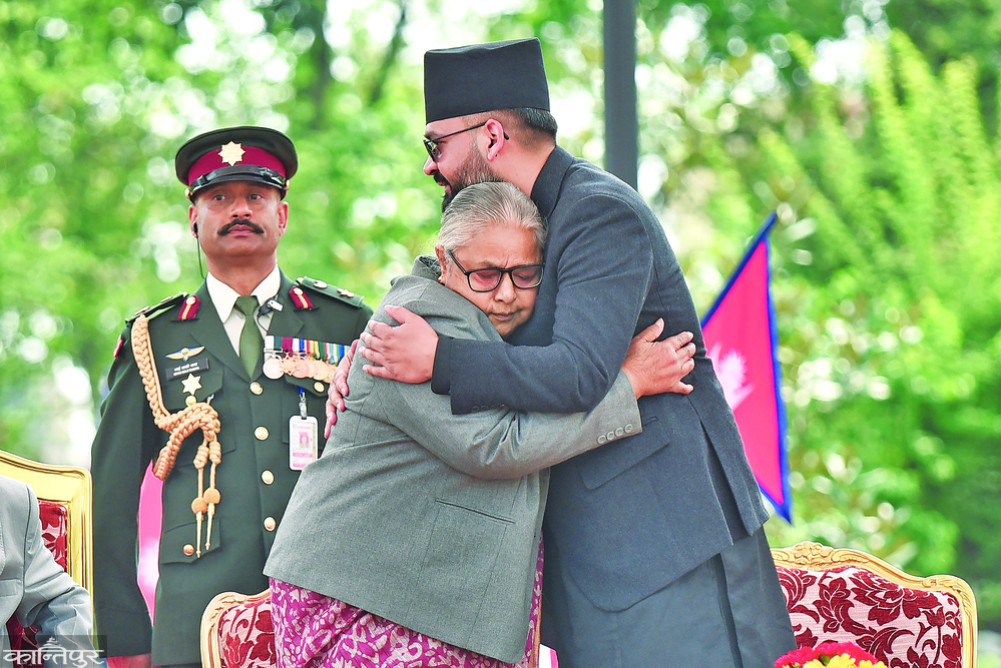
Even today, in a loud public circle like the political circle, a woman who has been appointed to a powerful position like the country's chief executive is still viewed more as a manager who 'fixes a broken house' than as a powerful 'ruler', making it clear that our 'social discourse' has not made much progress.
We use Google Cloud Translation Services. Google requires we provide the following disclaimer relating to use of this service:
This service may contain translations powered by Google. Google disclaims all warranties related to the translations, expressed or implied, including any warranties of accuracy, reliability, and any implied warranties of merchantability, fitness for a particular purpose, and noninfringement.
‘Today, democracy has won under your leadership #Ama.’
On the evening of 21 Falgun 2082, current Prime Minister Balendra Shah (Balen) wrote this on Facebook along with a photo of the then interim Prime Minister Sushila Karki. That day, general elections were held in Nepal and Shah was a candidate for the House of Representatives from the National Independent Party (RSVP). Balen’s use of the hashtag with Sushila Karki’s photo was a reference to Karki’s responsibility as the head of the interim government to make the general election successful. Not only Balen, but around 21 Falgun, fifty social media users have addressed Karki as Ama and given their confidence that the election was successful. Since Sushila Karki took over the leadership of the interim government in Bhadra 2082, there have been many posts, articles published in the media, podcasts and TikTok videos addressing Karki as Ama. In the context of Nepali society, ‘Ama’ is considered the highest respectful title for women. It is believed that a woman is or should be a woman with adjectives such as compassion, a mine of tolerance, an embodiment of sacrifice, etc. Poems and writings that address the relationship of ‘Ama’ with high respect are found in Nepali literature. This article discusses how Nepali society has enclosed women’s public identity within the walls of motherhood, using the title ‘Ama’ given to Sushila Karki as the main basis and Karki as an example.
Institutionalization of reproductive-based address
Gerda Lerner argues in her important work ‘The Creation of Patriarchy’ that society maintains control over women by linking their identity to their reproductive function. According to Lerner, when a woman reaches a position or position that has been perceived for years as ‘not supposed to be’, the social system experiences a kind of cognitive dissonance. As a solution to this, the system looks for a ‘familiar pattern’. If we analyze the address of ‘mother’ to Sushila Karki based on Lerner’s explanation, it can be considered that after 23 Bhadra 2082, the public subconsciously transferred her from the place of reasoning and harsh justice like the court to the place of ‘kitchen and home’, that is, nurturing and abandonment.
A ‘judge’ implements justice based on the law, but a ‘mother’ nurtures her children based on ‘love’. When the country’s chief executive is addressed as ‘mother’, it becomes an indication that her decisions are born from ‘maternal intuition’ rather than constitutional expertise. According to Lerner, such a narrative plays an effective role in robbing any woman of her intellectual activism. According to her, this historical continuity of control ensures that even a powerful woman remains a ‘relative creature’. In this way, she is seen in terms of her relationship with others, not in terms of her independent existence. In the case of Sushila Karki, she is defined on the basis of her ‘maternal’ relationship with the ‘children of the nation’, that is, with ordinary Nepalis.
As a woman in a patriarchal Nepali society, Karki may have risen to powerful positions by overcoming many male-dominated obstacles in law and politics for years. As a woman in a patriarchal Nepali society, Karki may have risen to powerful positions by overcoming many male-dominated obstacles in law and politics for years. Despite this, our system is not able to separate her identity from the reproductive identity of ‘mother’, which is usually formed only after the production of biological children. On the contrary, looking at social media posts, YouTube, TikTok videos, and some articles and compositions in the mass media, it seems that our system is trying to further strengthen that narrative. The theory of ‘symbolic violence’ by French sociologist Pierre Berdieu can be applied here. Symbolic violence is not a physical injury, but an invisible rule in the human mind through thought, culture, and language. It shows that the inequality and exploitation of the lower classes by the powerful classes in society is ‘natural and just’. Rather than understanding it as wrong or violence, the powerless class remains in the illusion that ‘it is natural for this to happen’ and is forced to shape their thoughts and personalities accordingly. The powerless, by accepting the standards and perceptions set by the powerful, are unknowingly giving tacit approval or collusion in their own exploitation.
Domestication of Public Offices
Anthropologist Sally Slocum has a famous essay – ‘Woman the Gatherer’. In it, she says that in ‘hunter-gatherer’ societies, plant-based foods gathered by women accounted for 60 to 80 percent of the total family calories. According to Slocum, gathering was a more stable and reliable food source than the uncertain and risky work of hunting. Even if the men returned with the game and went on a feast for a few days, the women of the house would gather around them and provide food for the whole year. Even today, in Nepali society, if there is no food left after satisfying the family's hunger, the 'mother' of the house will only eat dal and rice, if dal and rice are gone, then she will eat dal and rice, if there is no milk, then dal and water, or if there is no water, then only water. But as the country's chief executive, Sushila Karki was not forced to do such 'collection', she had abundant resources and means available. Sushila Karki's fulfillment of the responsibility of holding elections as the Prime Minister of the interim government was only a 'very basic' responsibility. However, it does not matter if Karki is praised for holding elections in a complex situation, amidst various threats and uncertainties. But even when she was praised in this way, she was not portrayed as the 'Prime Minister' who fearlessly held elections as a powerful executive of the country, but rather was given the title of 'mother' who managed in countless places.
According to Penelope Eckert and Sally McConnell-Ginnett in their book Language and Gender, the main function of the ‘mother’ in the family under the traditional gender concept is to manage the ‘mind’ of the family members. Under this concept, the father, i.e. the main male in the family, is responsible for distributing the family budget, managing other finances, and completing the shopping orders of the children, while the woman is responsible for managing the mental pain, emotions, feelings, anger, and impulses of the family members. Being a ‘mother’ also means being a mediator in resolving conflicts between family members.
According to Penelope Eckert and Sally McConnell-Ginnett in their book Language and Gender, the main function of the ‘mother’ in the family under the traditional gender concept is to manage the ‘mind’ of the family members. While studying in school in Panchayat Nepal, I was taught the myth that in a dispute between the princes of Lamjung, Dajubhai Narahari and Draby Shah, over the state border, their mother spilled her milk in the Chepe River and set it as the border. From this myth, which is said that the border dispute between the brothers was settled with the condition that they would not be allowed to cross the Chepe River, fearing that it would be a sin to cross the mother's milk, to this day, the perception of society about women has not changed much. Just as the 'managerial' responsibility of resolving the hunger, anger, passion and various types of conflicts of the family members was considered to be the responsibility of the person with the title of 'mother' in the past, it can be said that it is the same even today. The commentary that Sushila Karki 'united' all the old and new parties and held the elections, as it is established now, brings to mind the mother of Narahari and Draby Shah who spilled milk in the Chepe River.
At this time, the introduction of the 'mother who manages a broken home' is being created in Sushila Karki's polta, which is saying that the first election will not be held, and the 'warriors' of the old parties have been included in the election and made to participate in the election. Why did the old parties decide to go to the election silently? Was it only by Karki himself convincing and convincing as 'mother'? Here, was Karki's role as a mediator as 'mother' the main one or the role of a powerful executive? Or was it not for both of these reasons, but did the parties have some other strategy of their own? And the criterion for a 'quality' mother is only to have the skill of always managing a broken home, 'reconciling' everyone? Do they have their own privacy, choice, autonomy and freedom or do they always have to reconcile everyone? Even today, in the hyper public sphere like the political sphere, women who are in a powerful position like the country's chief executive are seen more as 'housekeepers' than as powerful 'rulers', which clearly shows that our social discourse has not progressed much.
The narrative that women in public office are imprisoned within the walls of motherhood can be called 'domesticization of public office' based on the interpretation of feminist scholars. Sera Tamang's article 'Container of Motherhood': Media Portrayal of Maoist Camps and Ex-Combatant Women in Nepal' discusses how the Nepali media has portrayed the ex-combatants of the then 'People's Liberation Army' as 'sexual' based on the concept of 'motherhood'. Tamang says, ‘Focusing on newspaper and magazine reports on female ex-combatants in camps during Nepal’s transition period, my argument is that the media’s views, stereotypes and idealized portrayals of motherhood influence the content of the media. Such portrayals perpetuate patriarchal notions of motherhood and confine women to the private and domestic sphere of women.’ Tamang’s article states, ‘The media has repeatedly portrayed female ex-combatants who carried guns in the fighting, killed people, i.e., took their own lives, as ‘life-givers’, i.e. ‘mothers’ during the integration process.’
Mothers, i.e., blameless ‘upalla’ human beings
Herbert Blumer’s ‘Symbolic Interaction Theory’ explains how individuals construct meaning through everyday social interactions, language and symbols. The meaning of all those ‘symbols’ is constructed by society based on the daily interactions of a person, such as the language they use, the songs they sing, the stories they tell, the way they present their body or hair, etc. Such meanings are not fixed but change and are determined over time through mutual understanding or agreement. The interaction of Nepali society has established the meaning of the title ‘mother’ so intensively that it is very difficult for society to believe that mothers can generally have human vices such as committing any kind of mistake, crime, violence, corruption, etc. It is not the nature of ‘mothers’ to make mistakes, so they do not make mistakes. Or, there is a widespread comment that even if mothers make mistakes, those mistakes are automatically forgivable or forgettable because they are mothers.
The confinement of women who have become heads of state, like ‘mothers’ within the home, to the walls of ‘political motherhood’ is an extended form of domestic gender. The country's chief executives, who are equipped with all the resources, means, weapons and power, are not above question and criticism just because they are women. To look at the example of contemporary South Asia, we can take the power politics practiced by former Prime Ministers of Bangladesh Sheikh Hasina and Begum Khaleda Zia for years and the youth movement that took place during Sheikh Hasina's tenure as a response to it. The incident in 2024 when Sheikh Hasina had to leave the country due to public pressure confirms that even female rulers have a hunger for power and authority, and raising their voices against them or organizing movements to overthrow them is a natural political process, not a way to discourage some 'poor' woman. Heads of state, whether they are women or men, can also become objects of criticism. Their nepotistic, patronizing and controversial decisions must also be questioned. As heads of state, their weak and controversial actions, decisions and activities are also depicted in caricatures and cartoons.
राष्ट्रप्रमुख भइसकेका महिलालाई पनि घरभित्रकी ‘आमा’ जस्तै ‘राजनीतिक मातृत्व’ कै पर्खालमा सीमित गरिनु भनेको घरेलु लैंगिकताकै विस्तारित रूप हो । नेपाली परिवारहरूमा आमालाई आलोचना वा प्रश्न गर्दा छोराछोरीले आमाको ‘अपमान’ गरेको भन्ने अर्थ लगाइन्छ, सन्तानलाई ‘असल’ सन्तान हुन नसकेको ग्लानि बोकाइन्छ । राष्ट्रप्रमुख भएका महिलालाई पनि आमाकै रूप दिएर ‘उपल्ला मानव’ का रूपमा चित्रित गरिनु भनेको उनीहरूलाई जवाफदेहीविहीन बनाइनु पनि हो । डिम्ब तस्करीका अभियुक्तहरूलाई उन्मुक्ति दिएकी भनिएकी सविता बराल भण्डारीलाई महान्यायाधिवक्ताका रूपमा सुशीला कार्कीले नियुक्त गरेको निर्णयविरुद्ध उठेका आलोचनाका स्वरहरू उनलाई ‘आमा’ भनेर गरिएका चर्का महिमामण्डनका अगाडि बिलाएका छन् । कार्यकाल सकिँदै गर्दा उनले आफ्ना स्वकीय सचिवलाई राष्ट्रिय प्रकृति संरक्षण कोषको अध्यक्ष बनाएको कारण आएका आलोचना पनि ‘आमा’ उपाधिको अगाडि छायामा परेका छन् । उपाधिसँगै जोडिएर आउने भावुकता र क्षमाको सिद्धान्तले सर्लक्क छोपिदिँदा महिलाहरूले राष्ट्रप्रमुखका रूपमा देखाउनुपर्ने जवाफदेही, नागरिकका प्रश्नप्रति देखाउनुपर्ने जिम्मेवारीप्रतिको उदासीनता वा बेवास्ता पनि विकसित हुँदै जान सक्छ । यतिबेला चुनाव सम्पन्न गराएको एउटै जिम्मेवारी पूरा गरेको छायामुनि रहेर सुशीला कार्कीलाई कुनै सार्वजनिक प्रश्न गरिएको छैन । गरिएका प्रसंगहरू पनि अत्यन्त पातला र मधुरा छन् ।
भत्काऔं प्रजननजन्य सम्बन्धको पर्खाल
आजसम्म हाम्रो सामाजिक प्रणालीलाई नेपथ्यमा बस्ने, कमजोर शरीर र मधुरो बोलीसहित कहराउँदै घर व्यवहारमा खटिरहने ‘आमा’ मात्र मञ्जुर छ । परिवारका मान्छेको पेट भरेर आफू भोकै बस्ने ‘त्यागकी प्रतिमूर्ति आमा’ मात्र स्वीकार्य छ । दक्षिण एसियाका अन्य देशमा जस्तै नेपालमा पनि पितृसत्तात्मक संरचनाले महिलालाई सामान्यतया त्याग, पवित्रता, सहनशीलता आदिको कसीमा मात्र राखेर मूल्यांकन गर्ने गर्दछ । यस्तो प्रचलनले उनीहरूको राजनीतिक र प्रशासनिक व्यक्तित्वलाई ओझेलमा पार्दै आएको छ । आमा शब्दले सम्बोधित हुनु भनेको उच्च सम्मानित व्यक्तित्व हुनु हो भन्ने धारणालाई बहुसंख्यक महिलाले समेत नै पनि आन्तरिकीकरण (इन्टर्नलाइजेसन) गरिसकेका छन् ।
त्यसैले दसैंका बेला पनि बिनासजधज ‘साधारण’ सुतीको सारी लगाएर ‘देशका लागि’ खटिएकी सुशीला कार्कीको ‘आमा’ छवि समाजलाई अति प्रिय हुन्छ । निजी वृत्तमा दसैंका बेला म पनि सजधज गर्छु, आफ्ना लागि समय निकाल्छु भन्ने आमाहरू, सार्वजनिक वृत्तमा कानुनी रूपमा आफ्नो अधिकारका लागि, सार्वभौमिकताका लागि चर्को स्वरमा बोल्ने र माग गर्ने आमाहरू समाजलाई अप्रिय लाग्छन् । किनभने उनीहरूले ‘त्याग’ को भावना नकार्दै आफ्ना लागि अधिकारहरूको माग गर्छन्, सामाजिक प्रणालीले तोकेको ‘आमा’ को परम्परागत मापदण्ड पालन गर्दैनन् । त्यसैले हाम्रो सामाजिक प्रणालीलाई पनि सुशीला कार्कीलाई सबै स्रोत, साधन, शक्ति, शस्त्र आदिको निर्धक्क पहुँचमा रहेकी शक्तिशाली प्रधानमन्त्रीका रूपमा नभई आफूले सबै त्यागेर अरूलाई मिलाएकी ‘आमा’ का रूपमा हेर्न मञ्जुर भएको हो ।
महिलालाई उनले गर्ने प्रजननजन्य कार्यका आधारमा मात्रै स्थापित हुने सम्बन्धमा आधारित रहेर गरिने यस्ता सम्बोधनले सार्वजनिक वृत्तमा साँचो लैंगिक समानता प्राप्त गर्न कठिन हुन्छ । महिलालाई उनले गर्ने प्रजननजन्य कार्यका आधारमा मात्रै स्थापित हुने सम्बन्धमा आधारित रहेर गरिने यस्ता सम्बोधनले सार्वजनिक वृत्तमा साँचो लैंगिक समानता प्राप्त गर्न कठिन हुन्छ । यसबाट मुक्त राखेर उनीहरूलाई स्वतन्त्र ‘सार्वजनिक पहिचान’ का आधारमा परिचित गराइने प्रचलनको सुरुआत हुनुपर्दछ । सार्वजनिक वृत्तमा सक्रिय जोसुकै महिलाको मूल्यांकन उनीहरू ‘आमा’ भएका कारणले होइन, बरु उनीहरू कर्मठ, निष्पक्ष र निष्ठावान पेसाकर्मी हुनु वा नहुनुका आधारमा हुनुपर्छ ।
जबसम्म हामीले सार्वजनिक वृत्तमा स्वीकार्य हुनका लागि ‘आमा’ बन्नुपर्ने अप्रत्यक्ष सर्तहरू राखिएका भाष्य निर्माण गर्न छोड्दैनौं, तबसम्म हामी सार्वजनिक वृत्तमा प्रवेश गर्ने महत्त्वाकांक्षा हुर्काइरहेका बालिका, किशोरी, युवती र महिलामाथि दबाब सिर्जना गरिरहेका हुन्छौं कि उनीहरूको व्यावसायिक सीप मात्र पर्याप्त छैन । उनीहरूले सिंगो समाजको, समुदायको र अझै राष्ट्रको घरायसी अपेक्षाहरूको भावनात्मक र नैतिक भार पनि बोक्नुपर्नेछ । ‘मातृत्वको पर्खाल’ तोड्नु भनेको महिलाहरूलाई परिवार, समाज र राज्यका विभिन्न वृत्तमा एक स्वतन्त्र र अधिकार प्राप्त व्यक्तिका रूपमा अस्तित्वमा रहन दिनु हो ।