As Nepal celebrates 70 years of diplomatic relations with Switzerland, it is also an occasion for serious self-assessment for the country. For decades, Switzerland has not only provided assistance to Nepal – it has presented a development philosophy based on human rights, fairness, inclusion, and the dignity of labor.
We use Google Cloud Translation Services. Google requires we provide the following disclaimer relating to use of this service:
This service may contain translations powered by Google. Google disclaims all warranties related to the translations, expressed or implied, including any warranties of accuracy, reliability, and any implied warranties of merchantability, fitness for a particular purpose, and noninfringement.
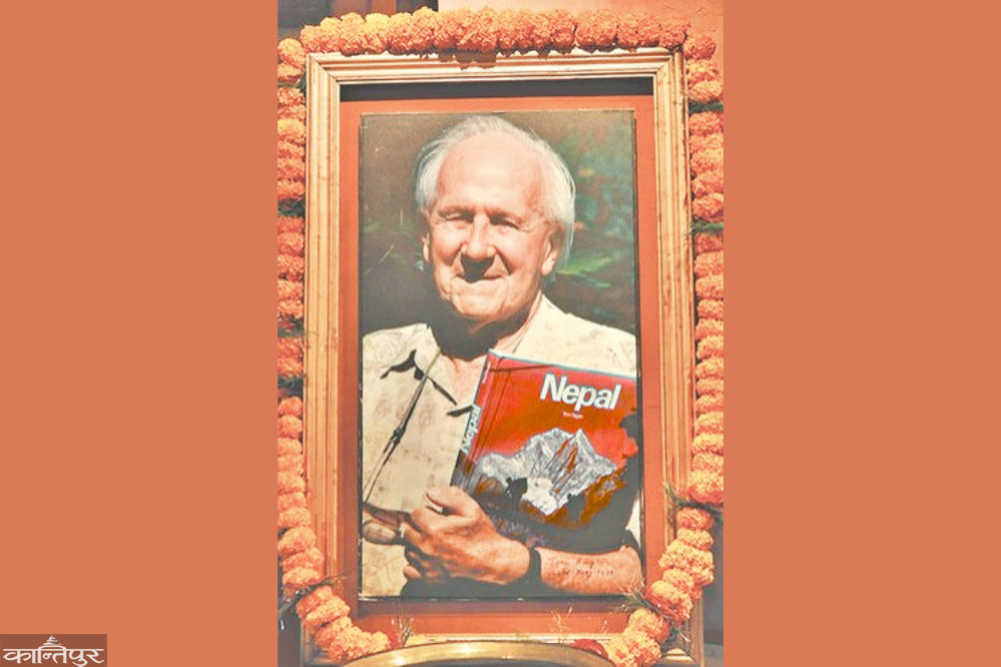
Swiss geologist Tony Hagen was a mysterious figure who seemed like a myth to me. If any foreigner understood Nepal in the 20th century the most and most closely, there would hardly be another name of Hagen's stature. Even if we examine only the hiking trips he made here at different times, it is almost like covering Nepal seven times. Having come to Nepal to understand the rocks and geology, he eventually became even more fascinated by the people and their culture. Through his eyes, the world got to know Nepal so much more closely.
Hagen's time in Nepal is the most special. Hagen was among the first foreigners to arrive in the 1950s as soon as the country opened its doors to tourists. At that time, the race for Mount Everest by powerful nations was at its peak. But Nepal's geography, diversity and uniqueness were in the shadows. Hagen gave it the strongest recognition on the world stage. Although he did not climb the mountains, he entered Nepal to study the Himalayas as a geologist. But more than that, his role was to promote Nepal as 'Shangri-La'. He closely guided the development of the country. His writings, the rare photographs he took of the nooks and crannies of that time, and his speeches around the world were the windows of Nepal for the world at that time.
Tony Hagen's phone
Born and raised near Jiri, the Switzerland of Nepal, I was a student in Pasug village, Hagen's own country, in 1999, as fate would have it. One day in a foreign land, someone called me on campus and called me.
‘Is this Khemraj?’ Not recognizing the deep voice on the phone, I asked him to introduce himself, saying that I was Khem.
The answer was: ‘This is Tony Hagen speaking.’
I still vividly remember that day, about two and a half decades ago. A man of enormous stature had appeared to me in such a relaxed and gentle manner. Tony Hagen, who had reached the latter half of his life, was as famous in Switzerland as he was in Nepal. There was special respect for him there. In particular, the Swiss have had a special affection for the Himalayas for centuries. Understanding the art of living, the skills and abilities required for living are paramount to them. Tony Hagen was a pioneer explorer of that Swiss essence. And, that day, when he casually asked me about my name and my news, I was momentarily overwhelmed with happiness.
‘I will meet you tomorrow,’ Hagen had contacted me after receiving a complaint that a Nepali had arrived there.
‘Yes. But I will tell you the class time first,’ he said before I could answer, ‘Don’t worry about that. I have already understood that. There is no class tomorrow morning.’
That was the first lesson I learned from Hagen that ‘Swiss perfection’ is not just about the clock, train times or the taste of chocolate there, it is part of their lifestyle.
In the next meeting, he did things to make me feel comfortable in his village. He, who was already 80 years old, showed me the surrounding mountains and rivers, saying that Switzerland was also like Nepal. We both understood that Switzerland and Nepal were very different despite being similar. However, the intimacy that cut through that was the strongest between us.
Hagen's footprint
April 18 marks 23 years since Tony Hagen passed away. Nepal honored him by granting him honorary citizenship and allowing him unlimited visa-free stay in Nepal. He was even granted exemptions for places where foreigners had to obtain separate permits throughout the country.
His 1971 book 'Nepal' contains very detailed descriptions of every corner of our country. Reading it, it seems that Hagen not only did modern mapping of Nepal, but also documented our people's lives, history and culture very well. In fact, he was as deeply immersed in Nepal as his own country. Nepali never felt alien to him.
His house in Lenzerheide was only half an hour away from where I lived in Switzerland by car. In between, we met several times. At that time, ‘The Ring of the Buddha’, based on Hagen’s life, had not been released. However, one day, after the final copy of it arrived, he said that he wanted to sit among the Nepalis and watch it, so we, the Nepali and Nepal-loving Swiss there, gathered. The opportunity took shape under the leadership of Shubha Elmer Lama, Nashma Shrestha, and Muna Gut Khatri, who are currently board members of the Tony Hagen Foundation. We brought Nepali dishes from home to make that special moment even more special. And, we watched them with interest while eating them. That stay was a moment to remember for him, and for us, a rare opportunity to reach the time of our ancestors. While we sat in the company of Tony Hagen, we were fascinated by the intersection of the past and the present.
Some of Hagen's collection included real scenes from the 1960s. Sometimes he was chased by a buffalo, sometimes the valuable stone he had collected for study was thrown away by the porter who was carrying it, saying, "What could he be carrying?" There were interesting stories full of funny and sometimes tragic struggles but showing the real world. Even amidst the slow pace of the country at that time, we saw the sincere hearts of the people, the still rivers and mountains. We even asked Hagen more about many things. After completing my studies, I left Switzerland for Canada for further studies. When I tried to ask for leave, he was ill. And that was my last meeting with him.
The Swiss Road to Switzerland
My birthplace is Salung in Dolakha. When the Lamusanghu-Jiri road was being dug with Swiss assistance, the ‘Labor for Food’ program was launched towards the end of 2030. At that time, one sack of maida and one gallon of soybean oil were given as labor contribution. Maida was introduced to our house for the first time when my father joined the construction of that road. I still remember frying it and making puris after the curiosity about how to eat maida spread in the village.
The second time, I reached Kathmandu via the same road called the Swiss Road. From there, I went to Switzerland to study, where I got to live near Tony Hagen. And, for almost 20 years now, I have been running/teaching a campus that teaches Swiss courses in hospitality and tourism. Tony Hagen and Swiss ties are intertwined in many ways in my life journey.
Before I went to study, eight Nepalese had gone to Parpan, Switzerland, in 1997. However, after that campus collapsed, Hagen took the initiative with his government to provide education to the stranded Nepalis who wanted to return home or to continue their studies there by providing other resources.
Hagen's two daughters, Monica and Catherine, grew up in Nepal for a long time. Dr. Catherine Hagen still visits Nepal every year and travels with a team of doctors to remote areas where access to health services is limited for treatment.
For politicians who keep saying that Nepal will become Switzerland, Professor Dr. Susanna von der Heide, with the help of her two daughters, compiled Hagen's book 'Decentralization and Development' from Hagen's writings. That book shows how Switzerland, despite being a country with the same geography, was able to prosper separately and what Nepal missed. This book is one of the books that policymakers must study. Reading the book now makes us feel how valuable he was.
After visiting Nepal when there were no main roads, he raised the issue of 'green roads' that would beautify the mountains like Switzerland instead of making them ugly. Although he understood Nepal's ethnic diversity closely, he used to say that the basis of decentralization should be linked to its economy.
As an advisor to the Nepal government, he drew up a blueprint for the development and expansion of modern suspension bridges. That particular wise idea was given to him by his assistant porters during his own long journeys and travels. Those who were afraid of swimming would pray that they would not capsize before boarding the boat. More importantly, their living space would not be uprooted by crossing the river like that. Such bridges, which have now reached more than 10,000, have become 'transformative' for Nepal.
The infrastructure for development is human skills, art and innovation. Switzerland is moving forward with the idea that the real asset of the country is its people, where four out of five people learn skills. If Hagen had truly understood this fact, he would have tried to explain this fact to Nepal in the 20th century. Perhaps at that time, Nepal had not even begun to dream of becoming Switzerland. If skill-teaching institutions like Jiri Technical Institute and Balaju Yantrashala, built with Swiss assistance, had been spread across the country, the foundations for Switzerland would have been laid in the same way. Such institutions were not just isolated successful projects. They were models of a self-reliant and egalitarian Nepal. However, we could not expand those models as a development philosophy across the country.
Let's look back
Today, Nepal is at a crucial juncture. Although the National Vocational Qualification System was passed by the Parliament, it has not been fully implemented. Reforming technical and vocational education and training is no longer an option, it is a necessity. The Swiss essence is that education will be useful in people's lives only by adopting a skill-based and work-based education system like that of Switzerland and linking it with industry.
Nepal, which is still taking a leap towards federalism, can empower its youth with dignified and world-class skills by establishing modern ‘trade schools’ in every province. The preamble to the Swiss constitution states: ‘The capacity of a people should be measured by the condition of its weakest member.’ In the current world, which is full of recent international uncertainties and conflicts, Nepal needs to learn not only systems and assistance but also guiding values from Switzerland.
As Nepal celebrates the 70th year of diplomatic relations with Switzerland, this is also an opportunity for serious self-assessment for the country. For decades, Switzerland has not only provided assistance to Nepal – it has presented a development philosophy based on human rights, fairness, inclusiveness and the dignity of labor. However, in most cases, we have not understood the deeper meaning of its assistance while receiving it.
Hagen is a university
Tony Hagen was a living pillar who knew Nepal even before the establishment of bilateral relations. His merit is incalculable. His dedication to recognizing, promoting and documenting Nepal, which is isolated in one corner of the world, is exemplary for anyone in the world. As we celebrate the 70th anniversary of bilateral relations, Hagen's footprints and contributions are felt everywhere, which will probably remain a glorious story to this day.
Hagen's legacy is like a university. We should not take the Nepal that Hagen saw and understood and left us with a reminder for free. Because understanding someone's geography and culture cannot be done by any hasty decision. This is a burden left by history for generations, which only a few people like Hagen dedicated to their cause can lift.
(Lakai is the president of the Nepal-Swiss Chamber of Commerce and Industries.)