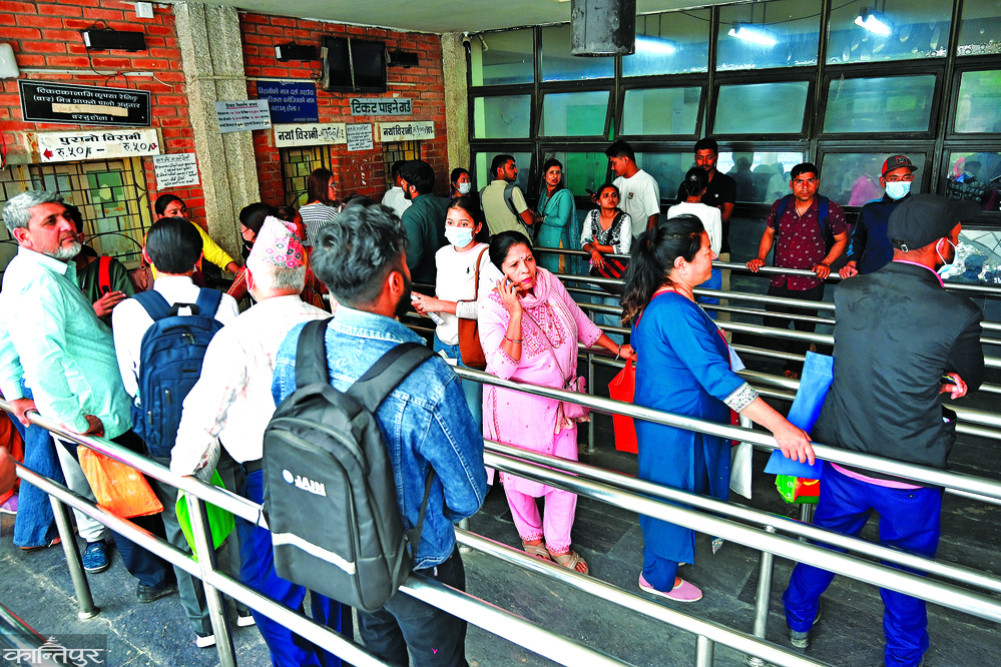
If you need surgery, you have to wait months. In Birma, you have to wait a year for urinary surgery, two months for neurosurgery, six months for nose, ear, and throat surgery, and even two to six months for other general surgeries. These periods are likely to be extended after two days of leave.
We use Google Cloud Translation Services. Google requires we provide the following disclaimer relating to use of this service:
This service may contain translations powered by Google. Google disclaims all warranties related to the translations, expressed or implied, including any warranties of accuracy, reliability, and any implied warranties of merchantability, fitness for a particular purpose, and noninfringement.
The government's decision to grant two days off a week (Saturday and Sunday) due to the fuel crisis has also affected government hospitals, which are suffering. Since government hospitals are usually overcrowded, there have been calls from time to time that hospital outpatient departments (OPDs) should be open on Saturdays, which used to be a holiday. However, the government has added Sundays as well. As the number of days available for services is reduced, the pressure on hospitals will increase even more on the remaining days.
On the other hand, those who have already booked a 'date' for surgery at large government hospitals are in confusion. This will force patients to face additional hassle for treatment, wait longer for surgery, or pay expensive fees to get services from private hospitals. Therefore, the government should at least make arrangements to regularize the previous service flow.
In large government hospitals, one has to stand in a long queue to get OPD services. If the treatment is not completed after a simple consultation with a doctor and additional tests are required, a few more days pass. Let's look at the example of Bir Hospital, where you have to wait at least three months for an MRI, three days for an ultrasound, and one to two weeks for a CT scan. After receiving the report, you have to stand in long lines and seek further advice from a doctor. Patients who need to be treated for a long time have to endure this torment regularly.
If you need surgery, you have to wait for months. At Bir, you have to wait for a year for a urinary surgery, two months for neurosurgery, six months for nose, ear, and throat surgery, and two to six months for other general surgeries. With the two-day holiday, such periods are likely to be extended. The situation is similar in other large government hospitals.
The decision to grant two days off will affect patients coming to large government hospitals in the district headquarters of various districts, including Kathmandu. Because those who come to such hospitals are usually from remote areas or urban areas, but have a relatively weak economic status.
People from different districts still come to Bir or Maharajgunj Teaching Hospitals (Teaching) in Kathmandu for treatment. Those who can afford the expensive fees of private hospitals generally do not want to stand in long queues at government hospitals. This class of people will be the victims of the government's decision. On the other hand, the fuel crisis is basically a problem that is faced by the middle or upper class. Because, they usually use their own vehicles. But the lower class people are more likely to reach government hospitals. The class that decided to take a two-day holiday after realizing the problem will be the one who will bear the problem. Even looking at it this way, the government's decision to take a hospital holiday seems inconsistent.
It can be understood that the government has adopted a two-day holiday strategy to minimize the impact of the fuel crisis. It is not that the government cannot take such decisions when it is in trouble. But if the citizens have to face more difficulties in health care in the name of avoiding the fuel crisis, it can be counterproductive. Because, getting timely treatment is the right of the citizens. The decision to increase the number of doctors and the service period provided by the hospital while keeping the number of doctors the same but increasing the workload and shortening the service period is considered to be a disregard for the rights of the citizens. There is no possibility of reducing the pressure on large government hospitals immediately.
The government does not have any strategy for that. Again, this is not an issue that can be resolved immediately. However, it is understood that the government did not consider the sensitivity of the health sector when it decided to apply the leave in a uniform manner in all sectors. This adds more physical and mental distress to the citizens, and using private hospitals as an alternative to get faster service also adds to the financial burden.
It is not that the decision to give two days off should be applied to all sectors. For example, it could not have been applied to hospitals. Or even if it was applied theoretically, the hospital could have been operated as before in practice. For that, additional allowances can be given to doctors to agree to serve.
The Ministry of Health and Population has directed all federal and provincial hospitals to make arrangements to provide OPDs on Sundays, considering the workload and manpower. For this, it has been asked to make arrangements to give a day off other than Saturday and to provide a substitute day off if it is not possible to give a day off. However, most of our hospitals are short of manpower. Therefore, even if the available manpower can run the hospital for a few days, it may be difficult in the long term.
Therefore, instead of implementing the decision unilaterally, the government should find an alternative to ensure that hospital services continue. New solutions can be found by discussing with hospitals and medical associations. Or, even if the government's decision is applied to other government offices or schools, a decision can be made not to apply to government hospitals. In such a case, government hospital services will continue as before.