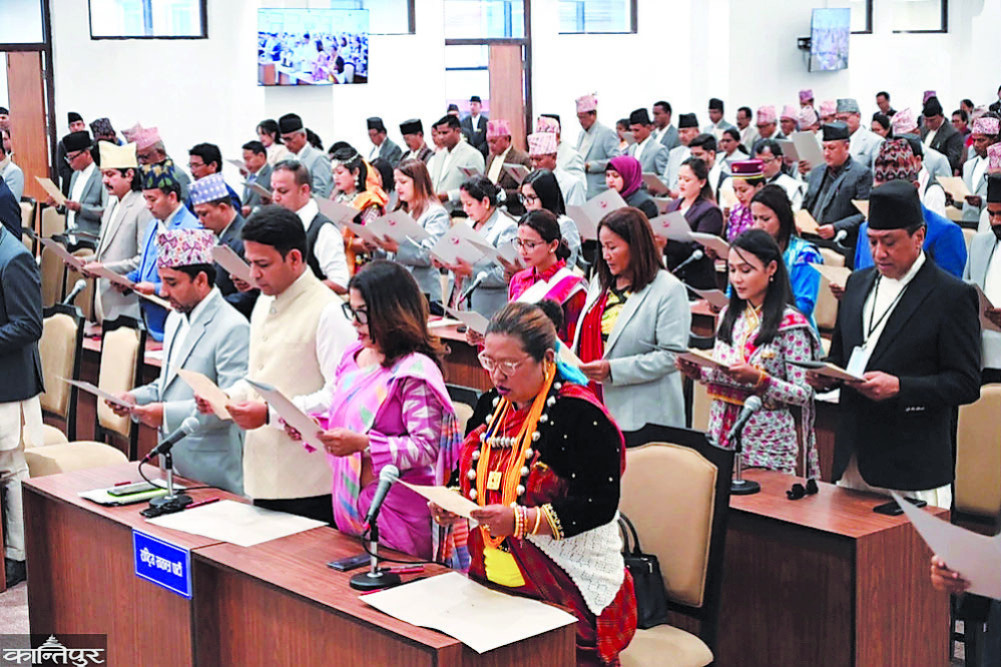
Article by Surya Dhungel - The role of parliament in contemporary democracy is constantly evolving. Parliament and the people it represents are facing new challenges. How should they respond to new forms of executive and administrative activity?
We use Google Cloud Translation Services. Google requires we provide the following disclaimer relating to use of this service:
This service may contain translations powered by Google. Google disclaims all warranties related to the translations, expressed or implied, including any warranties of accuracy, reliability, and any implied warranties of merchantability, fitness for a particular purpose, and noninfringement.
Constitutionalism establishes the belief that all state power should be exercised within the limits of the constitution. It ensures the rule of law, accountability and protection of fundamental rights. Parliament is the main expression of popular sovereignty, which makes laws, monitors the executive, ensures financial responsibility and represents the voice of the people. In a constitutional democracy, parliament is not only the supreme institution, but also an institution limited and guided by the constitution, which must act in accordance with the separation of powers and judicial norms,’ (Erskine May, Subhash Kashyap).
Much has been written about the concept of constitutionalism. Since the rise of constitutional rule since the 18th century, there has been great confidence that democratically elected parliaments around the world can deliver governance in line with high public expectations. Today, there is a broad consensus that these expectations have not been adequately met. The general perception is that parliaments are weak, do not have sufficient constitutional powers, or that the golden age of parliamentary control is over.
Meanwhile, the role of parliaments in contemporary democracies is constantly evolving as parliaments and the people they represent face new challenges. How should they respond to new forms of executive and administrative activity? Should they have a role in maintaining the independence of the judiciary? While judicial independence is often associated with independence from both parliament and the executive. How can they contribute to the protection of fundamental rights? Furthermore, can parliament exercise control over the executive in practice? Is the principle of separation of powers, especially within a parliamentary system, an appropriate standard of assessment? In particular, what is the relevance of constitutionalism in this context? Its analysis is needed.
Meaning of constitutionalism
In his study of the influence of the principle of separation of powers on Western constitutional development, Thomas Cooley, in 1870, MJC Weil, in 1967 and later jurists, said, ‘The main theme of the supporters of constitutionalism is a clear recognition of the role of government in society and a firm determination to control that government and to set limits on the use of its power.’
This suggests that supporters of constitutionalism and supporters of a strong parliamentary system share the same goal, where representatives of the people hold the government accountable and the executive prevents the risk of arbitrary use of power. However, this cannot be taken for granted for at least two reasons.
First, in a parliamentary system (notably the British model but also in many other democracies) the role of parliament is not only to hold the government accountable, but also to provide the government with the necessary powers to govern and to help implement its policies. Members of the majority party in parliament are often considered to have a high commitment to the policies of their leaders in the executive. Such harmony between parliament and the executive is an essential element of parliamentary government, although the relationship between these two institutions may take different forms.
Another aspect of this is the role of opposition parties in parliament to oppose government proposals, but their influence is limited if they are in the minority.
Another reason why parliamentary rule and constitutionalism are not natural partners is that parliamentary rule is primarily concerned with the interests of the majority, while constitutionalism is largely concerned with protecting minorities and individuals from excessive or abusive use of power by the majority. Therefore, constitutionalism and parliamentary rule are often seen as competitors or adversaries rather than companions.
Just as the executive is uncomfortable with external control that comes from judicial review of its decisions, parliament may also be reluctant to grant the judiciary the constitutional right to review legal acts or decisions made by a majority of parliament.
Constitutionalism and the political system
Constitutionalism has attracted widespread attention as a theory related to the political system of government, whether in terms of its impact on the structure and practice of states or in its analysis in academic studies. There are several reasons for the growing interest in it in recent years.
For example, the American Council on Constitutionalism, a program on constitutionalism organized in 1987 to mark the bicentennial of the US Constitution, provided a major impetus for comparative studies. Although the project began in the divided Berlin Wall, it later expanded to the post-communist countries of Central and Eastern Europe and to the post-apartheid era of South Africa.
Relatedly, the last two decades have been seen (especially in Europe) as an era of constitution-making. In 1990, the Council of Europe established the Venice Commission for Democracy and the Rule of Law. In 2004, the Commission published two large volumes entitled ‘Constitutions of Europe’, which included the constitutions of 45 countries.
Many of these constitutions were drafted after World War II or after 1990. This shows that constitutions often evolve in tandem with political developments. But at the same time, constitutions can also shape political events and set the boundaries of policy debates.
Walter Murphy has said that the linguistic similarity between the words ‘constitution’ and ‘constitutionalism’ creates confusion. There is no need for a close political connection between the two. Although there is disagreement about what constitutionalism aims to achieve and how it is achieved, its basic concept of limited government is clear.
According to Norwegian political scientist Jan-Erik Lane, constitutionalism is a political theory. It states that political rights should be limited by institutions that control the use of power. To this end, he has mentioned three basic limits:
– respect for human rights
– separation of powers
– compliance with international law
However, an evolved concept of constitutionalism can manage constitutional supremacy and its limits, democratic and judicial oversight, technology and digital knowledge and skills as meaningful tools. This concept also makes parliamentary practice effective, democratic and accountable.
Similarly, according to Hungarian jurist Andras Szajó, constitutionalism is a set of principles, practices, and institutional arrangements used to limit government. He says, ‘Constitutionalism always asks – is government regulation or decision preventing freedom?’ In this context, Mark Tosnett has mentioned that in the political theory of the liberal state, state power is considered the main threat to freedom.
According to this traditional view, the core element of constitutionalism is distrust of state power. However, the question arises – can a majority in parliament (which gives legitimacy to the government) show such distrust? Perhaps such distrust can be expressed more consistently through the judiciary because judges are considered to be able to evaluate independently.
Conclusion
According to Erskine May and Subhash Kashyap, two world-renowned scholars and authors of parliamentary constitutionalism and practice, the judiciary is also guided by the principles of constitutionalism. The judiciary has judicially formulated additional norms on parliamentary practice to ensure accountability to the constitution, the rule of law and accountability to the people. Therefore, it is essential for newly elected parliamentarians of Nepal to receive proper orientation on the principles and practices of parliamentary constitutionalism before entering the parliament.
According to Mark Tosnett and Malagodi, the recent elections and the subsequent political environment have shown that – ‘the people are looking for new alternatives and accountability than traditional parties, parliament should be a direct reflection of the expectations of the people. Parliament should maintain stability, consensus and constitutional balance.’
Additional norms on parliamentary practice Constitutionalism and the Role of Parliament by A. W. Bradley, Katja S. Ziegler and Dennis Baranger and Parliamentary Practice by Erskine May and Subhash Kashyap should be studied. These books are useful for parliamentarians.
(Dhungel is a senior advocate and professor of constitutional and human rights law)