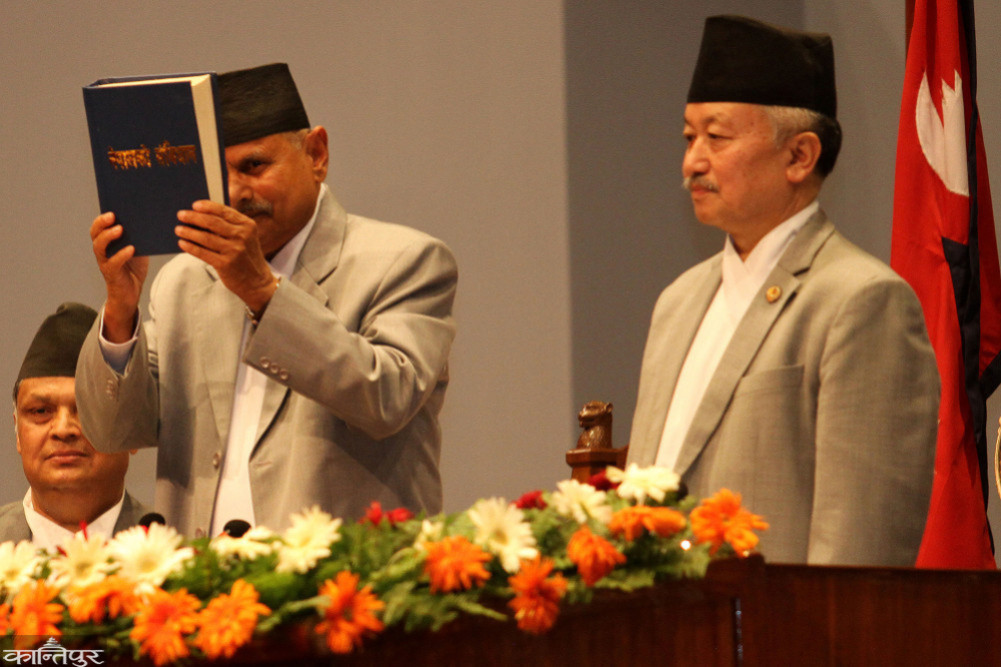
The current constitution, which has been issued by the Constituent Assembly with tireless efforts in line with the expectations of the people since 2007, should be revised through amendments. Repeatedly revoking and remaking the constitution undermines its supremacy psychologically. Making a small and concise constitution through amendments promotes good governance.
We use Google Cloud Translation Services. Google requires we provide the following disclaimer relating to use of this service:
This service may contain translations powered by Google. Google disclaims all warranties related to the translations, expressed or implied, including any warranties of accuracy, reliability, and any implied warranties of merchantability, fitness for a particular purpose, and noninfringement.
Ten years have passed since the promulgation of the current constitution. Although the dissatisfaction and disagreements in certain sectors and communities that existed when the constitution was promulgated are gradually disappearing, the issue of amendment is now attracting all of our attention.
Indeed, a period of ten years is an appropriate period for reviewing the constitution. The constitution itself has expected that the provisions should be reviewed through Articles 265 and 281, which is correct for the limited purpose of assessing the implementation and impact of the rights of women and Dalit communities or examining the suitability and effectiveness of various commissions. The issue of good governance, which has now been raised in a concentrated manner, should be the central aspect of constitutional reform.
The issue of amending the constitution is certainly complex. And, in many countries that have adopted a federal system, this issue becomes even more complex. However, that does not mean that the constitution will not be amended. Even in countries with a federal system, the constitutions have been amended repeatedly. There is an example of this in our neighborhood. When talking about the Constitution of Nepal, Article 274 allows for amendments to issues other than sovereignty, territorial integrity, independence, and the sovereignty vested in the people. If we want to know the national perspective before making amendments, Article 275 has already provided for a referendum. Therefore, if political parties do enough homework and cooperate, common points of agreement can be found. There may not be agreement on all issues at once, but if we move forward with a 'segmental approach' based on whatever agreement is reached, there is no question that the constitution will not be amended.
When talking about amendments, what the people have almost unanimously demanded through the recent elections is good governance. A stable and accountable government is necessary for good governance. This time, a stable majority government has been formed. However, whether a majority government will always be formed or not? It is not possible to say with certainty. A stable government is indispensable for the development of Nepal. In that case, in order to maintain the spirit of inclusiveness, the issue of maintaining inclusiveness by nominating candidates for direct elections and reducing the number of the 265-member House of Representatives by at least half, abolishing the National Assembly, which does not represent the provinces and is of little use, should be brought to the national debate.
If a consensus cannot be reached on abolishing the National Assembly, another option could be to reduce the current number and establish a 35-member National Assembly with 5 representatives elected from each province and chaired by the Vice President. In addition, the trend of making the Federal Parliament a helpless shadow of the executive without accepting its independent existence should be ended. For this, it is appropriate to rewrite clause (2) of Article 93 to provide that ‘Both Houses of the Federal Parliament shall prepare the agenda for discussion and shall be autonomous in the conduct of the session, and the end of the session of the Parliament shall be as recommended by the President in the case of the National Assembly and the Speaker in the case of the House of Representatives.’
In the case of proportional representation elections, as decided by the Supreme Court in the Balkrishna Neupane case on 30 November 2080, it would be better to amend Article 84, clause (2), to ensure the presence of individuals and groups from neglected classes, excluding those who have had the opportunity repeatedly, and to include a provision that states, ‘In such candidacies, arrangements shall be made to hold elections in such a way that no proportional representative is elected more than once, taking into account geography and territorial balance.’
In addition, members of parliament should be focused on their central role, i.e. forming the government, monitoring the government’s activities, passing the budget, and making laws. The issue of setting up a ‘Constituency Development Fund’ in the name of developing their constituencies and misusing budget funds in its name should be stopped. The responsibility for the development of constituencies should be left to the local level.
An important thing to consider in the context of good governance is the end of multidimensional discrimination and the promotion of inclusiveness. The detailed framework of fundamental rights outlined in the constitution is essential for its effective implementation. Annual plans, budgets and implementation audits are also required for the implementation of the rights of citizens of various classes (such as Dalits, women, children, the disabled, senior citizens, etc.). In addition, considering the fact that climate change has put the very existence of human life in danger, it seems necessary to add the provision in Article 30 to guarantee the ‘right to be protected from adverse conditions created by climate change’ as a fundamental right. In addition, it is necessary to add the provision in Article 47 regarding the implementation of fundamental rights that ‘there shall be a committee in the House of Representatives to monitor the implementation of laws made’.
Another issue that cannot be left out when discussing the issue of good governance is federalism. The main reason why Nepal had to move towards federalism is the various types of discrimination existing in Nepali society. Identity is an auxiliary issue related to that discrimination. The end of discrimination and the protection of identity can be achieved through rights, especially through the effective implementation of affirmative action, economic, social, religious and cultural rights. Federalism is only a service model. It is not all discrimination and deprivation. The case of countries that are very large in size and number is different. For small countries, the guarantee of rights and their effective implementation can be an easy path to the establishment of an egalitarian society and prosperity. Only 28 countries in the world have federalism. And, most of them are much larger than Nepal. The number of countries adopting federalism has not increased dramatically.
Although federalism is a very complicated issue in the context of Nepal, there has been no extensive and intensive discussion on it within the Constituent Assembly. Therefore, whether to maintain the federal system or not? This issue can be resolved by holding a referendum. If there is a consensus at the political level on maintaining federalism, the structure and level of federalism can also be discussed. Since Nepal's federal model has established a powerful local level, if we can maintain two-tier federalism, we can get rid of the cumbersome provincial structure and the political bureaucracy created in the name of federalism. In this context, the intelligentsia sometimes says that the budget allocated for the provinces is not that much. Since good governance is not only related to the budget but also to the use and misuse of power, it seems that it would be better from the perspective of good governance if two-tier federalism is firmly implemented. In short, discussions on federalism require great patience and understanding. While discussing this issue, we should proceed with caution, keeping in mind the possible obstacles.
Another issue that needs to be considered from the perspective of good governance is the establishment of various commissions. These commissions have not been able to do much to have a national impact in the past ten years. In view of this issue, if we increase the size of the existing human rights and establish a cell to look into the issues of women, Dalits, indigenous peoples, Madhesis, Tharu, Muslims, etc., in order to promote inclusion within it, these various commissions including the Inclusive Commission would not be necessary. When the constitution is large and cumbersome, there is pressure on the state treasury, and when a single institution can do the work, it does not seem necessary to establish redundant positions and institutions.
Talking about the executive branch, in the current election, some parties including the Rashtriya Swayamsevak Sangh (RSS) went to the election by specifying who would be the prime minister. This new experiment practically showed that we are going to use the prime ministerial system. If this system is to be maintained, if a majority is obtained from the election in this way, the elected prime minister should be able to make some experts who are not members of parliament ministers. If the people trust him, it is appropriate to let him form a team that will facilitate his work. From that perspective, the current provision of Article 78, which prohibits a person who is not a member of parliament from being a minister for more than 6 months, is an obstacle, and therefore an amendment is necessary. Also, since there is a national consensus on making the cabinet smaller, taking into account the issues of economy and eliminating duplication of work, it is appropriate to maintain the number of cabinets at 17 or 18 as shown by studies.
In the case of the judiciary, the structure of the Judicial Council, the appointment of judges, the arrangement of the Constitutional Bench, and reducing the workload of the Supreme Court are important from the perspective of good governance. Although the current provisions are good in terms of the conceptual aspect of an independent judiciary, the current structure of the Judicial Council has encouraged politicization. It seems appropriate to change that and establish a system where the judiciary is more responsible for the appointment of judges by establishing a majority council of judges, making the High Court the basis for the appointment of judges and making appointments to the Supreme Court by considering qualifications, experience and integrity from the High Court, and to apply the same test and selection method as Article 149 for district judges in the selection process to the High Court as well.
Since the entire Supreme Court is a constitutional court, instead of having a separate constitutional bench, a special bench should be set up to look into the disputes currently being considered by the constitutional bench and a provision should be made for a one-level review of the decisions of that bench. In order to reduce the workload, it is necessary to establish a system for reviewing cases and writs in the High Court itself, to do this work at the headquarters of the High Court, and to make the administrative court effective and establish a court to hear appeals from that court or to make arrangements for appeals to the High Court.
Although the ultimate responsibility for administering justice lies with the courts, good judicial governance cannot be maintained unless the relevant stakeholders, namely the Attorney General and the police, are given the freedom to investigate and prosecute. The Chief Prosecutor was mentioned at the time of writing the constitution. And, autonomy in the police service is the need of the hour. The Police Act of 2012 cannot meet the current needs.
Another issue related to good governance is security. The general public, as well as the Karki Commission, have expressed dissatisfaction with the role of the Nepali Army during the current Gen-G movement. It seems that arrangements should be made so that the Nepali Army can be used easily when internal security is disrupted and heritage is burned. For this, it seems that Articles 266 and 267 should be amended to enable the army to report to the National Security Council on security risks. It is important for the army to be mobilized for national disaster management and park security. However, the mobilization of the army in development work has led to a diversion from the original objective. Therefore, it seems that the provision of Article 267(4) that allows it to be involved in development work needs to be amended.
Political parties are the engines of democracy. However, given the current situation in Nepal, democracy within political parties has become an almost unattainable issue. It is not a good thing for people involved in a party to appear extremely helpless and insecure, and to be afraid to exercise their sovereign rights as citizens. Article 269 of the Constitution states that the statute of a political party should be democratic. However, it has not been possible to establish the issue that democracy also means the right to dissent. Therefore, Article 269 should be amended to make it constitutionally mandatory to open membership to all in the party, hold elections at every level by secret ballot, keep the party's income and expenditure transparent, and election expenses audited by an independent body.
राष्ट्रपतिले गर्ने माफी मुलतबीसम्बन्धी धारा २७६ मा रहेको व्यवस्था पनि विगतमा व्यापक दुरुपयोग भएको हो । रिगल लागयतका मुद्दामा सर्वोच्च अदालतले गरेको व्याख्याको रोहमा संशोधन र परिमार्जन गरिनु आवश्यक छ । उदार दण्ड नीतिले समाजलाई फाइदा त गर्छ । तर, कैदीमा सुधार आयो वा आएन ? ऊ पुनः अपराधको दुनियाँमा फर्कने के कति सम्भावना छ ? पीडित असुरक्षित हुने अवस्था छ वा छैन ? उसको कुरा के छ ? यी विषय बुझ्दै नबुझी र पीडितको पनि न्याय पाउने र न्यायमा सहभागी हुने मौलिक हक छ भन्ने बिर्सेर कारागारमा चाप पर्यो भन्दै ४० प्रतिशत कैद भुक्तान गरेपछि गोश्वारा रूपमा बाँकी कैद माफी दिने विषय न्यायपूर्ण देखिँदैन ।
जहाँसम्म संवैधानिक परिषद्सम्बन्धी धारा २८४ को कुरा छ, जुन उद्देश्यका लागि गठन गरियो सो पूरा हुन पाएन । संवैधानिक रूपमा नै सुशासन कमजोर देखिएको एउटा प्रमुख क्षेत्र यो पनि हो । नियुक्तिसम्बन्धी विवाद प्रकारान्तरले सर्वोच्च अदालतमा पर्ने हुँदा प्रधानन्यायाधीश त्यसमा रहनु उपयुक्त देखिँदैन । नियुक्तिसम्बन्धी अन्य विषयको मानक कानुन निर्माण गरी पूरा गर्न सकिन्छ ।
वर्तमान संविधान २००७ सालदेखि जनताले गरेको अपेक्षा अनुरूप संविधानसभाबाट अथक मिहिनेतसाथ जारी गरिएको हुँदा संशोधनमार्फत परिमार्जन गरिनुपर्छ । पटक–पटक संविधान खारेज गरी निर्माण गर्दा मनोवैज्ञानिक रूपमा त्यसको सर्वोच्चता स्खलित हुन पुग्छ । वर्तमान संविधानको सबैभन्दा कमजोर पक्ष भनेकै यो अत्यन्त खर्चिलो छ । संशोधनमार्फत संविधान सानो र छरितो बनाउँदा सुशासन प्रवर्द्धन हुन्छ । तसर्थ सोबारेमा नै बहस अघि बढाइनु श्रेयस्कर देखिन्छ ।
(भट्टराई सर्वोच्च अदालतका पूर्वन्यायाधीश हुन्)