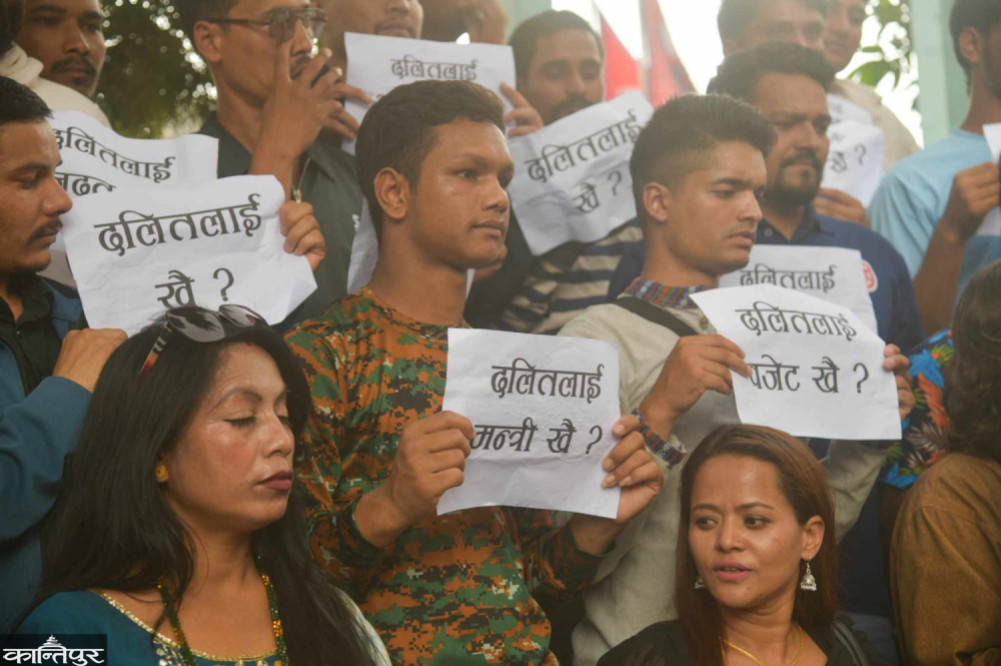
If the state is going to formally apologize to Dalits, including atonement for such serious atrocities and crimes committed against them, it should be considered a responsible step by the state.
We use Google Cloud Translation Services. Google requires we provide the following disclaimer relating to use of this service:
This service may contain translations powered by Google. Google disclaims all warranties related to the translations, expressed or implied, including any warranties of accuracy, reliability, and any implied warranties of merchantability, fitness for a particular purpose, and noninfringement.
The 100-point agenda for administrative reform passed by the Shah (Balen)-led government includes a point to apologize for the discrimination committed by the state against Dalits. The point states that the state, society and the structure have committed injustice, discrimination and deprivation against Dalits and historically excluded communities and that a reform program will be introduced within 15 days, including a formal apology, for social justice, inclusion and reconciliation.
It is a positive step for the state to apologize to the community, realizing the exploitation, oppression, atrocities and crimes committed against Dalits for thousands of years. The ruling power of the dominant ruling class and community enacted laws and carried out a series of cruel, oppressive and criminal discrimination against the Dalit community. To maintain the oppressive system, Dalits were completely banned from participating in state power.
Dalits have sacrificed in all struggles. Despite the sacrifices and contributions, the state continues to perpetuate atrocities and discriminatory crimes against Dalits. The state also needs to formally apologize to appreciate the contributions and sacrifices made by Dalits to the state and society. By practicing the same type of social and cultural system, the labor, skills, sweat and blood of the working Dalits were played Holi. Those who commit crimes against Dalits are respected in society, but Dalits who contribute to the functioning of society, the development of civilization, and the preservation of culture are never allowed to live a dignified life. If the state is going to formally apologize to Dalits along with atonement for such serious atrocities and crimes committed against Dalits by the state, it should be considered a responsible step by the state.
History is witness – agricultural production would not have been possible without the labor, skills, and contributions of Dalits. Dalits have made a huge contribution to human life by discovering and processing iron ore, producing all the materials necessary for agriculture and daily life. From temple idols, bells, and gajurs to the manufacture of everything needed for stoves, from clothes to shoes, from sanitation to songs and music, from farms to food pantry, there is no place where the blood and sweat of Dalits have not been seen.
However, those same Dalits are humiliated at every step, the doors of temples are closed, they are forced to suffer discrimination in the classrooms of schools that provide education. The state and society are standing as walls to resist for justice. However, be it the movement against tyranny or progressive change – Dalits have sacrificed in all struggles. Despite the sacrifices and contributions, the state continues to perpetuate atrocities and discriminatory crimes against Dalits. The state also needs to formally apologize to appreciate the contribution and sacrifice made by Dalits to the state and society.
The state based on the caste system has been denying Dalit representation. Dalits were not allowed to feel that ‘the state is ours’. The organs and bodies of the state could not realize the crisis, problems and suffering of Dalits and were forced to live a continuously oppressed life. The state, which played a role in promoting atrocities against Dalits by perpetuating the caste system, should not only apologize to Dalits by making them aware of the crime, but also ensure that it does not happen again in the future.
The state's apology to Dalits is not a sudden situation. The Dalit community in Nepal has been struggling for liberation with justice, equality, and self-respect for the past 80 years. The state has reached a situation of apologizing to Dalits because of the liberation movement carried out by Dalits, breaking state oppression, fighting against social oppression, and firmly standing for justice. Therefore, the apology that the government is said to make to Dalits is a product of that movement.
The practice of apologizing
The state's apology to Dalits is also an atonement for historical atrocities and a respect for people who have lived a life of struggle and oppression. States have apologized to Dalits all over the world, atoning for the atrocities and discrimination committed by the state. In the past, America, Britain, and European countries not only enslaved black groups, but also made them objects of purchase and sale. In history, there have been long struggles that those states should apologize and compensate for the inhuman and barbaric oppression committed against blacks by colonialists and white rulers.
South Asian countries have historically experienced extreme discrimination, oppression, and atrocities against Dalits, indigenous peoples, and marginalized communities. There was a fight that those states should apologize for the atrocities committed by whites against blacks, the genocide committed by German Nazis against Jews, and the exploitation of weak countries due to imperialist colonization. On November 27, 2006, the then British Prime Minister Tony Blair partially apologized for inhumane acts such as the slave trade. However, after Africans protested, he apologized again on March 14, 2007.
On February 13, 2008, Australian Prime Minister Kevin Rudd apologized for historical discrimination against the indigenous Aboriginal community there. In 2008, the US Congress apologized to the black community for serious crimes and atrocities committed by enslaving them in the past. In 2022, New Zealand Prime Minister Christopher Luzom apologized for the state's atrocities against the indigenous Maori.
Thus, many countries in the world have been apologizing for past apartheid and community crimes. However, in South Asian countries, Dalits, indigenous peoples and marginalized communities have historically been subjected to extreme discrimination, oppression and atrocities. However, the state has not expressed guilt and apologized. In Nepal, the state's apology to Dalits can be an example for South Asian countries as well.
The underlying issue with the apology
In Britain, when Tony Blair offered a partial apology for enslaving blacks, the community rejected the apology as a show. After the apology was rejected, he had to apologize again. This means that the issue of apologizing to Dalits on behalf of the state is taken lightly or whether it comes with a program that the Dalit community can experience in their lives. The point approved by the Council of Ministers states that reform programs will be introduced within 15 days. If a special program is really introduced to solve the basic problems of Dalits and can directly impact the lives of Dalits, the state's apology has practical meaning. Otherwise, it will be just like the state declaring an untouchability-free nation in the past. If there is no program for the Dalit community to feel, the apology offered by the state will have little meaning.
When the state apologizes to Dalits, it is necessary to focus on two issues in principle. One, ensuring justice. If the state is to apologize for the extreme oppression, exploitation, exclusion, and discrimination against Dalits throughout history, then the discrimination that has been happening historically against Dalits must end. In any incident against Dalits, the victim should get justice immediately. Since the state has the main responsibility of providing justice to citizens, it must be ensured that Dalits get justice after the apology is announced. For example, the family of Ajit Mijar, who has been waiting for justice for nine years, should get justice. The families of Angira Pasi to Inisha Bik, including those who were subjected to violence and murder, should get justice.
Two, ensuring compensation. The Dalit community has suffered a great loss due to the state's discrimination, exclusion, and deprivation. Dalits could not be strongly represented in the state power due to being deprived of politics. Due to being deprived of education, many opportunities have been denied, meaning that the community has suffered great losses. Due to exploitative labor relations, landlessness, and being deprived of resources, they have been forced to live a very difficult life. Not only this, the Dalit community is forced to live with serious psychological trauma due to cruel, inhuman discrimination and atrocities in daily life. Compensation for the damage caused to the Dalit community due to such cruel and serious crimes committed because of caste is an inherent issue in forgiveness.
Therefore, the state should review the history of the rulers who looted Dalits under the guise of power and wealth and compensate those who were forced to live a difficult life. Such practices have been practiced in the world. For example, in 2015, the US announced that it would provide $12 million in compensation to Jewish survivors of the genocide. In 1971, the US government gave $1 billion to the Alaskan tribes, while in 1952, the German government provided compensation to Jewish settlements affected by the Holocaust. Australia has launched a special program to eliminate inequality among Aboriginal people and is running economic and settlement management programs. Therefore, along with the apology, the state must ensure justice for Dalits, commit to no more injustice, and address the issue of compensation for historical violence, atrocities, and discrimination. This alone justifies the apology.
Implementation of the apology: The then action plan
Exploitative labor relations, landlessness, and being deprived of resources have forced them to live extremely difficult lives. Not only this, the Dalit community is forced to live with serious psychological trauma due to cruel, inhuman discrimination and atrocities in daily life. The announcement of the state to apologize to Dalits has created a public debate. Hopefully, the government will soon make the list of programs public as stated in the decision. The state needs to develop a short-term and long-term plan to address the problems of Dalits. Since there is a 100-day action plan, some of the topics that should be included in the action plan along with the apology are discussed here.
1. As soon as the state apologizes to the Dalits, all the state and local governments in the country should apologize for the brutal oppression, humiliation, exclusion and discrimination committed by the state against the Dalit community in the past. Each local government should invite the Dalit community and apologize for the discrimination and crimes committed in the past and express a commitment not to repeat the discrimination in the future. This helps to build a common understanding against the caste system and strengthen the self-confidence of Dalits. In 2007, London Mayor Ken Livingstone expressed his sorrow over the slave trade in history and apologized for the crimes committed by his ancestors in history. Such a practice should be practiced in Nepal too.
2. Dalits are forced to face discrimination and injustice on a daily basis but have not been able to get justice. Therefore, a plan should be made to ensure justice through a fast track by studying the situation of access to justice for Dalits. The government can at least immediately start the work of reforms that can be done to achieve justice according to the existing constitutional and legal system. For example, if a person feels that he has been discriminated against on the basis of caste, an arrangement can be made to inform them immediately through a hotline. Within a maximum of 12 hours of receiving information about the incident, the state can register a mandatory complaint with the police, initiate investigation and take action. For this, it is necessary to make the Dalit cell in the Nepal Police systematic, responsible and resourceful.
3. Many Dalits are waiting for justice. Victims of caste-based violence, murder, rape, beatings and insults have not been able to get justice. The victims of those incidents should get justice as much as possible under the initiative of the state, while those involved in the crime should be taken action immediately. For example, Ajit Mijar's body has been in a teaching hospital for nine years, but those involved in the crime are walking around carelessly. A separate bench should be formed to hear the issue of caste-based discrimination raised by the Dalit movement and arrangements should be made to provide justice in such cases at a fast pace.
4. Evaluation of compensation and formulation of a special action plan. It is necessary to identify and evaluate the damage caused to the Dalit community in the economic, social, educational, political and psychological fields due to the state's anti-Dalit system, and to formulate a special strategy and program for compensation to be provided to Dalits. यसका लागि अध्ययन कार्यदल निर्माण गरी क्षतिको विस्तृत खाका र परिपूरणको योजना निर्माण गरिनुपर्छ । समान अधिकारले दलितलाई क्षतिपूर्तिसहित न्याय दिन सक्दैन, त्यसैले दलितलाई क्षतिपूर्तिसहित विशेष अधिकार सुनिश्चित गरिनुपर्छ ।
५. नेपालमा दलितका सन्दर्भमा भएका संवैधानिक र कानुनी व्यवस्थाको प्रभावकारी कार्यान्वयन हुन सकेको छैन । त्यसैले समानुपातिक समावेशीकरण, आर्थिक, सामाजिक र सांस्कृतिक अधिकार सुनिश्चित गर्न उपलब्ध कानुनी व्यवस्थाको दृढतापूर्वक कार्यान्वयन हुनुपर्छ । यसका साथै संविधानको धारा ४० मा समावेश दलित हक कार्यान्वयनका लागि छुट्टै एकीकृत दलित ऐनको आवश्यकता छ । माफी कार्यान्वयनका सन्दर्भमा यो कानुन बनाउने विषय सरकारको प्राथमिकतामा पर्नुपर्छ भने जातीय भेदभाव तथा छुवाछूत (कसुर र सजाय) ऐन, २०६८ कार्यान्वयन हुनुपर्छ । यस्ता ऐन, कानुन र नीति निर्माण समुदायसँगको बृहत् परामर्शबाट गरिनुपर्छ ।
६. नेपालमा सबैभन्दा धेरै गरिबी, अभाव र संकटग्रस्त जीवन बाँच्न विवश दलित समुदाय हुन् । राज्यको विभेदकारी नीतिकै कारण दलित भूमिहीन हुन पुगेका हुन् । विभेदकारी नीति र व्यवहारकै कारण दलित आर्थिक अवसरबाट वञ्चित हुन पुगेका हुन् । त्यसैले राज्यले तत्काल भूमिसुधारको नीति निर्माण गरी कार्यान्वयन गर्नुपर्छ भने गरिबी निवारणको विशेष प्याकेज कार्यक्रम लागू गर्नुपर्छ । यसका साथै राष्ट्रिय सभाले पारित गरेको दलित अधिकारसम्बन्धी संकल्प प्रस्तावको पूर्ण रूपमा कार्यान्वयन गरिनुपर्छ ।
७. संरचनात्मक सुधार र निर्माण । निकै लामो दलित आन्दोलनबाट संवैधानिक राष्ट्रिय दलित आयोग गठन भएको छ । तर, राज्यले आयोगलाई आवश्यक स्रोत, साधन र जनशक्ति दिएको छैन । आयोगलाई सशक्त बनाउने र दलित विकासका लागि ‘दलित विकास प्राधिकरण निर्माण माफी’ कार्यान्वयनको कार्ययोजनामा पर्नुपर्छ । यसैगरी राज्यले दलितका समग्र समस्या हल गर्ने अल्पकालीन र दीर्घकालीन रणनीति बनाएर अगाडि बढेको खण्डमा माफीले व्यावहारिक सार्थकता पाउन सक्छ, नत्र भने यो केवल नारामै सीमित हुन सक्छ ।
संघर्षको निरन्तरता
राज्यले दलितसँग माफी माग्नु सकारात्मक पहल हो । माफी व्यवहारमा रूपान्तरित हुन दलितले न्यायको सुनिश्चितता भएको महसुस गर्नुपर्छ भने अब दलितमाथि अन्याय हुँदैन भन्ने ग्यारेन्टी हुनुपर्छ । यसैगरी राज्यले दलितमाथि गरेको विभेद, क्रूर दमन, अत्याचार र अपराधको क्षतिपूर्ति प्रदान गर्नुपर्छ । करिब ३५ सय वर्षदेखि विभेद, बहिष्करण र उत्पीडनमा पारिएको दलित समुदायको मुद्दा माफीको घोषणाले मात्रै सम्बोधन गर्न सक्दैन । दलितको राजनीतिक प्रतिनिधित्वको अधिकार, आर्थिक अधिकार, शैक्षिक, सामाजिक–सांस्कृतिक क्षेत्रका समग्र सवाल सम्बोधन नगरी दलितको मुक्ति हुन सक्दैन ।
जात व्यवस्थामा आधारित संरचनात्मक समस्या हल गर्ने सवाल दलित मुक्तिसँग अभिन्न रूपमा गाँसिएको छ । राज्यले ल्याएका सुधार र सकारात्मक पहलको सम्मान गर्दै दलितमाथिको संरचनात्मक विभेद, बहिष्करण, अपमान र हिंसाविरुद्ध दलित अनि सामाजिक न्यायका पक्षधर, सबैले दलित मुक्तिका लागि संघर्षलाई निरन्तरता दिइरहन जरुरी छ ।