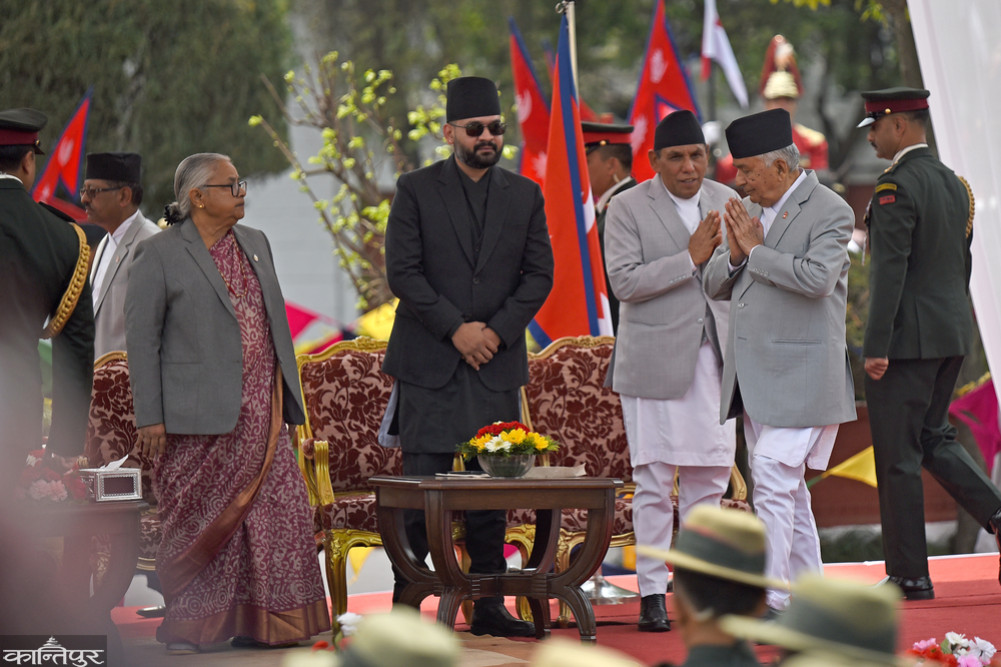
This time, the Council of Ministers has been expanded all at once. Earlier, even though ministers of state were appointed, a small Council of Ministers of 25 was formed as per the facilities provided by the Constitution, and inclusivity was not taken into account as per the spirit of the Constitution.
We use Google Cloud Translation Services. Google requires we provide the following disclaimer relating to use of this service:
This service may contain translations powered by Google. Google disclaims all warranties related to the translations, expressed or implied, including any warranties of accuracy, reliability, and any implied warranties of merchantability, fitness for a particular purpose, and noninfringement.
As per the mandate of 21 Falgun, the government has been formed under the leadership of senior Rashtriya Swayamsevak Sangh (RSS) leader Balendra Shah. The RSSS had sought votes from the people to make Shah the Prime Minister and since he was approved by the people, it is natural that he should become the Prime Minister. The formation of the Council of Ministers on Friday has broken some past practices.
For example, earlier, it used to take months for the Council of Ministers to be complete and the issues of division of power used to be left open. This time, the Council of Ministers has been expanded all at once. Earlier, even though ministers of state were appointed, a small Council of Ministers of 25 people was formed as per the facility provided by the Constitution and inclusivity was not taken into account as per the spirit of the Constitution.
This time, the size of the Council of Ministers is only 15 members, for the first time, one-third of women have been made ministers and it has also been made inclusive in terms of community. For a long time, the Council of Ministers was dominated by older leaders. This time, there is a majority of youth. Now the Council of Ministers should transform these positive aspects within itself into energy to fulfill the people's expectations.
The background of the current government is linked to the Gen-G movement of 23 Bhadra and the destruction of 24 Bhadra. Citizens were dissatisfied with the increasing distance between citizens and the state, state administrators being caught up in irregularities and corruption, increasing opacity, weakening accountability, increasing arrogance in political leaderships, lack of employment opportunities, and failure to realize good governance and service delivery. That is why the Gen-G movement was held. The actions and decisions of the current government should be such as to embody the feelings of the Gen-G movement.
The main aspect in which citizens realize the capacity of the government is the improvement in service delivery. In our country, all service delivery including administrative, health, education, agriculture, security, etc. is weak and criticized. Citizens do not get service quickly and easily in a procedural manner. There is always doubt about the quality of government services. There is no transparency due to the low use of technology. Citizens have to pay bribes even for work that is done according to the rules.
Service providers do not speak a citizen-friendly language. Therefore, work should be done to streamline the process, enhance the use of technology, and make service providers user-friendly. There are always delays in development work. It is difficult to complete project work on time. The development budget is spent only minimally. The current government should remove obstacles and delays in development work. Once the project starts, it should be able to fix the final date for its completion. This not only increases trust in the state, but also increases the productivity of citizens.
Employment opportunities are few in our country. Due to this, more than two thousand youths go for foreign employment every day. A large number of them are going as forced and unskilled workers. In such a situation, the government should be able to achieve high economic growth and continue it for a few years. It should encourage domestic and foreign investment.
If the government increases its spending capacity and ensures the security of investment, it will motivate the private sector. This is necessary, because the private sector was also attacked on 24 Bhadra. It has discouraged them. Therefore, not only the security of the private sector, but also ending the negative perception expressed towards the private sector and boosting morale should be the government's priority.
Another primary issue is to formally make public the report of the Commission of Inquiry into the incidents of 23 and 24 Bhadra and fully implement it. The then Prime Minister and UML Chairman KP Sharma Oli and Home Minister and Congress leader Ramesh Lekhak were arrested on Saturday morning. This has already started the implementation process of the report.
However, the government will have to face the questions and suspicions raised by the manner in which they were arrested, using executive power rather than a court order, and this. Both have been taken under control with an urgent arrest warrant, whereas this executive power facility is used when the accused flees, destroys evidence or obstructs the investigation. This weapon has been used to arrest people who are unlikely to do so, which has raised legal and political questions.
On the other hand, after the arrest of Oli and Lekhak, who were in high political positions during the incident on 23, the process of action should also proceed against other people as recommended by the Commission. At the same time, there are many suspicions in Nepali society regarding Bhadra 24. The commission has not been able to say much about it, it has only recommended further investigation. Even if the commission has not been able to say anything, the citizens have seen the country burned, vandalized, and people killed. This issue must also be resolved, the accused must be investigated and action taken against the guilty. The government has no room for being selective.
The work of almost two-thirds of the government should be legal. Procedures should be followed. The relationship between the party and the government should be strong to ensure political stability and, through that, to make the government's work citizen-oriented. In the past, even when the government was strong or when a single party had a majority, political accidents have occurred due to the failure to have a harmonious relationship between the government and the party. The Rashtriya Swayamsevak Sangh (RSS) and Prime Minister Shah can learn a lesson from that.