The importance of one person reaching the top in the country's power and politics cannot be established until politics that is responsible and honest towards the people is initiated. Let's hope that the new leader of the Nepal government, Balen, understands this issue.
We use Google Cloud Translation Services. Google requires we provide the following disclaimer relating to use of this service:
This service may contain translations powered by Google. Google disclaims all warranties related to the translations, expressed or implied, including any warranties of accuracy, reliability, and any implied warranties of merchantability, fitness for a particular purpose, and noninfringement.
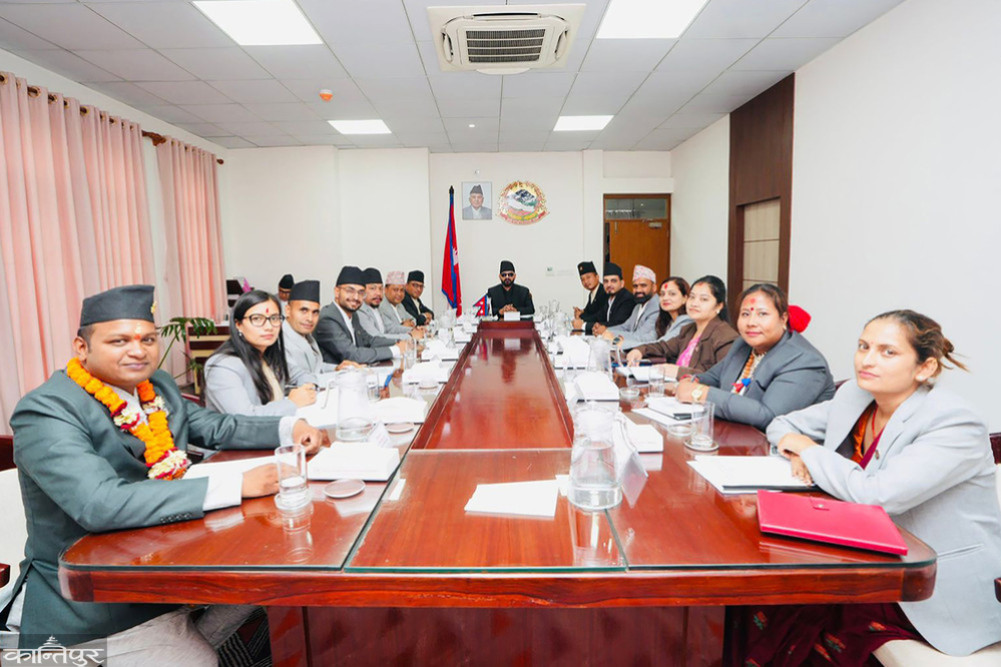
Amidst the good wishes of representatives of various religions and sects in Nepal, Balendra Shah took the oath of office as the Prime Minister of Nepal on Friday. Representatives of various religions and sects sang hymns at the grand swearing-in ceremony held in the courtyard of the Presidential Palace. According to the republican constitution, Nepal is a secular country.
The impact of Balendra Shah's decision to contest the election from Jhapa against UML Chairman KP Oli was miraculous. It was a surprising experience for the Communists and the Congress of Jhapa that the voters who had been voting for Chairman Oli were flocking to Balen. However, since the majority of the people here are Hindus, representatives of the minority religious communities 'Islam' and 'Christian' sects were not seen at the grand ceremony. Small mistakes are bound to happen in such grand events. The Nepali people do not pay much attention to the small 'shortcomings' of the organizers of the event. Was the event grand or not? That is what their attention is focused on. There is no point in pointing out the small 'exciting' mistakes in such events.
After Balen Shah took the chair of the Prime Minister, the people of both Madhesh and the hills were thrilled. Madhesh had been heated up by Balen's name even before the elections. In the history of Nepali statehood, no personality from Madhesh had won the post of Prime Minister. As soon as Balen Shah was presented as the candidate for Prime Minister, the Madhesis had 'silently' united for his victory.
The impact of Balen Shah's decision to contest the election from Jhapa against UML Chairman KP Oli was miraculous. It was a surprising experience for the Communists and the Congress of Jhapa that the voters who had been voting for Chairman Oli were flocking to Balen. Balen hoisted the victory flag of UML Chairman Khadga Prasad Sharma Oli, who was buried in Jhapa. In fact, the elections held in Falgun took away the respect not only of Oli, but also of influential Nepali Congress leader Gagan Thapa. Thapa, who had reached Sarlahi to contest the election, suffered a humiliating defeat from Amresh Singh. Only Maoist leader Prachanda escaped defeat.
The background to Balen Shah's rise to power is the Gen-G rebellion that took place last Bhadau and the massacre and destruction committed in the name of that rebellion. As Prime Minister, Balendra Shah's responsibility is to immediately treat the injuries inflicted on the minds of the people due to that accident. Perhaps understanding the 'reality' of this rebellion, Prime Minister Balen Shah ordered the arrest of Oli, the Prime Minister during the rebellion and the self-styled leader of the UML, and Ramesh Lekhak, who was the Home Minister in his cabinet, on the morning of Saturday, the day after he came to power, based on the report of the Gauri Bahadur Karki Commission. He certainly would not have given such an order without the consent of the 'Bhadrakali' center. This must have satisfied the arrogance of those who created discord in the name of the Gen-G movement. However, what will be the reaction of the general public to this? That remains to be seen.
In the current context, the three major political parties – Congress, UML and Maoists – that have earned a name as the ruling parties are in disarray. Due to lack of unity, all three parties are in disarray. Maoist Party Chairman Prachanda, the hero of the establishment of the republic in Nepal, is in a politically disarray. Although it appears ‘unified’ from the outside, UML is not as strong as it is being portrayed. Nepali Congress leaders have weakened the Nepali Congress. The leaders of the Jamaat, who challenged Sher Bahadur Deuba’s leadership ability, are themselves in a disarray.
The ability to provide even the necessary facilities for the daily life of the Nepali people was not seen in the previous governments that ruled. The country is headed for decline because of them. In the past three decades, the Maoist, UML and Congress Party governments have not been able to create a situation where people can earn a living by sweating inside the country. No government has paid attention to the development of internal resources and means.
No government has been able to stop the widespread misuse of national property. It cannot be denied that the country has faced many hardships due to leaders who dreamed of sending capable human resources abroad as slaves and building the country with the revenue from them. No government has been able to stop the widespread misuse of national property. It cannot be denied that the country has faced many hardships due to leaders who dreamed of sending capable human resources abroad as slaves and building the country with the revenue from them. Governments were unable to pay salaries to employees until Nepalis who went abroad for employment sent money. Neither agriculture, nor farming, nor industry, nor trade - until the people become serious about these terrible problems, no solution will be found. This is a common fact.
This is a very interesting thing - almost none of the political parties and their leaders in Nepal have been able to become media literate. Neither have the media outlets been able to become serious about the people. Even highly educated leaders who can give fluent speeches about the importance of media in the 21st century do not have knowledge of media culture. Even people who have a general understanding of the important role of independent media in a democracy, after coming to power, control the media. Compared to the way the country's institutional media was abolished during the Gen-G movement of the past, social media dominated the minds of the people. At a time when media like 'TikTok' was becoming popular, the government took control of social media in the name of 'regulation'. The movement became even more concentrated in resistance to that.
In the post-republican Nepali society, it is a sad experience that the government and private sector media outlets are unable to play the role of visionaries for professional people. The people suffer greatly when journalists working in the media do not understand the signs of the times. This is a very scary situation. All media outlets in Nepal are run on the basis of confusion and deviation. Media operators remain invisible. Such confusion and deviation are more prevalent in government media outlets.
The latest movement has made it clear that the government should not take ownership of the media in a democratic republic. Such a situation is counterproductive. The government and political party leaders have been accepting this fact from time to time. However, none of the political parties and so-called policy makers have shown any interest in stopping this trend. Everyone is worried about themselves and their families and relatives. Everyone wants to reach a position of social and political control of power. Everyone has the tendency to rule and is the most. In such a situation, how will the new structure of the new Nepal be formed? The country is currently reeling under an incredible situation. Will a new Nepal be formed, will it not be formed, and even if it is formed, how ugly will it be? This is a critical time that patriotic Nepalis should think seriously.
Whatever the case, for now, a curtain has been drawn on one door of the political transition that has begun in the country. Life will gradually become easier. However, the Nepali people have yet to pay a price for this ease. The claim that the living standards of the people are increasing by showing the colorful 'index' of development
Despite all efforts, Nepal has not been able to embark on the path of progress. The importance of a person reaching the top in the country's power and politics cannot be established until responsible and honest politics towards the people is initiated. Let's hope that the new leader of the Nepali government, Balen, has understood this.
If the previous governments had been serious and tried to find solutions to the problems of the people, there would not have been a situation of rebellion now. There is no point in keeping this proven fact in the quota. The Nepali people have the power to raise their voice against the inefficient government. As long as the people have this power, the country's identity will be safe.
If the previous governments had been serious about finding solutions to the people's problems, there would not have been a situation of rebellion now. There is no point in glossing over this proven fact. Journalist Lincoln Stephens has written in his book 'Revolt is Not Reform' - Anger and resentment alone are not enough to eradicate corruption. The people express their desire for economic and social change through large-scale movements and resentment. However, this alone is not enough to change the society and system. Only result-oriented economic and social reforms can deal with rebellion.
Balen Shah's rise to power is not unnatural. His 'image' as a singer was sharpened by social media. He was not very successful as an administrator. As the mayor of Kathmandu Metropolitan City, the expectations placed on him by the city residents were not fulfilled. However, he was given the benefit of the doubt. The people thought that the city administration and central government employees did not support him. However, there was nothing like that. Balen also understood this issue. In the recent past, poets and artists have entered politics with their many dreams. However, their effectiveness was not seen. However, Balen's personality was attractive and his singing was magical. The rap he sang using 'Chameli' as an image was very impressive.
As far as politics is concerned, it was not easy for Balen to establish his political effectiveness in a traditional society like ours. He contested the election as a well-wisher of the National Independent Party. Although his relationship with the Rashtriya Swatantra Party was friendly, it was 'uneasy'. That uncomfortable situation still persists. If he fails to show signs of effective change within the next 6 months, the exodus will begin from there. His name will also be added to the wave of some Nepali leaders who are in the future. We cannot survive in this competitive world by just shouting the slogan of a 'beautiful, peaceful, vast' country like ours, which lacks resources and means for development.