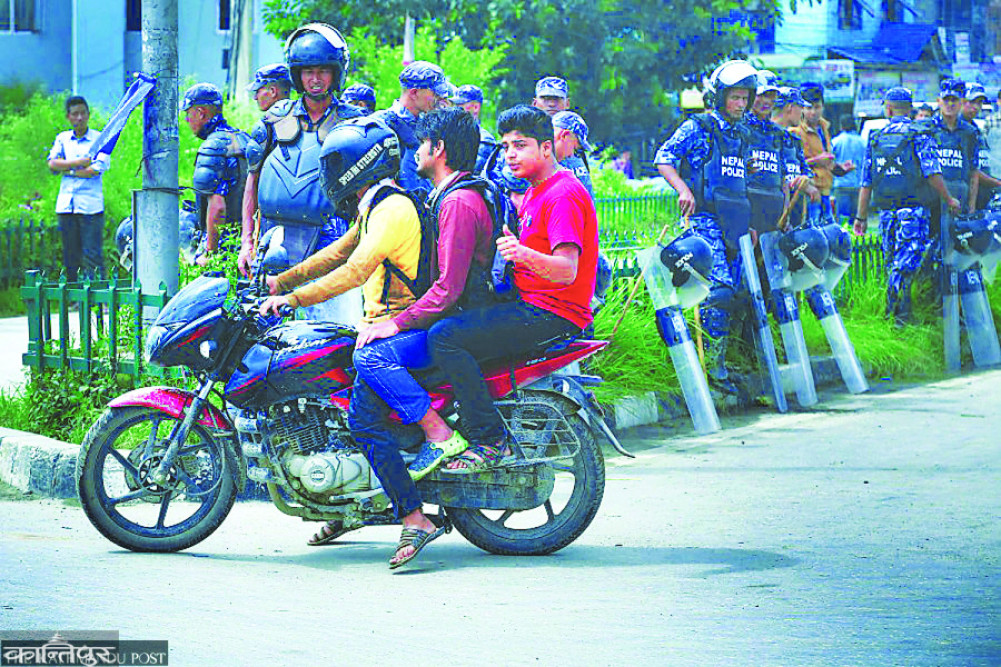
Perhaps Nepal is the only country where motorcycle or scooter drivers are not required to wear helmets.
We use Google Cloud Translation Services. Google requires we provide the following disclaimer relating to use of this service:
This service may contain translations powered by Google. Google disclaims all warranties related to the translations, expressed or implied, including any warranties of accuracy, reliability, and any implied warranties of merchantability, fitness for a particular purpose, and noninfringement.
Your own head is as strong as iron! Why bother wearing a helmet?’ is the thought that comes to the mind of many motorcycle or scooter drivers. Similarly, ‘Is a helmet worn for the traffic police or in case you get caught in a traffic accident, where should you wear it to protect your head or brain?’ The thought also comes to mind.
Therefore, even though most drivers wear helmets on main roads or in places where there are traffic police, you can see bikes or scooters running without wearing helmets on inner roads, squares, and alleys. The practice of motorcycle or scooter drivers not wearing helmets is probably unique to Nepal. However, if we believe the words of many neurosurgeons or surgeons who treat after vehicle accidents, it has been found that a good quality helmet is life-saving to a large extent. How does a helmet protect the head or brain?
Let’s look at an example to find out. You drop a raw egg from a height of about two or three feet to the ground, and then drop the same egg from the same height, wrapped in plastic, straw, foam, or soft cloth.
You know the exact result – when the egg falls freely, it breaks in places. However, when the egg is dropped tightly, it does not break or is safe even if it falls from a great height. Similarly, if you have a car accident while wearing a helmet, it protects your head from hitting the ground or hitting a hard surface like the road (ground).
The impact energy that is applied to it while hitting the ground is spread out, reducing the impact. And, the foam (soft material) placed inside the helmet also increases the impact duration and reduces the damage. It helps to stop the head at low speeds. The outer shell of the helmet spreads the impact that is concentrated on a small surface, reducing the amount of force that is applied to a single point.
And, since the foam inside the helmet is flexible and compressible, it protects the driver's head by dissipating the energy impact according to the speed of the vehicle in the event of an accident. Helmets are not meant to make drivers completely safe, but since the brain is an important part of any organism and the brain controls and controls all body processes, if the head is saved, it can be considered a great achievement.
When a blow is made to a structure (brain) inside a certain hard shell like the head, it has a direct impact at the time of injury, and the backforce also has a reaction effect, like the aftershocks after an earthquake. Why should you wear a helmet? The simple answer is – its correct use saves the driver from death. According to a study, wearing a helmet in a motorcycle accident reduces the risk of death Reduces the risk by about 42 percent, mainly because helmets are considered highly effective in reducing the mortality rate from head injuries. Helmet use reduces the risk of serious injuries or bleeding inside the brain.
According to a study conducted in the United States, serious head injuries that can occur in drivers who wear helmets were reduced by about 70 percent. According to an African report, helmets were found to reduce the risk of head injuries by up to 88 percent. Similarly, hospital stays, medical expenses, and the time of the affected person are also saved.
Injured people wearing helmets are discharged from the hospital on average three days earlier, and the need to be kept in the ICU and mechanical ventilator for artificial respiration is reduced. Hospital expenses are saved in lakhs. According to the Vehicle and Transport Management Act of Nepal- 2049, it is mandatory for motorcycle drivers and passengers to wear helmets.
According to the new bill (2081), there is a clear provision that even passengers sitting in the back should wear helmets. However, in practice, only the driver is required to wear them. In terms of health-oriented laws, wearing helmets by both motorcyclists and passengers indicates a high level of traffic safety awareness in society. The benefits of wearing a helmet regularly include protecting the brain and head, and reducing serious head injuries (by 65-70 percent). The risk of death is reduced.
Sudden death improves by about 50 percent. Traffic safety awareness and culture are created. How to choose a helmet? In this regard, only standard or certified helmets should be used. It is considered better to use helmets that have passed scientific tests such as ISI (India), ECE (Economic Commission of Europe), DOT or Snell (USA).
That is, the helmet should not be torn off or cracked even with a small impact. When it comes to choosing the right helmet, it should cover the entire head rather than a half-helmet, provide adequate protection to the jaw, eyes, ears and face, and be able to be tightened. The foam of the helmet should be soft and reliable. You should choose a helmet that is breathable, sweat-wicking, and odor-resistant. The front visor should also be UV-resistant and moisture-resistant.
The foam inside the helmet ages over time, and such a structure can weaken protection. As the helmet ages, protection decreases. Therefore, the helmet should be replaced at regular intervals. Therefore, it is necessary to replace the helmet after an accident or after 5 years. A helmet cannot provide complete protection against all types of injuries, especially those caused by mild to moderate impacts. The size and fit of the helmet must be correct. An incorrect helmet reduces its effectiveness.
Only the outer shell of the helmet protects the bones of the head, EPS foam and new technology are important to protect against injuries deep in the brain. Helmets not only provide structural protection for the head, but also protect the brain. Its correct use and regular replacement can help reduce the risk of serious injury in accidents. Making excuses for not wearing a helmet, such as ‘it’s a short distance, there are no traffic police, or something like that,’ is dangerous.