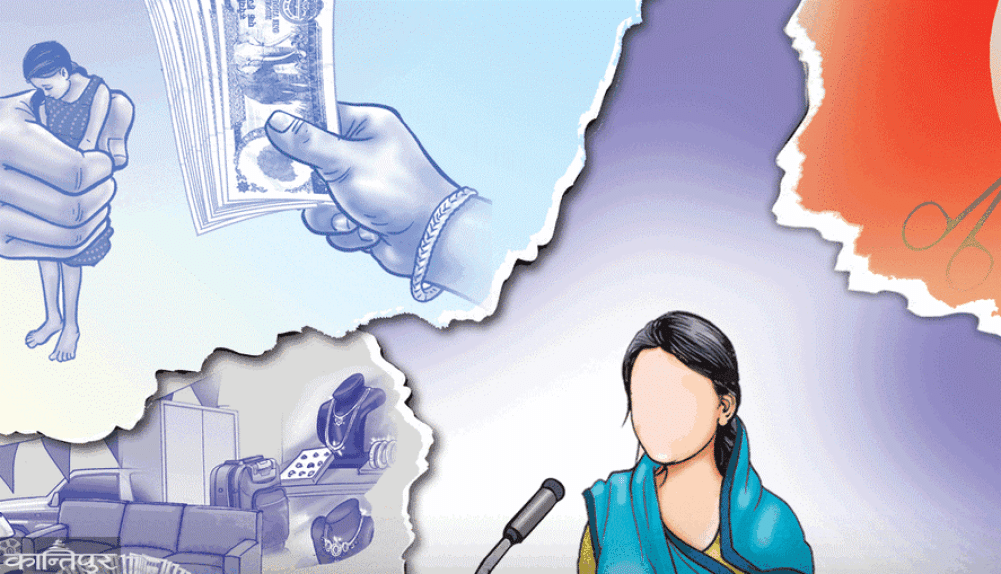
'Women's empowerment' has become a popular topic because women do not have the same opportunities as men in all fields.
We use Google Cloud Translation Services. Google requires we provide the following disclaimer relating to use of this service:
This service may contain translations powered by Google. Google disclaims all warranties related to the translations, expressed or implied, including any warranties of accuracy, reliability, and any implied warranties of merchantability, fitness for a particular purpose, and noninfringement.
Gender equality is the equal access and control of women, men, and other gender groups over the opportunities provided to citizens by the family, society, and the nation. Since women do not have the same opportunities as men in all fields, ‘women’s empowerment’ has become a popular topic.
The latest political developments have also made it clear that today’s conscious society is in favor of women’s empowerment. Gender equality is a prerequisite for building a civilized, cultured, and developed society. In our perspective, the only way to achieve gender equality is through women’s empowerment. Since the equal status of women and men cannot be maintained in political, social, and economic indicators, inclusion is formally visible but cannot be achieved in reality.
Gender inclusion can be a guide to all types of class, ethnic, linguistic, and geographical inclusion. The United Nations has set ‘Sustainable Development Goals’ in 2015 to institutionalize all types of equality in the global community. It is highly commendable to adopt gender equality as an important goal among the 17 goals under the Sustainable Development Goals. And, Nepal is also a party.
While discussing the need and importance of women's empowerment, the situation of violence against women in Nepal cannot be ignored. 1 in 4 women here suffers from physical, mental or sexual violence in their lifetime. In this way, the state's responsibility to protect basic human rights is questioned. There are women from specific classes and communities who are at high risk of violence.
Now, the issue of complete guarantee of women's safety and women's empowerment should be taken as the main agenda of the state. The main priority of the new government is to end all forms of violence against women and mainstream gender in development. According to the results of the House of Representatives elections-2082, women's participation in the House of Representatives has reached around 35 percent.
Although there is no significant increase in the 33 percent as per the constitutional provisions, it can be hoped that the majority of young women representatives at the policy-making level will institutionalize gender-responsive governance. Even though the House of Representatives elections have been concluded, the attention of political parties should be drawn to significantly increase the number of female candidates in the local level and provincial assembly elections-2084.
It is essential to promote and replace more women in the chief positions, which is limited only to the deputy chief posts at the local level. Nepal has been a party to various international commitments on women's rights and empowerment. The current constitution of Nepal is also women-friendly. Women's issues have been addressed in many sectoral policies.
Despite this, the general stakeholders understand that the implementation aspect has been weak. A clear action plan with a time frame for implementation, objective definition of responsibility and accountability, and a budget should be arranged with priority to achieve the expected goals. Only then will the implementation aspect be result-oriented. Looking at the situation of Nepalese women, the number of women suffering from various customs and traditional violence is staggering.
The shocking statistics on domestic violence, violence through technology, and even sexual violence show that the next government should not delay in developing an integrated data system on gender-based violence without delay and in institutional strengthening for a fact-based speedy justice system, a system of prescribed compensation, and complete women's safety.
For the multifaceted empowerment of women and the establishment of a speedy justice system in cases of gender-based violence, various institutional structures (such as the National Women's Commission, the Ministry of Women, Children, and Senior Citizens, women's branches and local judicial committees at the local level, one-stop crisis management centers in 97 government hospitals in the country, and women, children, and senior citizen service centers at 223 locations under the Nepal Police) have been established and services are being provided.
Despite this, the next government should not delay in restructuring the relevant bodies as the issue of gender sensitivity in service delivery is not felt by the citizens. Educational institutions have the highest role in gender socialization. Gender-sensitive subjects should be added to the existing system in the curriculum from secondary school to higher education.
Targeted women should be identified and skills-based programs should be conducted to address the issue of women's poor access to economic resources, which is a major factor in violence against women. And, the existing system for women's access to property should be widely publicized. Since most of the time of women is spent on caregiving and household work, a master plan should be formulated that calculates the economic value of such work. For this, objective research and investigation are necessary.
There have been efforts for gender equality and women's empowerment in the past. The results of the efforts made are being achieved at a slow pace. There has been clear progress in the issue of women's empowerment, but there is a need to continue by giving more momentum to the efforts made to protect the human rights of ordinary women.
There are also marginalized women, single women, elderly women, women with disabilities, Muslim and Madhesi women. The need of the day is a gender-responsive government that governs in a way that can provide opportunities for women who are deprived and at the bottom of society to live a life free from violence and discrimination.