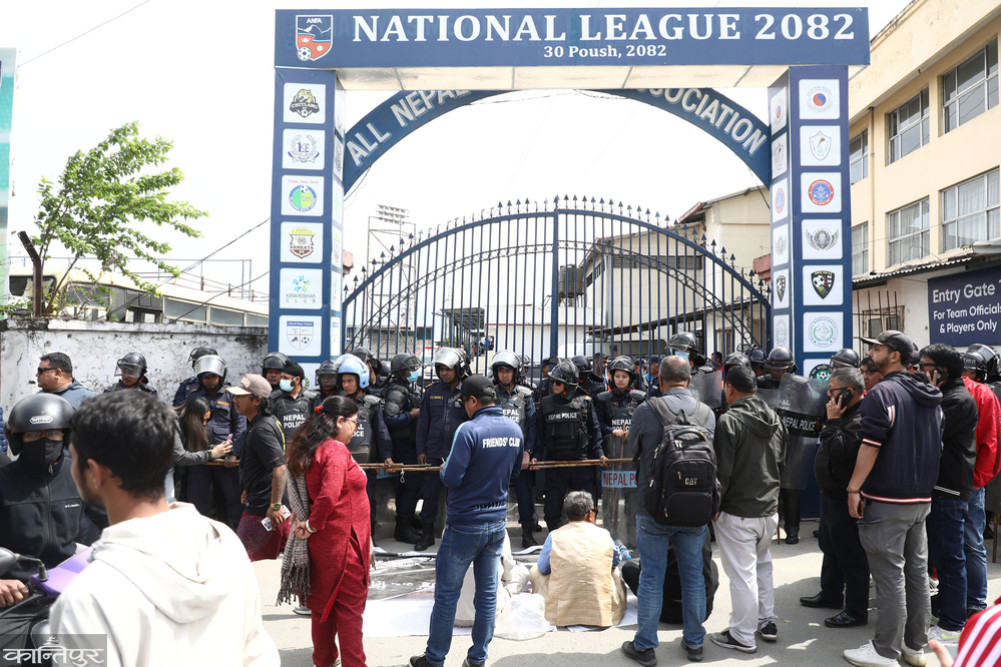
For the improvement of the sports sector, political games in leading institutions should be stopped. Unnecessary interference from the government should also end. Adequate competitions should be organized.
We use Google Cloud Translation Services. Google requires we provide the following disclaimer relating to use of this service:
This service may contain translations powered by Google. Google disclaims all warranties related to the translations, expressed or implied, including any warranties of accuracy, reliability, and any implied warranties of merchantability, fitness for a particular purpose, and noninfringement.
Nepali football has become a strong image to present the downward journey of any sector. At one time, Nepali football was widely discussed in terms of competition, results, and sportsmanship. There was praise and criticism.
Nowadays, the game itself is becoming difficult, and results and sportsmanship are not visible. Political ambitions have been given priority over sports in the leading organizations of football. Therefore, problems have been seen in every part of the Nepali football sector. Mainly, the problems are going towards complications rather than solutions. If the entire sports sector, and in particular all the structures like the government, National Sports Council, and ANFA, which are responsible for the development of football, do not take serious and prudent steps in time, Nepali football will definitely move towards nothingness in the near future. They should be ready to take drastic steps and sacrifices together to give the Nepali football sector the right path.
The FIFA ranking can be an example to illustrate the declining state of Nepali football. In 2018, the FIFA ranking of Nepali men's football was 165th. It has fallen to 170th place in 2019, 171st in 2020, 171st in 2021, 176th in 2022, 175th in 2023, 178th in 2024 and 182nd in 2025. There are many reasons for the 17-place drop in 8 years. For example, there is a conflict between the National Sports Council (NSC) and the All Nepal Football Association (ANFA).
There is intense polarization between the parties that make and stop the ANFA elections, which has led to uncertainty in the election of the leading organization of Nepali football. The men's national league and the women's Martyrs' Memorial League are in a state of suspension. The sports sector has been shaken by the immigration letter that players who came on tourist visas are not allowed to play and must obtain a work permit to play. As the internal dispute reaches its peak, even the international games that Nepal is to play are in doubt.
At present, ANFA is preparing to form a new committee for the next four years through elections. The necessary process for the election has also been completed. However, the NSC has already ordered the ANFA to stop all election processes. While the ANFA establishment is making every effort to hold the elections on the date it announced, the possibility of the NSC interfering in the ANFA and forming a new ad hoc committee is also being assessed.
On the other hand, there is a possibility that the International Football Federation FIFA will impose a ban on Nepal and that it will also form a ‘Normalization Committee’ sooner or later. In a situation where the elections cannot be held and there is government interference in the ANFA, FIFA may impose a ban on Nepal. In such a situation, the men's Nepali national team will have to face a serious void. It will be the most difficult task to come out of it and revive it.
While the Martyrs' Memorial Women's League is being held at the Chyasal Stadium and the men's national league at the ANFA Complex in Satdobato, the Immigration Department of the Government of Nepal has written to the All Nepal Football Association (ANFA) asking foreign players on tourist visas not to play, both leagues have been suspended. Most of the teams playing in the national league, except for the departmental teams APF, Army and Police, have foreign players.
Earlier, foreign players used to come and play on tourist visas. The process of registering foreign players and obtaining work permits is cumbersome and the process is also long. However, since Rule 20 of the Immigration Regulations, 2051 states that foreign citizens who obtain a visa cannot do any work other than the purpose for which they obtained the visa, this issue should be resolved as soon as possible. The government's initiative and facilitation are also necessary. There is little football activity and it is obstructing the development of football, so a quick decision is inevitable.
Since the league itself is rare, professional development of football has not been possible in Nepal. A situation has not been created to invest in football and nurture it from clubs to players. Since players are also unable to play the game, problems have arisen in skill development and personality development. Players have become unemployed. Recently, key members of the national team have migrated abroad, including former captain Sujal Shrestha to Pujan Uparkoti.
Players are migrating abroad due to fear of not having income and wasting their energetic time due to lack of games. When discussing Nepali cricket, it is easy to understand the plight of football. NPL has started in cricket, which has become a center of activity worth crores. Players are relatively busy. Having the opportunity to play with players from home/foreign countries has contributed to skill development. If any budding player works hard, there are many opportunities for him. There is a crowd of spectators. On the other hand, it is the opposite in football. Activity is low. Even when there is activity, the audience is almost zero.
For the improvement of the sports sector, political games held in leading organizations should be stopped. Unnecessary interference from the government should also be ended. Adequate competitions should be organized. It not only keeps the players busy, but also ensures financial security. It also helps in producing new players. Opportunities for 'exposure' should also be available. If games can be organized with other countries, it contributes to skill development.