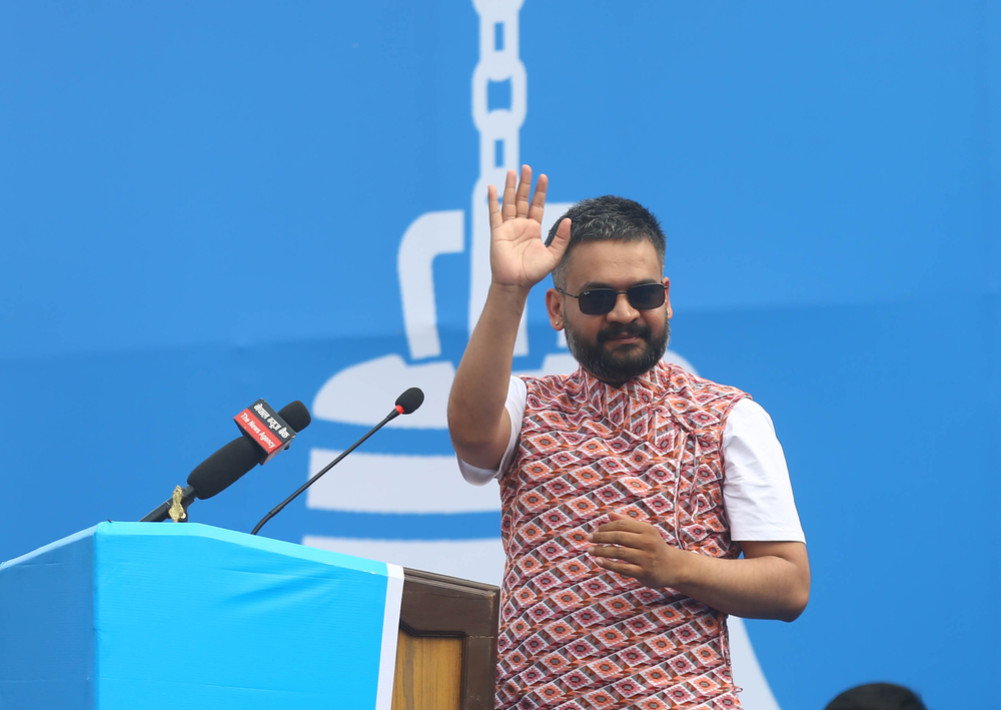
Good governance and service delivery remain challenges for the Rashtrapati Bhavan. How it embraces democratic values and norms, and how much space it gives to the opposition will also be important questions.
We use Google Cloud Translation Services. Google requires we provide the following disclaimer relating to use of this service:
This service may contain translations powered by Google. Google disclaims all warranties related to the translations, expressed or implied, including any warranties of accuracy, reliability, and any implied warranties of merchantability, fitness for a particular purpose, and noninfringement.
This week will add two important pages to Nepal's political history. First, the Prime Minister of the interim government, Sushila Karki, is leaving Singha Durbar after fulfilling her responsibilities. The first female Prime Minister, Karki, has been able to bring the country out of a serious political/constitutional transition by holding elections within the stipulated time frame. This will be a reference that will be remembered in history as a successful example.
Second, with a new and strong mandate, senior leader of the National Independent Party (RIP), Balendra Shah (Balen), will enter Singha Durbar as the Prime Minister. Balen, 36, the youngest among the prime ministers so far, is taking office as the first prime minister from a Madhesi background.
Both these references are historical turning points in Nepali politics. Up to this point, the country has gone through a complex transition period. However, political stability has not yet been ensured. As hopes and expectations have increased, so have questions of suspicion and doubt.
Will the country now achieve good governance, peace, prosperity, and stability? Will the power-oriented political culture change after the new mandate? Will democratic values be promoted? Will the country get a responsible government and a strong opposition in the changed political balance of power? What will be the role of the administration/security administration? How effective and neutral will they be? What will be the role of the Nepali Army, which has become the mediator of the recent transition period? The future of the hopes and expectations that have arisen now lies in the womb of the above questions. The roles of stakeholders including the ruling party, the opposition, the bureaucracy, the security administration, the media and civil society in these questions will be the basis for guiding the future political destination. This analysis has been prepared considering the need for a debate on these questions on the eve of the formation of the new government.
Let's start the debate with the National Independent Party (NISP), which has emerged as a powerful party in the Nepali political horizon.
The stage that the NISP has reached today after being approved by a large public vote is a huge political achievement for it. It is not only a matter of surprise that a party with a history of only three and a half years has achieved great achievements in the elections, it has also raised hope and enthusiasm.
It is not the time to question the Rashtriya Swayamsevak Sangh (RSS), which is undergoing a test. It is appropriate to comment only on its governance qualities/deficiencies, qualifications/incompetence, vision/style of work. However, it is imperative for this emerging political force, which is facing challenges, to be vigilant at every step. That is because, if this party can show its governance qualifications, the transition will end, and if it proves to be incompetent, there will be a risk of a new transition.
A large number of citizens are cheering after the latest public address of President Ravi Lamichhane. After he presented himself in a very balanced and polite manner while training his MPs, many praised it as a responsible and mature expression. Some others who were quick to cheer did not delay in giving the title of 'politician'. It is a positive thing that Lamichhane, who came into the limelight by making hateful and provocative statements, has changed and appeared in a polite and soft style after his victory. However, the 'jubilation' of the Rashtriya Swayamsevak Sangh (RSS), which is carrying the heavy burden of public expectations on the basis of one address, will be an emotional impulse.
Past examples say that getting a strong mandate is one thing, implementing it correctly and effectively is another. In the 2048 general election, the Nepali Congress won a strong majority. However, the government fell before completing its term due to internal turmoil. The Congress got that opportunity for the second time in the 2056 general election. It could not sustain that either. The Maoists got a similar opportunity in the first Constituent Assembly election in 2064. In 2074, the UML and the Maoists together got almost two-thirds of the vote. However, they could not do justice to that vote.
This does not mean that the new ones cannot either, just because the old parties could not do it. However, it is worth considering that the exercise of power is not as easy as sitting on the street and criticizing. To think about this, it is enough to look at the working style and practice of the interim government led by Sushila Karki. She has become a subject of thanks by holding elections on time. However, has her exercise of power been free from controversy and question? Gen-G activists are standing on the streets carrying placards, expressing their dissatisfaction with the interim government. The interim government fulfilled its mandate to hold elections. However, it has not made any progress towards changing the aspirations for change carried by the movement. In fact, it has not even dared to make the report of the inquiry commission it formed public.
Karki, who was considered spotless, has been embroiled in controversy since her appointment as Attorney General and her appointment as her own personal secretary. She has raised questions about transparency and accountability, and has not made her own asset details public. She claimed that other ministers have submitted their asset details to the Prime Minister's Office. However, when questions were raised in the media several times, she ignored them and did not make them public. The ministers she chose left their posts midway to contest elections by making a ladder of posts. This was widely criticized, but she defended that irresponsible move. Questions have been raised against her for failing to balance geopolitical sensitivities. She has faced criticism for her obsession with pilgrimages while traveling. The RSP can learn from these recent exercises that while it is easy to criticize from outside power, it becomes challenging once it reaches the level of implementation itself.
Also, since the RSP is a new political force, it lacks governance experience. Although it has previously joined a coalition government, this party is new in terms of governance experience. The people have high expectations. The people have less patience and a tendency to seek immediate results. As much as the competence and willpower of the political leadership are needed to give results to the people, an agile bureaucracy and its support are also needed. The common complaint that the bureaucracy is slow has been heard. Miraculous reforms in this will be a challenge for the RSP to face at the beginning.
The RSP's manifesto will take a lot of reading. Now it must be able to implement it. Just as the narrative that the country is uninhabitable was made after the crowds of people going abroad were seen at the airport every day, can it now create a 'counter' narrative by creating a queue of people returning? The Rashtriya Swayamsevak Sangh (RSS) has a long list of challenging tasks on its shoulders, including economic reforms, corruption control and good governance, and providing security to a society that has been 'traumatized' by the devastation caused by the Gen-G movement.
Good governance and 'service delivery' are still a challenge for the RSS. The question of how it embraces democratic culture and values, and how much 'space' it gives to the opposition will also be important. Lamichhane has been praised for showing political culture by appreciating the history of the struggle of old political parties in the MP orientation program. However, there is also a line within the RSS that wants politics without opposition. Lamichhane himself had asked for votes during the election campaign, saying, 'Either close the shutters of the RSS or those of the old parties.'
Against this backdrop, the power structure of Nepali politics has changed after the election. The RSS has become not only a large but also a powerful party, while the Congress is in second place in parliament, but as a weak opposition. Leftist forces like UML and Maoists have shrunk and are on the defensive.
The presence of regional parties from Madhesh in parliament has reached zero. The RPP did not get the public opinion that was seen when the former king took to the streets. Even if the political forces other than the ruling party have shrunk in terms of numbers, a responsible opposition is necessary for the strengthening and promotion of democracy.
In a democracy, no matter how large the public opinion is, politics cannot be one-sided. A responsible government and a strong opposition are the energy of the democratic system. The behavior of the ruling party towards the opposition and how responsible the opposition can hold itself will determine the future political stability. If the opposition engages in unnecessary obstruction politics in the name of keeping the government under pressure and the government adopts a policy of crushing the opposition under the guise of power, it will be counterproductive. Therefore, the challenge before the RPP government will be to manage it by constructively collaborating without ignoring the opposition voice from the parliament to the streets.
In the coming days, the effectiveness of the RSN government will also be measured by the question of how much civilian control it has been able to keep the security administration and military institutions under. What will be the role of the Nepali Army, which has increased in Nepali politics, in the coming days? Questions have begun to arise. Recently, senior journalist Kishore Nepal tweeted, ‘No matter whose name Balen Shah and Ravi Lamichhane propose, it is the Bhadrakali Secretariat that will seal the name of the minister. There is no need to keep making quotas after knowing that Haledo is a traitor.’ This is a serious question raised about the competence of the RSN leadership and the role of the army.
After the Gen-G movement and the subsequent chaotic destruction, the Nepali Army has been praised on one side for managing the chaos, while on the other side, it has been criticized for burning down important state institutions including Singha Durbar. In any case, the Nepali Army played a leading role in finding a way out of the horrific situation of chaos that arose on 24 Bhadra. It provided leadership facilitation for the formation of an interim government. Which also helped to contain the violence. In particular, the active presence of the Nepali Army was the main reason why the current election was free of violence. It can also be called active surveillance. The election was held under the active surveillance of the army, which made it the most violence-free election to date.
The role of the military in transition management is not unusual. However, in every crisis, a situation where politics is weak and the army dominates is not conducive to the flourishing of a democratic system. In a democratic system, it is not the problem that the army is strong, but the problem that politics is weak. This is where the attention of the new holders of power should be drawn. Maintaining a balance of trust and distance with the military institution will be one of the main tasks of the RSVP government.
What must be mentioned is that the leadership to face these complications and challenges has fallen on the shoulders of Balen, who entered the army headquarters to meet the army chief immediately after being elected as the mayor of Kathmandu. Why he entered Bhadrakali immediately after being elected remains a mystery to this day. Although the day of the appointment of the Prime Minister is approaching, Balen's overall personality remains shrouded in mystery. There is a saying that people prefer mystery to truth. This sentence largely captures the psychology of the current Nepali society, which is ‘Balencrazy’. Nepali society is eagerly waiting to see the mysterious young Balen become the Prime Minister. On Ram Navami next Friday, he will become the youngest but most powerful Prime Minister with a two-thirds majority.
Balen, who jumped into national politics before completing his term as mayor of Kathmandu, has reached the position of taking over the reins of the country’s governance within a few weeks of joining the National Independent Party. Whether his ‘brand’, which was sold during the elections, will shine even more now that he is leading the government or its value will decrease, we will have to wait and see. However, the truth is that he has great challenges ahead of him, who has reached the height of popularity. The internal balance of power within the party, coordination with the leadership, and especially the coordination and relationship with party president Lamichhane, will determine the ease or difficulty of his Prime Ministerial journey. That alone will not be enough.
He also faces the challenge of transforming himself from an impulsive, childish, and mysterious image into a mature Prime Minister who can make institutional decisions. The Nepali public is looking for a guardian/Prime Minister who can put the hope of good governance into practice, operate an agile administrative mechanism, and demonstrate maturity in geopolitics, diplomacy, and multilateral dialogue. Balen, who has received a rare opportunity, has begun a harsh test.