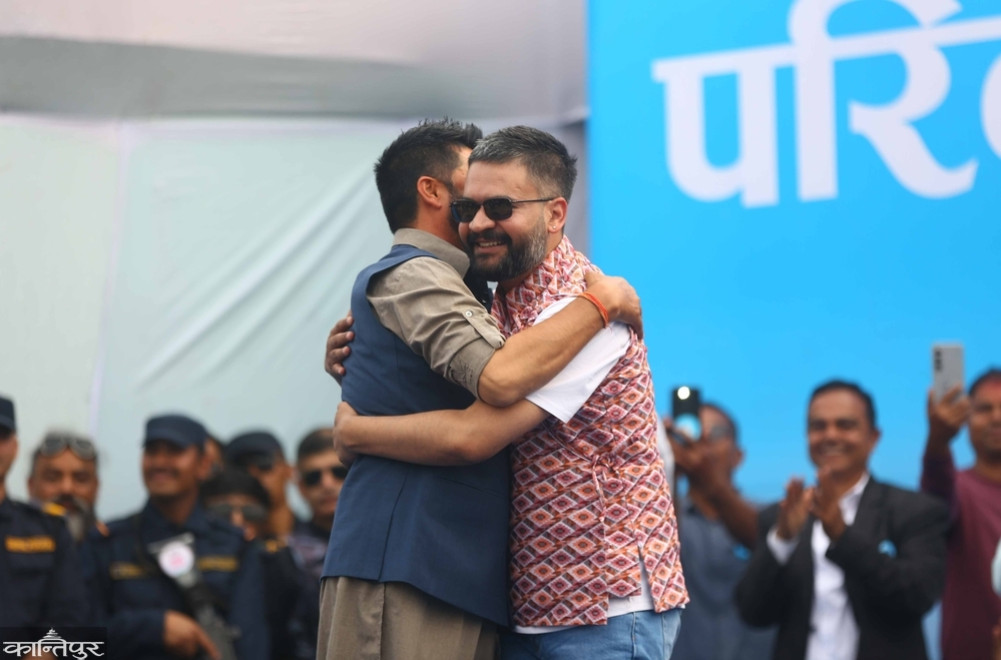
If there is a personality or power clash between President Ravi Lamichhane and senior leader Balen Shah within the Rashtriya Swayamsevak Sangh (RSS) party, it will prove to be a major betrayal. Leaders and activists should be aware of such potential ego clashes and power struggles to respect public opinion and protect change.
We use Google Cloud Translation Services. Google requires we provide the following disclaimer relating to use of this service:
This service may contain translations powered by Google. Google disclaims all warranties related to the translations, expressed or implied, including any warranties of accuracy, reliability, and any implied warranties of merchantability, fitness for a particular purpose, and noninfringement.
The results of the recent House of Representatives elections in Nepal have given the National Independent Party (NISP) an unprecedented public vote, displacing the party-based dominance of traditional political forces. This victory is not just the emergence of a new party, but rather a collective citizen revolt against decades of misrule, institutional corruption, and administrative inertia without service delivery. This 'blue wave' of almost two-thirds has paved the way for the new government to create history. However, managing the high public expectations created with this seems to be the biggest and most difficult test now.
Nepal is currently in the throes of a multifaceted crisis. Economically, the country is in a state of stagnation. In the absence of a production-based economy, there is a brain drain and labor migration of young people. The financial deficit and trade deficit are increasing. Administratively, bureaucratic laxity and process-oriented working style have prevented ordinary citizens from feeling the presence of the state. Politically, instead of decentralization of authority in accordance with the essence of federalism, middlemen have institutionalized policy-level corruption. If these existing problems cannot be resolved through structural reforms, there is a risk that this new public opinion will be limited to arithmetic alone.
Historical and contemporary context
Due to bureaucratic laxity and process-oriented working style in the administrative sphere, ordinary citizens have not been able to feel the presence of the state. Historical and contemporary context shows that governments with powerful majorities around the world have fallen victim to political collapse by failing to deliver results in line with public expectations. In Nepal's political history, powerful public opinion and mathematical majorities alone have not been able to guarantee stability and good governance.
From the BP Koirala government of 2016 to the CPN government of 2074 BS, all of them failed due to internal conflicts and factionalism. Most recently, the Congress-UML government formed in 2081/82 was also displaced by the Gen-G rebellion in 2082 Bhada due to misgovernance. This confirms that the lifespan of a government depends not on numbers, but on the ethics of governance and people-oriented working style.
A similar trend is also seen in the international scenario. In the UK, Boris Johnson, who won a majority in 2019, was ousted due to 'partygate' and internal strife, while his successor, Liz Truss, was ousted in 45 days due to economic mismanagement. In Sri Lanka, the Rajapaksa government with a large majority reached the point of state collapse due to populism and short-sighted economic policies. In India, the party governments led by Rajiv Gandhi in 1984 and Morarji Desai in 1977 collapsed due to the mutual egos and factional politics of the leaders. In Australia, in the past decade and a half, prime ministers like Kevin Rudd and Tony Abbott were ousted before completing their terms due to dissatisfaction within the party. In Bangladesh, Sheikh Hasina's rule ended in 2024 due to a popular uprising. This confirms that in a parliamentary system, not only a mathematical majority, but also internal unity and results are decisive.
Power struggle within political parties: A warning for the Rashtriya Swayamsevak Sangh (RSS)
Internal strife within parties has repeatedly led to instability in Nepal's political history. Even though the Nepali Congress secured a clear majority in the multi-party era after 2048, the government led by Girija Prasad Koirala could not last a full term due to severe internal conflicts within his own party and factionalism such as 'Chhattise' and 'Chauhattare'. Similarly, in BS. 2054, the CPN-UML split and the CPN-ML was formed under the leadership of Bamdev Gautam, which had a direct impact on the politics of the time. The CPN (Maoist), which entered the peace process after the ten-year people's war, also split into various factions and sub-faction. The Madhesh pro-democracy parties were so fragmented due to a series of divisions that in the 2082 elections, those forces reached a state of zero seats.
The context of the displacement of Sher Bahadur Deuba's old leadership through a special general convention due to dissatisfaction within the Nepali Congress in the recent phase, the split of the CPN-Unified Socialist Party and the process of forming the CPN by merging with the CPN-Maoist Center, the exit of leaders including Janardan Sharma from the CPN-Maoist Center - this highlights the serious personal conflicts and power struggles within the parties. The exit of influential leaders of the Rashtriya Swayamsevak Sangh (RSS) Sumana Shrestha and Santosh Pariyar has also indicated that there is a challenge to the balance of power even within the new forces. Such internal conflicts have caused great harm not only to political parties, but also to the operation of the government, state management and the overall national interest.
In this context, if there is a personality or power clash within the RSP between Ravi Lamichhane, who has been the party's president since its inception, and senior leader Balen Shah (or other leaders) who recently joined, it will prove to be another big betrayal in Nepali political history. In order to respect public opinion and protect change, it seems essential for the leaders and cadres of the Rashtriya Swatantra Party (RSWP) to be very aware of such potential ego clashes and power struggles. The challenge is that characters like President Ravi Lamichhane and Balen Shah must transform themselves from populist leaders into mature politicians in the internal balance of power and working style within the RSWP.
Formulas of a successful government
Since the Nepali people voted by trusting this manifesto rather than just looking at the faces of the candidates, the work of the party and the government after being elected should be based on this ‘contract’ approved by the people rather than any other new thing. The manifesto that the National Independent Party (RSWP) made public before the election, calling it a 'promise' or 'contract', is the main basis for its performance. Since the Nepali people voted in this manifesto without looking only at the faces of the candidates, the work of the party and the government after being elected should be based on this 'contract' approved by the people rather than on other new things. How practical or implementable its agenda was may be an internal matter of the party, but the RSWP should be aware because the people will now evaluate the party on this basis.
The main agenda of the Rashtriya Swayamsevak Sangh (RSS) focuses on the concept of a directly elected Prime Minister and Chief Minister, the appointment of non-party experts in constitutional bodies, and the legal guarantee of ‘right to recall’ and ‘right to reject’. Along with this proposal, governance reforms with a completely impartial (non-political) President and the provision of Provincial Councils have been made. It aims to make government services completely paperless and hassle-free by investigating past scams through a powerful independent body and adopting a ‘digital first’ policy.
Considering education and health as the fundamental responsibility of the state, it has put forward a plan to integrate health insurance through the ‘single payer healthcare’ model and operate quality ‘smart schools’ in every municipality. Economically, it has promised an open market economy, facilitation of foreign investment and creation of jobs in the country through ‘seed capital’ for the youth. Overall, its main goal is to transform the existing political situation by adopting technology-friendly service delivery and zero tolerance against corruption. Issues related to the form of governance of the state require constitutional amendment, of which the Rashtriya Swayamsevak Sangh (RSS) is believed to be aware.
It is imperative for the new government to learn from the mistakes of the past and adopt some concrete ‘success formulas’. First of all, the government should make the merit system its main mantra. It should break the tradition of hiring ‘its own’ people as in the past and give responsibility to result-oriented administrative figures. Second, government services should be completely digitized and made personless and paperless so that corruption is cut to the roots. Third, according to the experts’ blueprint for economic reform, an environment should be created to attract foreign investment by emphasizing production and exports. Fourth, the rule of law should be strictly enforced, where no one is exempted on the basis of power and access.
Ultimately, although the challenges for the new government are many, the opportunities are historic. The government should make the public feel the change in the first 100 days so that the enthusiasm seen among the people does not turn into disappointment. The term of the new government is not only the period of power but also a pre-test to instill confidence in the people that the ‘state exists’ and to chart the course for the next 5 years. This new political experiment of Nepal will be successful only if the bureaucracy, which is confused in the process, is transformed into a performance-based system, and the mindset of ‘nation first’ can be raised above party interests. Otherwise, history is sure to record it as another failed government. To avoid the cycle in which previous powerful governments failed, it is imperative for the new government led by the Rashtriya Swayamsevak Sangh (RSS) to adopt some safeguards.
The new government’s safeguards
Citizen monitoring and public hearings should be institutionalized. Finally, the government should constructively collaborate with the opposition instead of showing two-thirds power. Only when the opposition is taken into confidence in matters of national importance and foreign policy does the decision-making process mature and the democratic system become stronger. For the stability and success of the new government, internal democracy and an exit strategy must first be ensured. In a context where the main reason for the collapse of previous majority governments was the individualistic thinking and the clash between the power center within the party, it is now necessary for the leadership to promote open discussions and instill a culture of ‘resigning if there is no performance’. This prevents any individual from becoming bigger than the institution. Similarly, to keep the government's image clean, conflict of interest management should be rigorous. The mistake of assigning the responsibility of the relevant ministry to a person with a conflict of interest (such as the Ministry of Infrastructure to a contractor or the Ministry of Labor to a manpower entrepreneur) should be corrected and a strict code of conduct should be implemented.
To increase the efficiency of the government, priority should be given to appointments based on expertise instead of political participation. Good governance is possible only by abandoning the tendency to recruit 'their' people in strategic bodies and appointing them from an independent list of skilled experts. In addition, the Prime Minister and ministers should regularly face questions directly from the public. Citizen monitoring and public hearings should be institutionalized. Finally, the government should constructively collaborate with the opposition instead of showing two-thirds power. Only when the opposition is taken into confidence on issues of national importance and foreign policy, the decision-making process matures and the democratic system becomes stronger.
The main basis for the future political journey and success of the ruling party of the Nepali Congress lies in its internal balance of power and working style. At present, it seems essential that the party leaders reflect not only political charm but also efficiency with a sense of responsibility. It is the need of the day for young MPs to become more serious and responsible in the coming days, learning from the immaturity seen in some past parliamentary practices. It is necessary to balance popularity with administrative restraint, democratic dialogue and the rule of law and mold it into an institutional system. Reflecting on the reality that the past 'politics of prohibition' has not provided a way out for the country, the new power should emphasize on establishing 'systems, not revenge' instead of being biased towards the old parties.
Respecting the experience and parliamentary knowledge of the old leaders and developing a culture of 'consensus and cooperation' will be a sign of political maturity. In addition, the mistake of violating established processes should be avoided by forming an advisory group of experienced administrators, diplomats and legal experts. Every MP should imbibe the formula of ‘5 S’ such as punctuality, civility, truthfulness, restraint and activism in public life and parliament. Their main mantra should be the resolve that ‘I am not here to serve, but to change the system, every signature of mine shapes the future of the country’. Ultimately, transforming new zeal and enthusiasm into concrete performance and demonstrating the humility that ‘we move forward by learning and improving’ will prove to be the surefire formula for gaining public trust and establishing the credibility of the leadership.